Many writers, students, and English learners search for the difference between further vs farther because the two words are very similar and are often used interchangeably. While both relate to distance or extension, they traditionally have different meanings and uses.
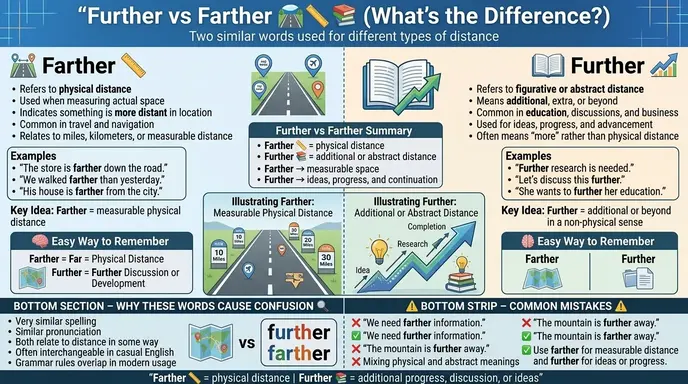
In simple words, farther refers to a physical distance, while further refers to a figurative, abstract, or additional degree of distance.
Understanding the difference between further and farther can improve your writing accuracy and help you communicate more clearly.
This guide explains further vs farther clearly, including definitions, grammar rules, examples, similarities, common mistakes, and real-world usage.
Quick Answer: Difference Between Further vs Farther
The main difference between further and farther is the type of distance being discussed.
- Farther = physical or measurable distance.
- Further = figurative distance, additional amount, or greater extent.
Simple Example
✅ The school is farther down the road.
(Physical distance)
✅ We need further discussion before making a decision.
(Figurative or additional progress)
Definition of Further and Farther
- Further: More advanced, additional, or to a greater degree.
- Farther: At a greater physical distance.
Quick Definitions
Further: More or beyond in a figurative sense.
Farther: More distant in a physical sense.
Simple Example
- Can you explain this further?
- The park is farther than the library.
Pronunciation of Both (US & UK)
| Term | US Pronunciation | UK Pronunciation |
| Further | FUR-ther | FUR-thuh |
| Farther | FAR-ther | FAH-thuh |
Now let’s understand when to use each word correctly.
Difference Between Further and Farther Comparison Table
| Feature | Further | Farther | Similarity |
| Main Meaning | Additional or greater extent | Greater physical distance | Both indicate progression |
| Distance Type | Figurative | Physical | Both involve “more” |
| Common Usage | Ideas, discussions, progress | Roads, miles, locations | Both are adverbs and adjectives |
| Formal Writing | Very common | Common | Both grammatically correct |
| Can Mean “Additional” | Yes | No | Both extend something |
| Physical Distance | Sometimes accepted | Preferred | Both may appear in distance contexts |
| Modern Usage | More flexible | More specific | Both widely understood |
| Part of Speech | Adjective, adverb | Adjective, adverb | Same grammatical roles |
This table clearly shows the difference and similarity between further and farther for quick understanding.
Key Differences Explained Between Further and Farther
Physical Distance vs Figurative Distance
The traditional rule is simple.
Use farther for measurable physical distance.
Use further for non-physical or abstract distance.
Example
✅ We drove farther than expected.
(Physical distance)
✅ We need further research.
(Additional progress)
Additional Amount or Degree
Further often means “more” or “additional.”
Examples:
- Further information
- Further assistance
- Further investigation
- Further education
Farther cannot normally replace further in these situations.
Travel and Location
When discussing actual locations, farther is usually preferred.
Examples:
- The beach is farther away.
- The gas station is farther down the highway.
Physical measurement is involved.
Progress and Development
Further commonly refers to advancement.
Examples:
- Further discussion is needed.
- The project moved further along.
- Scientists conducted further testing.
No physical distance is involved.
Why Do Further and Farther Exist?
Both words originated from the concept of distance.
Over time:
- Farther became associated with physical space.
- Further developed broader meanings involving progress, degree, and extension.
Modern English sometimes overlaps their usage, but the traditional distinction remains useful.
How Further Works
Additional Information
Examples:
- Further details will be provided later.
- Please contact us for further assistance.
Greater Degree
Examples:
- The situation became further complicated.
- Further improvements are expected.
Advancement
Examples:
- She wants to further her career.
- The company aims to further innovation.
In these examples, physical distance is not involved.
How Farther Works
Physical Distance
Examples:
- The store is farther away than I thought.
- We walked farther than yesterday.
Measurable Locations
Examples:
- Their house is farther down the street.
- The mountain is farther north.
The focus is actual geographic distance.
Further vs Farther in Everyday English
Casual Conversation
Many native speakers use further for both meanings.
Example:
✅ The park is further down the road.
Although traditional grammar prefers “farther,” this usage is increasingly common.
Academic Writing
Formal writing often follows the traditional distinction.
Examples:
- Further research is needed.
- The village is farther from the city.
Business Communication
Further is extremely common in professional settings.
Examples:
- Further information
- Further action
- Further review
- Further analysis
Difference Between Further and Farther in Writing
| Writing Situation | Correct Choice |
| Physical travel distance | Farther |
| Additional explanation | Further |
| More research | Further |
| Greater road distance | Farther |
| Additional support | Further |
| Progress or development | Further |
Following this guideline improves clarity.
Difference + Similarity Between Further and Farther
| Feature | Further | Farther | Similarity |
| Indicates More Distance | Yes | Yes | Both imply extension |
| Physical Distance | Sometimes | Preferred | Both relate to distance |
| Abstract Distance | Yes | No | Both compare positions |
| Additional Information | Yes | No | Both modify nouns or verbs |
| Professional Usage | Very common | Less common | Both accepted words |
| Modern Flexibility | High | Moderate | Both understood by readers |
This table clearly shows the difference and similarity between further and farther for quick understanding.
Real Life Examples with Further and Farther
Example 1
✅ The hotel is farther from the airport than the train station.
Physical distance.
Example 2
✅ We need further evidence before making a decision.
Additional information.
Example 3
✅ She walked farther than anyone else in the group.
Measurable distance.
Example 4
✅ Further improvements will be announced next month.
Additional progress
Example 5
✅ Scientists conducted further studies on climate change.
More research.
Common Mistakes with Further and Farther
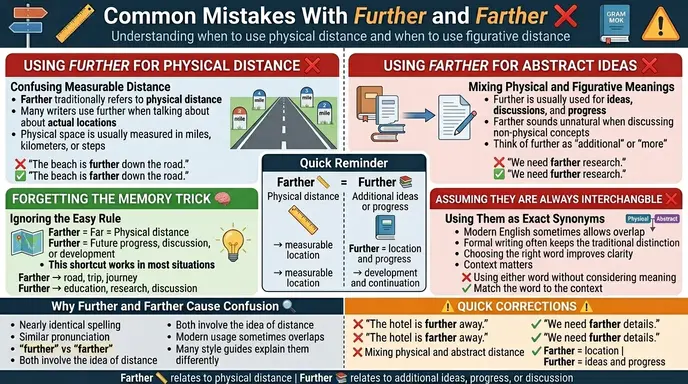
Using Farther for Additional Information
❌ Farther details are available online.
✅ Further details are available online.
Using Further for Strict Physical Distance
Although often accepted, traditional grammar prefers:
✅ The park is farther away.
instead of:
⚠️ The park is further away.
Forgetting the Physical Distance Rule
Many beginners mix the words because both involve the idea of “more.”
Quick Memory Tip
- Farther = Far = Physical distance
- Further = Further discussion, further information
This simple trick helps most learners choose correctly.
When to Use Each
Use Further When:
- Discussing additional information.
- Talking about progress.
- Referring to a greater degree.
- Describing advancement.
Examples:
- Further explanation
- Further education
- Further analysis
Use Farther When:
- Discussing measurable physical distance.
- Comparing locations.
- Talking about travel distance.
Examples:
- Farther down the road
- Farther from home
- Farther north
Why People Get Confused Between Further and Farther
Similar Meaning
Both suggest moving beyond something.
Similar Spelling
Only one letter differs.
Modern Usage Overlap
Many speakers use further in both situations.
Shared Origins
Historically, the words developed from similar roots.
Expert Insight
From a practical writing perspective, most readers will understand your meaning If you use further or farther.
However, professional writers, editors, teachers, and style guides often recommend maintaining the traditional distinction because it improves precision.
Using farther for measurable distance and further for additional progress or information creates clearer communication.
In modern English, further has become increasingly flexible and is commonly accepted in many contexts where farther once dominated. Still, understanding the classic rule remains valuable for academic, professional, and formal writing.
Frequently Asked Questions
What is the main difference between further and farther?
Farther refers to physical distance, while further refers to additional degree, progress, or abstract distance.
Can further and farther be used interchangeably?
Sometimes, especially in casual English, but traditional grammar distinguishes them.
Which is correct: further away or farther away?
Traditionally, farther away is preferred for physical distance.
Is further used for additional information?
Yes. Further commonly means additional or more.
Why do people confuse further and farther?
They have similar meanings, spellings, and historical origins.
Is farther becoming less common?
Yes. Many modern speakers increasingly use further for both meanings.
Which word should I use in formal writing?
Use farther for physical distance and further for figurative or additional meanings.
What is an easy way to remember the difference?
Farther = far = physical distance. Further = additional or beyond.
Conclusion
Understanding the difference between further vs farther becomes easy when you remember one simple rule: farther relates to physical distance, while further relates to additional degree, progress, or figurative distance.
If you are measuring miles, roads, or locations, farther is usually the best choice. If you are discussing information, research, development, or advancement, further is generally correct.
Although modern English increasingly accepts further in many situations, especially casual speech, following the traditional distinction helps create clearer and more professional writing.
By remembering that farther deals with physical distance and further deals with additional progress, you can confidently choose the right word in almost any situation.
Discover More Articles!
British vs American English: A Complete Guide for Learners
Difference Between Breathing and Respiration: Explained
Difference Between Goods and Services:With Simple Examples

James Whitmore. Labdiff.com is my english grammar comparision website. I explore the history and evolution of English words. I write detailed comparisons explaining why spellings change over time and how British and American English diverged. My articles add depth and credibility to grammar comparison topics.