Many students and health conscious individuals search for the difference between breathing and respiration because the two terms are often used interchangeably in biology, medicine, and everyday conversation.
While they are closely related, they are not the same process. Understanding the distinction is essential for learning how the human body obtains and uses energy.
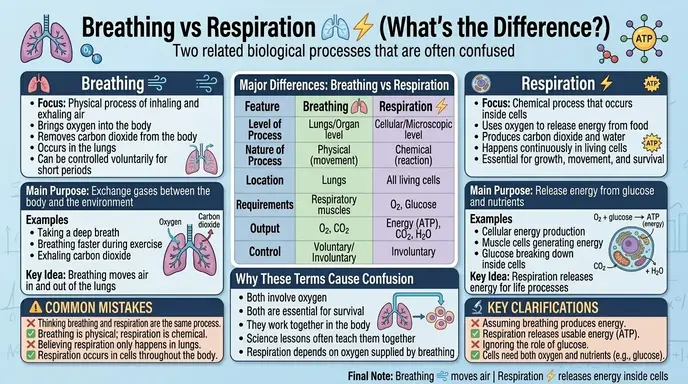
In simple words, breathing is the physical process of moving air into and out of the lungs, while respiration is the chemical process in cells that releases energy from food.
The difference between breathing and respiration is a fundamental concept in biology, physiology, healthcare, and life sciences.
This guide explains breathing and respiration clearly, including definitions, functions, types, biological mechanisms, real world examples, similarities, and expert insights.
Quick Answer: Difference Between Breathing and Respiration
The main difference between breathing and respiration is their purpose and location in the body.
- Breathing is the mechanical process of inhaling oxygen and exhaling carbon dioxide through the lungs.
- Respiration is the chemical process where cells use oxygen to break down glucose and release energy.
For example:
When you take a breath during exercise, that is breathing. When your muscle cells use oxygen to produce energy for movement, that is respiration.
Definition of Breathing and Respiration
- Breathing: The physical movement of air into and out of the lungs to exchange gases with the environment.
- Respiration: A biochemical process in living cells that releases energy from food molecules.
Simple Example
- Breathing = taking air in and out
- Respiration = producing energy inside cells
Pronunciation of Both (US & UK)
| Term | US Pronunciation | UK Pronunciation |
| Breathing | bree thing | bree thing |
| Respiration | res puh ray shun | res puh ray shun |
Now let’s understand this clearly through human biology, cellular energy production, and real life examples.
Difference Between Breathing and Respiration Comparison Table
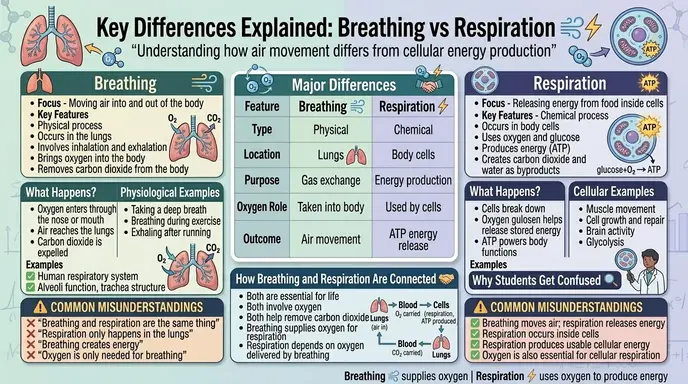
| Feature | Breathing | Respiration | Similarity |
| Nature | Physical process | Chemical process | Both support life |
| Location | Lungs and respiratory organs | Every living cell | Both involve oxygen |
| Purpose | Gas exchange | Energy production | Both essential for survival |
| Control | Can be voluntary and involuntary | Completely involuntary | Both occur continuously |
| Energy Release | No energy produced | Energy released as ATP | Both linked to metabolism |
| Oxygen Usage | Takes oxygen into body | Uses oxygen inside cells | Both require oxygen in aerobic organisms |
| Carbon Dioxide | Removed from body | Produced during energy release | Both involve CO₂ |
| Biological Level | Organ level | Cellular level | Both work together |
This table clearly shows the difference and similarity between breathing and respiration for quick understanding.
Key Differences Explained Between Breathing and Respiration
Physical Process vs Chemical Process
The biggest difference is the type of process involved.
- Breathing is mechanical and physical.
- Respiration is chemical and biochemical.
Breathing moves gases, while respiration releases energy.
Location in the Body
Breathing occurs mainly in:
- Nose
- Trachea
- Bronchi
- Lungs
Respiration occurs inside cells, especially within structures called mitochondria.
Energy Production
Breathing itself does not generate energy.
Respiration releases energy that powers:
- Muscle movement
- Brain activity
- Cell growth
- Organ function
Voluntary Control
Breathing can sometimes be controlled consciously.
Examples include:
- Meditation
- Swimming
- Singing
Respiration cannot be consciously controlled because it happens automatically inside cells.
Biological Function
Breathing supplies oxygen.
Respiration uses oxygen.
This relationship is what connects the two processes.
Why Do Breathing and Respiration Exist?
Living organisms need a continuous supply of energy to survive. Cells require oxygen to efficiently break down glucose and produce ATP, the body’s main energy currency.
Breathing exists to bring oxygen into the body and remove carbon dioxide. Respiration exists to convert nutrients into usable cellular energy.
Without either process, life cannot continue.
How Breathing Works
Inhalation
During inhalation:
- The diaphragm contracts.
- The chest cavity expands.
- Air enters the lungs.
Oxygen rich air moves into tiny air sacs called alveoli.
Gas Exchange
Inside the alveoli:
- Oxygen enters the bloodstream.
- Carbon dioxide leaves the blood.
This exchange supports cellular respiration throughout the body.
Exhalation
During exhalation:
- The diaphragm relaxes.
- Carbon dioxide rich air leaves the lungs.
This removes waste gases produced during respiration.
How Respiration Works
Cellular Energy Production
Cells use oxygen and glucose to create energy.
The basic aerobic respiration equation is:
C_6H_{12}O_6 + 6O_2 \rightarrow 6CO_2 + 6H_2O + Energy
This reaction releases energy needed for life processes.
ATP Formation
Respiration produces ATP (adenosine triphosphate), which powers cellular activities.
ATP supports:
- Muscle contraction
- Nerve signaling
- Protein synthesis
- Cellular repair
Mitochondrial Function
Most respiration occurs in mitochondria, often called the “powerhouses” of the cell.
Types of Respiration
Aerobic Respiration
Aerobic respiration uses oxygen and produces large amounts of energy.
Most human cells rely on aerobic respiration.
Anaerobic Respiration
Anaerobic respiration occurs without oxygen.
It produces less energy and may create byproducts such as lactic acid.
This often happens during intense exercise.
Difference Between Breathing and Respiration in Real Life
| Real Life Situation | Breathing | Respiration |
| Running | Faster inhaling and exhaling | Increased energy production |
| Sleeping | Slower breathing rate | Continuous cellular energy release |
| Exercise | More oxygen intake | More ATP production |
| Meditation | Controlled breathing | Respiration continues automatically |
| Recovery after exercise | Deep breathing | Removal of metabolic waste products |
Both processes become more active during physical activity.
Difference Between Breathing and Respiration in Human Health
Respiratory Diseases
Conditions affecting breathing include:
- Asthma
- Pneumonia
- Chronic bronchitis
These can reduce oxygen delivery to cells.
Cellular Respiration Problems
Respiration can be affected by:
- Mitochondrial disorders
- Oxygen deprivation
- Metabolic diseases
These problems reduce energy production.
Modern Health Monitoring
Devices developed by companies like Apple and Fitbit can track breathing rates and other health indicators to support wellness monitoring.
Real Life Examples with Breathing and Respiration
Exercise
When running:
- Breathing rate increases.
- Respiration speeds up inside muscle cells.
Sleeping
Breathing continues automatically.
Respiration keeps producing energy for vital organs.
Climbing Stairs
The body requires more oxygen.
Respiration increases ATP production to power muscles.
Sports Performance
Athletes train breathing efficiency to support higher rates of cellular respiration.
Emergency Medicine
Doctors monitor breathing because oxygen supply directly affects cellular respiration.
Difference + Similarity Between Breathing and Respiration
| Feature | Breathing | Respiration | Similarity |
| Main Function | Gas exchange | Energy production | Both sustain life |
| Type | Physical | Chemical | Both involve oxygen |
| Location | Lungs | Cells | Both occur continuously |
| Energy Output | None | ATP produced | Both support metabolism |
| Carbon Dioxide Role | Removed | Generated | Both involve CO₂ movement |
| Importance | Oxygen supply | Cellular function | Both essential for survival |
This table clearly shows the difference and similarity between breathing and respiration for quick understanding.
Why People Get Confused Between Breathing and Respiration
Everyday Language
Many people casually use respiration when they actually mean breathing.
Biological Connection
The two processes depend on each other closely.
Similar Oxygen Involvement
Both involve oxygen and carbon dioxide, making them seem identical.
Simplified Education
Basic science lessons sometimes introduce the concepts together, causing confusion.
Common Mistakes with Breathing and Respiration
| Mistake | Correct Understanding |
| Thinking they are identical | They are separate biological processes |
| Believing breathing produces energy | Respiration produces energy |
| Assuming respiration occurs only in lungs | It occurs in cells |
| Ignoring cellular respiration | It is essential for life |
| Thinking breathing can replace respiration | Both are required |
Quick Memory Tip
- Breathing = moving air
- Respiration = releasing energy
When to Use Each
Use “Breathing” When:
- Discussing inhalation and exhalation
- Talking about lungs
- Referring to respiratory rate
- Explaining gas exchange
Use “Respiration” When:
- Discussing cellular energy production
- Studying biology
- Explaining metabolism
- Talking about ATP generation
Using the correct term improves scientific accuracy.
Why People Get Confused in Breathing and Respiration
Shared Role in Oxygen Use
Both processes involve oxygen, making them appear identical.
Educational Overlap
Textbooks often teach them together.
Similar Health Discussions
Doctors and health articles frequently discuss both within respiratory health topics.
Continuous Interaction
Breathing supplies oxygen that respiration uses, creating a strong connection.
Expert Insight
In practical biology and medicine, breathing and respiration are viewed as interconnected but distinct processes.
Breathing operates at the organ level by supplying oxygen and removing carbon dioxide, while respiration functions at the cellular level by producing ATP from nutrients.
Most beginners focus only on the lungs when learning about oxygen use. However, the real goal of breathing is to support respiration inside billions of cells throughout the body.
This relationship explains why oxygen delivery is critical for exercise performance, organ health, brain function, and overall survival.
Understanding the difference between breathing and respiration helps students grasp fundamental biological concepts and provides a clearer picture of how the human body generates energy.
Frequently Asked Questions
What is the main difference between breathing and respiration?
Breathing is air movement in and out of the lungs, while respiration is cellular energy production.
Does breathing produce energy?
No. Respiration produces energy, not breathing.
Where does respiration occur?
Respiration occurs in cells, mainly inside mitochondria.
Is breathing necessary for respiration?
Yes. Breathing supplies oxygen needed for aerobic respiration.
What is ATP?
ATP is the main energy carrying molecule produced during respiration.
Can respiration occur without oxygen?
Yes. Anaerobic respiration occurs without oxygen but produces less energy.
Why do we breathe faster during exercise?
To supply more oxygen for increased cellular respiration.
Which process removes carbon dioxide?
Breathing removes carbon dioxide from the body, while respiration produces it.
Conclusion
Understanding the difference between breathing and respiration is essential for learning how the body obtains and uses energy.
Breathing is the physical process of inhaling oxygen and exhaling carbon dioxide through the lungs, while respiration is the chemical process inside cells that releases energy from glucose.
Although they are closely connected, they occur at different biological levels and serve different purposes.
Breathing ensures a continuous oxygen supply, while respiration converts nutrients into ATP, the energy needed for every cellular activity.
In real world biology, health science, and medicine, both processes are equally important. Without breathing, cells would not receive oxygen. Without respiration, the body would not be able to produce energy.
Once you fully understand the difference between breathing and respiration, the relationship between oxygen, energy, and life becomes much clearer.
Discoer More Articles!
Difference Between Clip and Magazine:In 30 Seconds
Roth vs 401(k) Explained Clearly: Which One Should You Choose?

labdiff.com is my English grammar comparison website where I simplify confusing words, spelling differences, and usage rules through clear explanations and examples. My goal is to help learners, writers, and students understand English easily and use correct grammar with confidence.