Many English learners, students, writers, and even native speakers search for the difference between lie vs lay because these two verbs are among the most commonly confused words in English.
They look similar, sound related, and both involve a resting position, but they have different meanings and grammar rules.
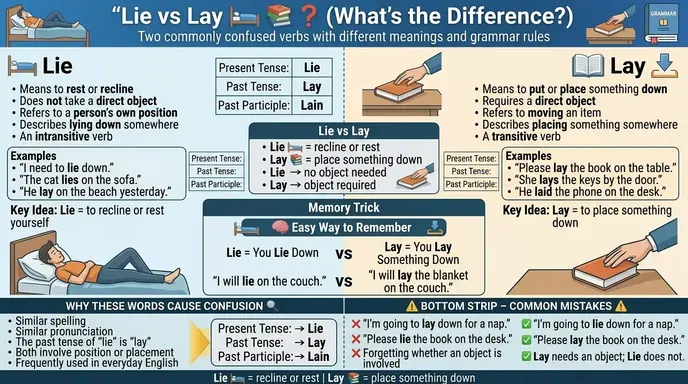
In simple words, lie means to recline or rest by yourself, while lay means to put or place something down.
The confusion often comes from their past tense forms, which overlap and make sentences harder to interpret.
This guide explains lie vs lay clearly, including definitions, verb forms, examples, common mistakes, similarities, differences, and practical usage tips.
Quick Answer: Difference Between Lie vs Lay
The main difference between lie and lay is Ifr an object is involved.
- Lie = to rest or recline (no object needed)
- Lay = to put or place something (requires an object)
Simple Example
✅ I want to lie down on the couch.
(No object is being placed.)
✅ Please lay the book on the table.
(The book is the object being placed.)
Definition of Lie and Lay
- Lie: To rest, recline, or be in a horizontal position.
- Lay: To put, place, or set something down.
Quick Definitions
Lie: The subject rests by itself.
Lay: The subject places something somewhere.
Example
- I need to lie down.
- I will lay the keys on the counter.
Pronunciation of Both (US & UK)
| Term | US Pronunciation | UK Pronunciation |
| Lie | lye | lye |
| Lay | lay | lay |
Now let’s understand why these verbs create so much confusion.
Difference Between Lie and Lay Comparison Table
| Feature | Lie | Lay | Similarity |
| Meaning | Rest or recline | Put something down | Both relate to position |
| Requires Object | No | Yes | Both are verbs |
| Present Tense | Lie | Lay | Used in daily speech |
| Past Tense | Lay | Laid | Both describe actions |
| Past Participle | Lain | Laid | Both have irregular forms |
| Common Usage | Lie down | Lay a book down | Both involve placement |
| Grammar Type | Intransitive verb | Transitive verb | Both appear in writing |
| Difficulty Level | Often confused | Often confused | Common English verbs |
This table clearly shows the difference and similarity between lie and lay for quick understanding.
Definition of Verb Forms
Understanding verb forms is the key to mastering lie and lay.
Lie (to recline)
| Tense | Form |
| Present | Lie |
| Past | Lay |
| Past Participle | Lain |
| Present Participle | Lying |
Examples
- Today I lie down.
- Yesterday I lay down.
- I have lain down all afternoon.
- I am lying down.
Lay (to place something)
| Tense | Form |
| Present | Lay |
| Past | Laid |
| Past Participle | Laid |
| Present Participle | Laying |
Examples
- I lay the book on the desk.
- Yesterday I laid the book there.
- I have laid the book down.
- I am laying the book on the table.
Key Differences Explained Between Lie and Lay
Object Requirement
This is the most important rule.
Lie does not need an object.
Example:
✅ The cat lies on the sofa.
The cat is simply resting.
Lay requires an object.
Example:
✅ Lay the blanket on the bed.
The blanket is being placed.
Action vs Placement
Lie describes a position.
Example:
✅ The dog is lying on the floor.
Lay describes placing something.
Example:
✅ She is laying the dog’s blanket on the floor.
Subject Responsibility
With lie, the subject performs the action on itself.
Example:
✅ I lie down.
With lay, the subject acts on another object.
Example:
✅ I lay the phone on the table.
Why Do Lie and Lay Exist?
English developed separate verbs for:
- Being in a resting position
- Placing an object in a position
Over time, their similar spellings and overlapping tense forms created confusion for learners.
The biggest source of confusion is that the past tense of lie is lay, which looks identical to the present tense of lay.
How Lie Works
Used for Resting
Examples:
- I need to lie down.
- The baby is lying in the crib.
- The dog lies near the fireplace.
Used for Position
Examples:
- The town lies near the coast.
- The keys lie on the desk.
Nothing is being placed by someone.
Used Figuratively
Examples:
- The answer lies in the details.
- Success lies in preparation.
Here, lie means “exists” or “is located.”
How Lay Works
Used for Placement
Examples:
- Lay the laptop on the desk.
- Lay the plates on the table.
- Lay the documents here.
Used for Arranging
Examples:
- Workers laid bricks.
- The company laid cables underground.
Used for Production
Examples:
- Chickens lay eggs.
- Birds lay eggs in nests.
This is another common use of lay.
Lie vs Lay in Everyday English
At Home
✅ I am going to lie down.
✅ Please lay the towel on the chair.
At Work
✅ Lay the report on my desk.
✅ The files lie in the cabinet.
Healthcare Settings
Doctors often say:
✅ Lie down on the examination table.
Because the patient is reclining.
Difference Between Lie and Lay in Writing
| Situation | Correct Word |
| Resting on a couch | Lie |
| Putting a book down | Lay |
| Reclining in bed | Lie |
| Placing dishes on a table | Lay |
| Existing in a location | Lie |
| Setting an object somewhere | Lay |
This distinction improves grammar accuracy.
Difference + Similarity Between Lie and Lay
| Feature | Lie | Lay | Similarity |
| Action Type | Resting | Placing | Both involve position |
| Object Needed | No | Yes | Both are verbs |
| Used Daily | Yes | Yes | Common English words |
| Present Form | Lie | Lay | Similar sounding |
| Irregular Verb | Yes | Yes | Grammar challenge |
| Physical Position | Yes | Yes | Related concepts |
This table clearly shows the difference and similarity between lie and lay for quick understanding.
Real Life Examples with Lie and Lay
Example 1
✅ I want to lie down after work.
The person is resting.
Example 2
✅ Lay your backpack on the floor.
An object is being placed.
Example 3
✅ The cat lies near the window.
The cat is resting.
Example 4
✅ She laid the groceries on the counter.
Objects were placed somewhere.
Example 5
✅ The solution lies in careful planning.
Figurative use of lie.
Common Mistakes with Lie and Lay
Using Lay Without an Object
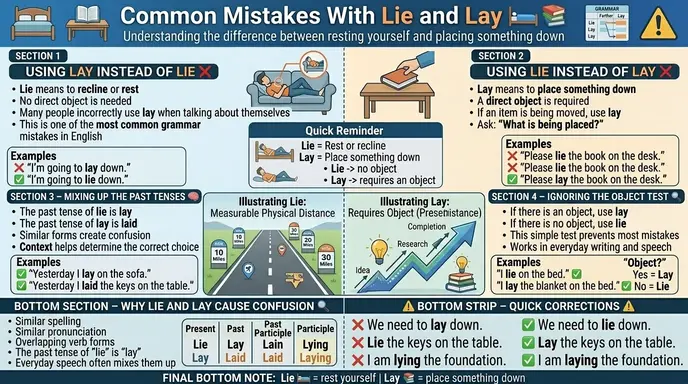
❌ I am going to lay down.
Traditional grammar prefers:
✅ I am going to lie down.
Mixing Up Past Tenses
Remember:
- Lie → Lay → Lain
- Lay → Laid → Laid
Forgetting the Object Rule
Ask yourself:
“Am I placing something?”
If yes, use lay.
If no, use lie.
Quick Memory Tip
Lie = Recline
Both words contain the letter “I.”
Lay = Place
Both actions involve moving an object.
When to Use Each
Use Lie When:
- Resting
- Reclining
- Existing in a place
- No object is involved
Examples:
- Lie down.
- The town lies nearby.
Use Lay When:
- Placing something
- Setting something down
- Arranging objects
- An object is involved
Examples:
- Lay the phone on the table.
- Lay the papers here.
Why People Get Confused Between Lie and Lay
Similar Meanings
Both involve position and location.
Shared Verb Forms
The past tense of lie is lay.
Everyday Misuse
Many native speakers mix them up in casual speech.
Irregular Grammar
Their tense patterns differ from regular verbs.
Expert Insight
From a grammar and editing perspective, lie and lay remain among the most frequently corrected verb errors in English.
Professional writers often rely on a simple test: if there is an object receiving the action, use lay. If the subject is merely resting or reclining, use lie.
While casual conversation sometimes blurs the distinction, maintaining the correct usage improves clarity and professionalism in academic, business, and formal writing.
In practical use, mastering this single object rule solves most lie versus lay mistakes immediately.
Frequently Asked Questions
What is the main difference between lie and lay?
Lie means to recline or rest, while lay means to place something down.
Does lay require an object?
Yes. Lay always involves placing something.
Does lie require an object?
No. Lie does not need an object.
Why is lie vs lay confusing?
Because the past tense of lie is lay.
Is “lay down” always wrong?
Not always. It is correct when an object is being placed.
What is the past tense of lie?
The past tense of lie is lay.
What is the past tense of lay?
The past tense of lay is laid.
How can I remember the difference?
If you’re placing something, use lay. If you’re resting, use lie.
Conclusion
Understanding the difference between lie vs lay becomes much easier when you focus on one essential grammar rule: lie means to rest or recline, while lay means to place something down.
Lie does not require an object because the subject performs the action on itself. Lay requires an object because something is being moved or positioned.
Although their verb forms can seem confusing, especially because the past tense of lie is lay, remembering the object rule helps eliminate most mistakes.
If you’re writing professionally, studying grammar, or improving your English skills, mastering lie and lay will make your communication clearer, more accurate, and more confident.
Discover More Articles!
Who vs Whom Differences: When to Use Each Correctly in English
Endocytosis and Exocytosis Differences with Easy Examples
Further and Farther Explained in Simple English

James Whitmore. Labdiff.com is my english grammar comparision website. I explore the history and evolution of English words. I write detailed comparisons explaining why spellings change over time and how British and American English diverged. My articles add depth and credibility to grammar comparison topics.