Many students, business owners, and consumers search for the difference between goods and services because both are essential parts of economics, trade, business operations, and daily life.
Although goods and services are closely connected in modern economies, they are not the same thing.
Understanding their differences helps people make better business decisions, understand markets, and improve financial knowledge.
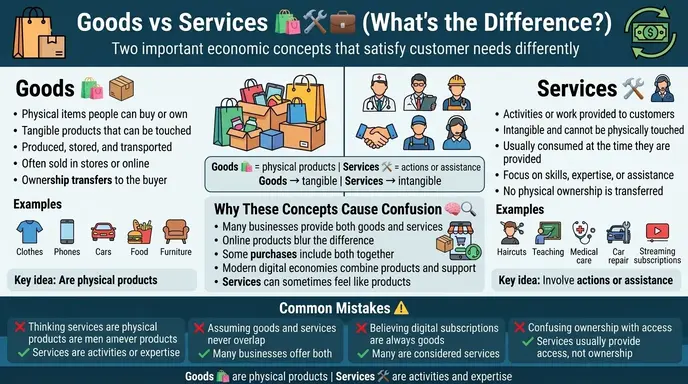
In simple words, goods are physical products that people can see, touch, own, or store, while services are activities or tasks performed for customers without creating a physical product.
The difference between goods and services becomes especially important in economics, marketing, retail, e commerce, hospitality, healthcare, and digital businesses.
This guide explains goods and services clearly, including definitions, economic functions, real world examples, similarities, business applications, consumer behavior, and expert insights.
Quick Answer: Difference Between Goods and Services
The main difference between goods and services is tangibility.
- Goods are physical items that can be owned, stored, and transferred
- Services are intangible activities performed to satisfy customer needs
For example:
A smartphone is a good, while mobile repair support is a service.
Definition of Goods and Services
- Goods: Physical products that can be seen, touched, bought, sold, or stored.
- Services: Intangible activities or tasks provided to customers for value or benefit.
Simple Example
- Goods = physical products
- Services = actions or assistance
Pronunciation of Both (US & UK)
| Term | US Pronunciation | UK Pronunciation |
| Goods | gudz | gudz |
| Services | sur vi siz | sur vi siz |
Now let’s understand this clearly through economics, business models, customer experience, and real world examples.
Difference Between Goods and Services Comparison Table
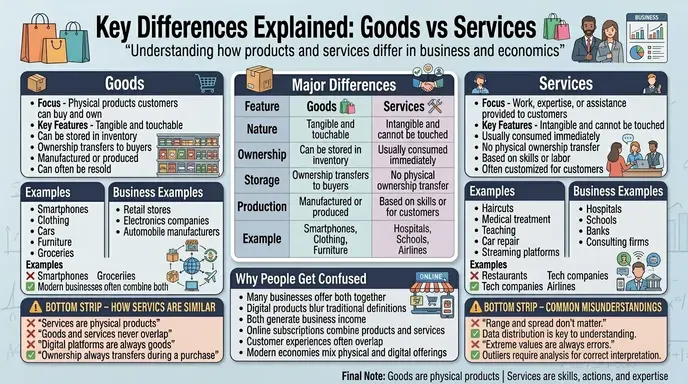
| Feature | Goods | Services | Similarity |
| Nature | Physical products | Intangible activities | Both satisfy customer needs |
| Ownership | Can be owned | Cannot usually be owned | Both involve economic value |
| Storage | Can be stored | Cannot usually be stored | Both are bought and sold |
| Production Timing | Produced before consumption | Produced during consumption | Both support businesses |
| Tangibility | Tangible | Intangible | Both serve consumers |
| Quality Consistency | Often standardized | Can vary by provider | Both affect customer satisfaction |
| Transportation | Can be shipped | Usually delivered directly | Both require business systems |
| Examples | Cars, books, phones | Banking, healthcare, education | Both drive economies |
This table clearly shows the difference and similarity between goods and services for quick understanding.
Key Differences Explained Between Goods and Services
Tangible vs Intangible
The biggest difference is physical presence.
- Goods are physical objects
- Services are non physical experiences or actions
You can touch a laptop, but you cannot physically hold a consulting service.
Ownership Difference
Goods transfer ownership after purchase.
Services usually provide temporary benefits rather than ownership.
Example:
- Buying a car = ownership of a good
- Hiring a driver = receiving a service
Production and Consumption
Goods are often produced before customers buy them.
Services are usually created and consumed simultaneously.
For example:
- A restaurant meal is prepared before serving
- A haircut happens while the service is delivered
Storage Ability
Goods can usually be stored in warehouses or homes.
Services generally cannot be stored because they happen in real time.
Standardization
Goods often maintain consistent quality through manufacturing.
Services may vary depending on:
- Employee skill
- Customer interaction
- Timing
- Experience quality
Why Do Goods and Services Exist?
Modern economies depend on both physical products and human expertise. Goods satisfy material needs, while services provide convenience, support, knowledge, entertainment, and problem solving.
As technology evolved, service industries grew rapidly alongside traditional manufacturing sectors.
How Goods Work
Manufacturing and Production
Goods are created through:
- Factories
- Agriculture
- Assembly systems
- Industrial processes
Physical Distribution
Goods move through:
- Supply chains
- Retail stores
- Shipping systems
- E commerce platforms
Companies like Amazon transformed how physical goods are sold and delivered globally.
Ownership Transfer
Once purchased, goods usually become the buyer’s property.
How Services Work
Human Skill and Expertise
Services rely heavily on:
- Knowledge
- Labor
- Customer interaction
- Professional expertise
Real Time Delivery
Most services are consumed as they are performed.
Examples include:
- Teaching
- Medical treatment
- Haircuts
- Legal advice
Digital Services
Modern digital platforms expanded service industries significantly.
Companies like Netflix and Spotify primarily provide digital services rather than physical goods.
Difference Between Goods and Services in Economics
| Economic Feature | Goods | Services |
| Economic Sector | Manufacturing and production | Service industry |
| Physical Inventory | Required | Usually unnecessary |
| Customer Interaction | Lower in many cases | Often higher |
| Automation Potential | High | Varies by industry |
| Consumption Style | Ownership based | Experience based |
Both are essential for economic growth and employment.
Difference Between Goods and Services in Business
Goods Based Businesses
Businesses selling goods focus on:
- Manufacturing
- Inventory
- Logistics
- Product quality
Examples:
- Electronics
- Clothing
- Furniture
Service Based Businesses
Service companies focus on:
- Customer experience
- Expertise
- Communication
- Relationship building
Examples:
- Healthcare
- Education
- Banking
Hybrid Business Models
Many companies combine both goods and services.
Example:
Apple sells physical products like iPhones while also providing digital services like cloud storage and streaming.
Real Life Examples with Goods and Services
Smartphone Industry
A phone is a good.
Technical support and cloud backup are services.
Restaurants
Food items are goods.
Table service and hospitality are services.
Education
Books are goods.
Teaching and tutoring are services.
Transportation
Cars are goods.
Ride sharing apps provide transportation services.
Companies like Uber mainly operate through service based business models.
Healthcare
Medical equipment represents goods.
Doctor consultations are services.
Difference + Similarity Between Goods and Services
| Feature | Goods | Services | Similarity |
| Main Nature | Physical | Intangible | Both satisfy needs |
| Ownership | Transferable | Usually non transferable | Both have economic value |
| Production | Before use | During use | Both involve business activity |
| Storage | Possible | Usually impossible | Both require management |
| Customer Experience | Product focused | Interaction focused | Both impact satisfaction |
| Modern Economy Role | Manufacturing driven | Service driven | Both support global trade |
This table clearly shows the difference and similarity between goods and services for quick understanding.
Why People Get Confused Between Goods and Services
Combined Business Models
Many businesses sell both goods and services together.
Digital Products
Digital products blur the line between goods and services.
Modern Technology
Apps, subscriptions, and online platforms combine product and service features.
Customer Experience Overlap
Consumers often experience both simultaneously.
Common Mistakes with Goods and Services
| Mistake | Correct Understanding |
| Thinking services are physical | Services are intangible |
| Assuming goods require customer interaction | Many goods are mass produced |
| Believing services can always be stored | Most services cannot |
| Ignoring digital services | Modern economies rely heavily on them |
| Treating goods and services separately in all cases | Many businesses combine both |
Quick Memory Tip
- Goods = things you can touch
- Services = actions performed for you
When to Use Goods or Services
Use “Goods” When:
- Discussing physical products
- Talking about manufacturing
- Referring to inventory
- Explaining ownership transfer
Use “Services” When:
- Discussing professional assistance
- Talking about experiences
- Explaining customer support
- Referring to expertise based work
Modern economies depend heavily on both.
Expert Insight
In modern business environments, the line between goods and services continues to evolve. Traditional economies once depended mainly on physical goods such as agriculture and manufacturing, but today service industries dominate many developed economies.
Technology companies, digital subscriptions, cloud computing, and online platforms increasingly blend products with ongoing service experiences.
Businesses that successfully combine high quality goods with strong customer service often achieve better customer loyalty and long term profitability. Consumers today expect not only reliable products but also excellent support, convenience, personalization, and digital integration.
Understanding the difference between goods and services helps consumers analyze business models, marketing strategies, pricing systems, and modern economic trends more effectively.
Frequently Asked Questions
What is the main difference between goods and services?
Goods are physical products, while services are intangible activities or assistance.
Can services be owned?
Usually no. Services provide temporary benefits rather than ownership.
Are digital products goods or services?
They can sometimes function as both depending on delivery and usage.
Is a restaurant meal a good or service?
The food itself is a good, while hospitality and serving are services.
Why are services important in the economy?
Services provide expertise, convenience, healthcare, education, and customer support.
Can businesses sell both goods and services?
Yes. Many modern companies combine both.
Are online subscriptions services?
Yes. Most subscriptions are considered digital services.
Which is more important: goods or services?
Both are essential for economic growth and modern living.
Conclusion
Understanding the difference between goods and services becomes easier once you focus on physical products versus intangible activities.
Goods are tangible items that people can own, store, and transfer, while services are actions, experiences, or assistance provided to customers without creating physical ownership.
Although both satisfy customer needs and create economic value, their production, delivery, storage, and customer interaction differ significantly.
Modern economies increasingly combine goods and services together through technology, digital platforms, and hybrid business models.
In real world business and economics, understanding the difference between goods and services helps consumers, students, and entrepreneurs make better decisions about products, industries, customer experience, and market trends.
Once you fully understand these concepts, business and economic discussions become much clearer and easier to analyze.
Discover More Articles!
Difference Between Clip and Magazine:In 30 Seconds
Roth vs 401(k) Explained Clearly: Which One Should You Choose?

labdiff.com is my English grammar comparison website where I simplify confusing words, spelling differences, and usage rules through clear explanations and examples. My goal is to help learners, writers, and students understand English easily and use correct grammar with confidence.