Many biology students, teachers, and science enthusiasts search for the difference between endocytosis and exocytosis because both are essential cellular transport processes.
They help cells exchange materials with their environment, maintain internal balance, and perform critical functions such as nutrient uptake, waste removal, and cell communication.
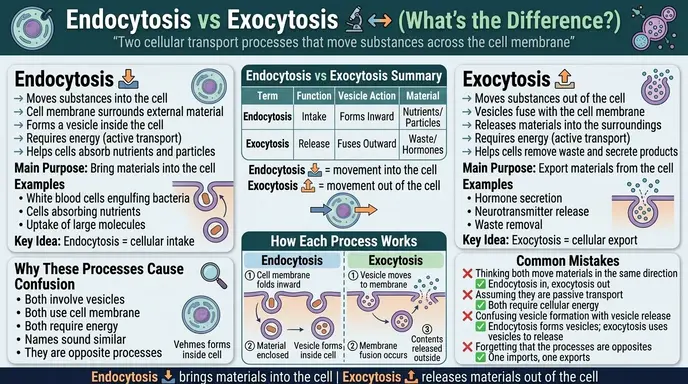
In simple words, endocytosis brings substances into a cell, while exocytosis moves substances out of a cell. Although both processes involve vesicles and require energy, they work in opposite directions.
This guide explains endocytosis and exocytosis clearly, including definitions, mechanisms, types, similarities, differences, real life examples, and biological importance.
Quick Answer: Difference Between Endocytosis and Exocytosis
The main difference between endocytosis and exocytosis is the direction of material movement.
- Endocytosis = substances move into the cell.
- Exocytosis = substances move out of the cell.
Simple Example
When a white blood cell engulfs bacteria, it uses endocytosis.
When a nerve cell releases neurotransmitters, it uses exocytosis.
Definition of Endocytosis and Exocytosis
- Endocytosis: A cellular process in which the cell membrane surrounds and brings substances into the cell by forming vesicles.
- Exocytosis: A cellular process in which vesicles fuse with the cell membrane and release substances outside the cell.
Quick Definitions
Endocytosis: Cell takes materials in.
Exocytosis: Cell sends materials out.
Pronunciation of Both (US & UK)
| Term | US Pronunciation | UK Pronunciation |
| Endocytosis | en-do-sy-TOE-sis | en-do-sy-TOE-sis |
| Exocytosis | ek-so-sy-TOE-sis | ek-so-sy-TOE-sis |
Now let’s understand how these cellular transport systems work.
Difference Between Endocytosis and Exocytosis Comparison Table
| Feature | Endocytosis | Exocytosis |
| Direction | Into the cell | Out of the cell |
| Main Purpose | Material uptake | Material release |
| Membrane Action | Membrane folds inward | Membrane fuses outward |
| Vesicle Formation | Created from cell membrane | Vesicle merges with membrane |
| Examples | Nutrient intake, phagocytosis | Hormone secretion, neurotransmitter release |
| Cell Surface Area | Usually decreases | Usually increases |
| Function | Import substances | Export substances |
| Energy Requirement | Requires ATP | Requires ATP |
This table clearly shows the difference between endocytosis and exocytosis for quick understanding.
Key Differences Explained Between Endocytosis and Exocytosis
Direction of Transport
The most important difference is movement direction.
- Endocytosis moves substances into the cell.
- Exocytosis moves substances out of the cell.
Think of them as opposite cellular transport systems.
Cell Membrane Behavior
During endocytosis:
- The membrane folds inward.
- A pocket forms.
- A vesicle is created.
During exocytosis:
- A vesicle approaches the membrane.
- The vesicle fuses with the membrane.
- Contents are released outside.
Primary Function
Endocytosis is mainly used for:
- Nutrient uptake
- Particle ingestion
- Fluid absorption
Exocytosis is mainly used for:
- Waste removal
- Hormone secretion
- Cell signaling
Effect on Cell Surface Area
Endocytosis removes portions of the plasma membrane.
Exocytosis adds membrane material back.
This balance helps maintain cell size and shape.
Biological Role
Endocytosis helps cells obtain resources.
Exocytosis helps cells communicate and eliminate substances.
Why Do Endocytosis and Exocytosis Exist?
Cells constantly interact with their surroundings.
Simple diffusion cannot transport all substances, especially:
- Large proteins
- Bacteria
- Hormones
- Cellular products
Endocytosis and exocytosis evolved to move these larger materials efficiently.
How Endocytosis Works
Step 1: Recognition
The cell identifies the material it needs to absorb.
Step 2: Membrane Folding
The plasma membrane folds inward around the substance.
Step 3: Vesicle Formation
The membrane pinches off, forming a vesicle inside the cell.
Step 4: Processing
The cell processes, stores, or digests the material.
Types of Endocytosis
Phagocytosis (“Cell Eating”)
The cell engulfs large particles.
Example:
White blood cells consuming bacteria.
Pinocytosis (“Cell Drinking”)
The cell absorbs fluids and dissolved substances.
Receptor-Mediated Endocytosis
Specific receptors capture target molecules.
Example:
Cholesterol uptake by cells.
How Exocytosis Works
Step 1: Vesicle Formation
Materials are packaged into vesicles, often by the cell’s Golgi apparatus.
Step 2: Transport
The vesicle moves toward the plasma membrane.
Step 3: Fusion
The vesicle membrane fuses with the cell membrane.
Step 4: Release
The contents are expelled outside the cell.
Types of Exocytosis
Constitutive Exocytosis
Occurs continuously.
Used for:
- Membrane maintenance
- Routine protein release
Regulated Exocytosis
Occurs only when triggered.
Used for:
- Hormone secretion
- Neurotransmitter release
Difference Between Endocytosis and Exocytosis in Human Biology
| Biological Function | Endocytosis | Exocytosis |
| Nutrient Uptake | Yes | No |
| Waste Removal | Rarely | Yes |
| Hormone Release | No | Yes |
| Cell Communication | Indirect | Direct |
| Immune Defense | Yes | Sometimes |
Both processes are essential for healthy cell function.
Difference Between Endocytosis and Exocytosis in Cell Communication
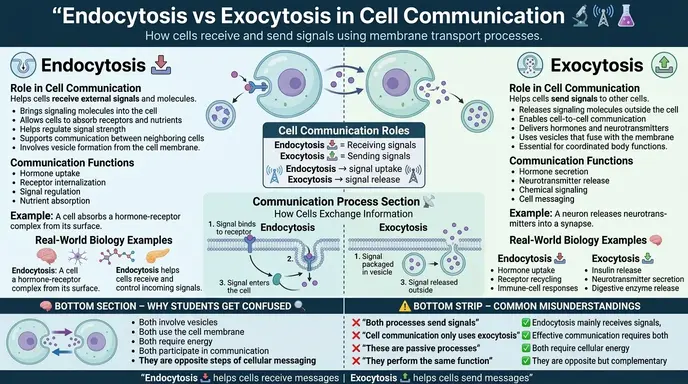
Endocytosis
Cells absorb signaling molecules and nutrients.
Exocytosis
Cells release signaling molecules.
Examples include:
- Hormones
- Enzymes
- Neurotransmitters
This communication allows tissues and organs to function together.
Difference Between Endocytosis and Exocytosis in Nervous System Function
Endocytosis
Neurons recycle membrane components and signaling materials.
Exocytosis
Neurons release neurotransmitters into synapses.
This process enables nerve signals to travel throughout the body.
Difference + Similarity Between Endocytosis and Exocytosis
| Feature | Endocytosis | Exocytosis | Similarity |
| Vesicle Use | Yes | Yes | Both use vesicles |
| Energy Required | Yes | Yes | Active transport processes |
| Membrane Involvement | Yes | Yes | Plasma membrane participates |
| Material Movement | Into cell | Out of cell | Transport substances |
| Cellular Importance | Essential | Essential | Maintain cell function |
| Found in Eukaryotes | Yes | Yes | Common cellular processes |
This table clearly shows the difference and similarity between endocytosis and exocytosis for quick understanding.
Real Life Examples with Endocytosis and Exocytosis
White Blood Cells Fighting Infection
White blood cells engulf bacteria through endocytosis.
Insulin Release
Pancreatic cells release insulin through exocytosis.
Neurotransmitter Release
Nerve cells use exocytosis to transmit signals.
Nutrient Absorption
Cells absorb certain nutrients through endocytosis.
Cellular Waste Disposal
Cells eliminate some waste products through exocytosis.
Common Mistakes with Endocytosis and Exocytosis
Confusing the Direction
The most common mistake is reversing the directions.
Remember:
- Endo = enter
- Exo = exit
Assuming They Are Passive Processes
Both require energy.
Ignoring Vesicle Function
Vesicles are central to both processes.
Thinking Only Specialized Cells Use Them
Nearly all eukaryotic cells perform these functions.
Quick Memory Tip
- Endo = Enter
- Exo = Exit
This shortcut helps students remember the difference quickly.
When to Use Each Concept
Endocytosis Is Used When:
- A cell needs nutrients.
- A cell engulfs pathogens.
- A cell absorbs large molecules.
Exocytosis Is Used When:
- A cell releases hormones.
- A cell secretes enzymes.
- A cell sends chemical signals.
Both are essential for survival.
Why People Get Confused Between Endocytosis and Exocytosis
Similar Names
The terms sound very similar.
Both Use Vesicles
Both processes involve membrane-bound vesicles.
oth Require Energy
Students often assume they are identical because both are active transport mechanisms.
Opposite Functions
Since they are reverse processes, learners frequently mix them up.
Expert Insight
In biology education, endocytosis and exocytosis are among the most important examples of active transport.
While textbooks often present them as simple opposites, their roles go far beyond material movement.
These processes help regulate immunity, hormone secretion, neurotransmission, nutrient absorption, tissue repair, and cellular communication.
In real biological systems, cells constantly balance endocytosis and exocytosis to maintain membrane stability and proper function.
Understanding this balance provides a deeper insight into how living organisms survive, grow, and respond to their environment.
Frequently Asked Questions
What is the main difference between endocytosis and exocytosis?
Endocytosis moves substances into the cell, while exocytosis moves substances out of the cell.
Do both processes require energy?
Yes. Both are active transport mechanisms that use ATP.
What are vesicles?
Vesicles are small membrane-bound sacs that transport materials within cells.
Is phagocytosis a type of endocytosis?
Yes. Phagocytosis is a form of endocytosis that engulfs large particles.
Why is exocytosis important?
It allows cells to release hormones, neurotransmitters, enzymes, and waste products.
Do animal cells use both processes?
Yes. Most animal cells regularly perform both endocytosis and exocytosis.
How do neurons use exocytosis?
Neurons release neurotransmitters through exocytosis.
What is an easy way to remember the difference?
Endo = Enter the cell. Exo = Exit the cell.
Conclusion
Understanding the difference between endocytosis and exocytosis is essential for learning how cells interact with their environment.
Endocytosis allows cells to bring nutrients, fluids, and particles into the cell by forming vesicles from the plasma membrane.
Exocytosis performs the opposite role by releasing hormones, neurotransmitters, enzymes, and waste products outside the cell through vesicle fusion.
Although these processes work in opposite directions, they share several important features, including vesicle transport, membrane involvement, and energy requirements.
Together, they help cells maintain balance, communicate with other cells, absorb nutrients, fight infections, and support countless biological functions.
By remembering the simple rule Endo means enter, Exo means exit you can quickly distinguish between these two essential cellular transport mechanisms.
Discover More Articles!
Difference Between Goods and Services:With Simple Examples
Difference Between Breathing and Respiration: Explained
Who vs Whom Differences: When to Use Each Correctly in English

James Whitmore. Labdiff.com is my english grammar comparision website. I explore the history and evolution of English words. I write detailed comparisons explaining why spellings change over time and how British and American English diverged. My articles add depth and credibility to grammar comparison topics.