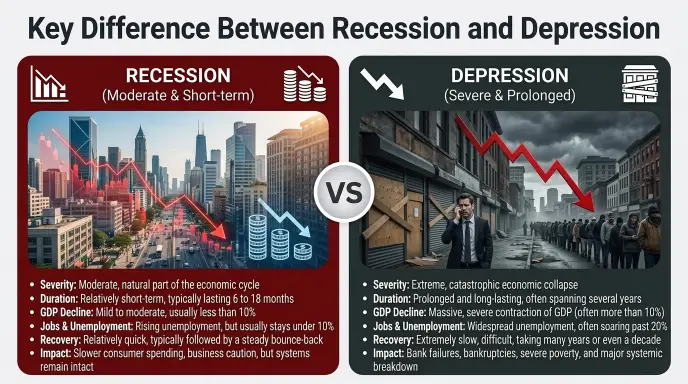
Have you ever heard people talk about an economic recession?
You may also hear about an economic depression.
Both terms describe difficult times for an economy.
However, they do not mean exactly the same thing.
A recession is a significant decline in economic activity.
It can affect businesses, workers, and household spending.
A depression is a much deeper economic downturn.
It usually involves more serious and lasting economic damage.
For example, businesses may reduce hiring during a recession.
During a depression, many businesses may close permanently.
Unemployment may also remain very high for years.
Understanding the difference between recession and depression is important.
It helps students understand economic news and financial discussions.
It also helps readers understand changes in jobs and prices.
This guide explains both terms in simple English.
You will learn their causes, effects, duration, and key differences.
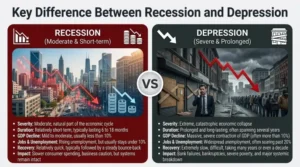
🔑 Key Difference Between Recession and Depression
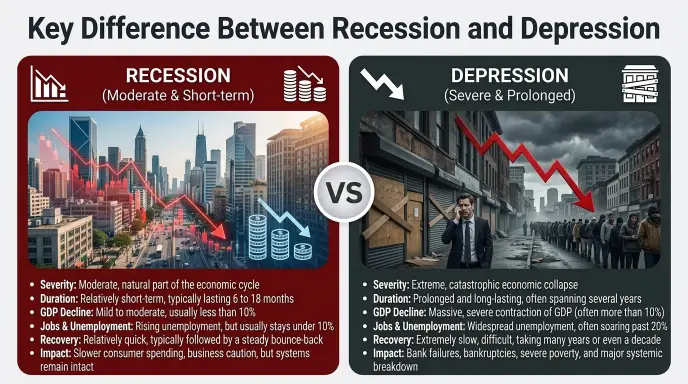
The main difference is the severity and duration of economic decline.
| Feature | Recession | Depression |
|---|---|---|
| Meaning | Significant economic decline | Extremely severe economic decline |
| Severity | Serious | Much more severe |
| Duration | Often relatively short | Usually prolonged |
| Unemployment | Often increases | Can become extremely high |
| Business Activity | Slows down | May decline dramatically |
| Consumer Spending | Often decreases | Can fall sharply |
| Production | Decreases | Can fall significantly |
| Business Closures | May increase | Can become widespread |
| Recovery | May happen sooner | Can take many years |
| Example | Great Recession | Great Depression |
There is no single universal definition of a depression.
Economists consider the depth and duration of economic damage.
📉 What Is a Recession?
A recession is a significant decline in economic activity.
It affects production, employment, income, and consumer spending.
During a recession, businesses may earn less money.
They may reduce hiring or lay off workers.
Consumers may also spend less on goods and services.
For example, a clothing store may lose many customers.
The owner might reduce orders and delay expansion plans.
Other businesses may make similar decisions.
A recession can affect many industries at once.
However, its severity can vary between countries and periods.
📉 What Is an Economic Depression?
An economic depression is an exceptionally severe economic downturn.
It is generally deeper and longer than a recession.
During a depression, many businesses may struggle to survive.
Unemployment can remain extremely high for years.
Industrial production and household spending may fall sharply.
Banks may also face serious financial problems.
These problems can make borrowing more difficult.
A depression can create widespread hardship for families.
Recovery may take a long time.
⏳ Difference in Duration
Duration is an important difference between these terms.
A recession may last several months or longer.
Some recessions continue for more than a year.
A depression usually involves a longer period of hardship.
Its economic effects can continue for several years.
However, time alone does not define a depression.
The depth of the economic decline also matters.
📊 Difference in Economic Severity
A recession can cause serious economic problems.
Businesses may lose sales and reduce investment.
A depression involves a much deeper decline.
Production and spending may fall dramatically.
Many industries may experience severe financial pressure.
Households may struggle to find stable employment.
The overall economic impact is usually much greater.
👷 Difference in Unemployment
Unemployment often increases during a recession.
Businesses may stop hiring new workers.
Some companies may also reduce their staff.
During a depression, unemployment can become extremely high.
Finding a new job may become much harder.
Long periods without work can hurt families.
Lower household income can also reduce consumer spending.
This can create further problems for businesses.
🏭 Difference in Business Activity
Business activity often slows during a recession.
Companies may delay new projects.
They may also reduce production and operating costs.
During a depression, business activity can decline much further.
Many companies may close their doors permanently.
Factories may produce fewer goods.
Suppliers may lose customers and revenue.
These problems can spread across entire communities.
💰 Difference in Consumer Spending
Consumer spending plays a major role in economic growth.
During a recession, people may become more careful.
They might delay buying cars or other expensive items.
During a depression, spending may fall much more sharply.
Many families may face job losses or reduced income.
Lower spending can hurt businesses.
Businesses may then cut production and jobs.
This cycle can make the downturn worse.
🏦 Difference in Banking Problems
Banking problems can occur during a recession.
However, they do not happen in every recession.
A severe depression may involve widespread financial instability.
Some banks may fail or restrict lending.
Businesses may struggle to borrow money.
Consumers may also find loans harder to obtain.
Reduced lending can slow economic activity further.
📈 Difference in Stock Markets
Stock markets may fall during a recession.
Investors may expect lower company profits.
During a severe depression, market losses can be much larger.
Investor confidence may remain weak for a long time.
However, stock market performance alone does not define a depression.
Economists also examine employment, production, and income.
🏠 Difference in Housing Markets
Housing markets can weaken during a recession.
Home sales may decrease.
Builders may delay new construction projects.
During a depression, housing problems can become more severe.
Falling incomes may make mortgage payments harder.
Some families may lose their homes.
Construction and property investment may also decline.
The effects depend on local economic conditions.
🌍 Common Causes of a Recession
Recessions can happen for several reasons.
1. High Interest Rates
High interest rates make borrowing more expensive.
Businesses may delay investment and expansion.
Consumers may also reduce major purchases.
2. Financial Crises
Financial crises can weaken banks and businesses.
They can also reduce access to credit.
3. Falling Consumer Demand
People may suddenly reduce their spending.
Businesses may then experience lower sales.
4. Supply Problems
Shortages can make production more difficult.
Higher energy costs can also pressure businesses.
5. Falling Asset Prices
Declining property or stock prices can reduce wealth.
This may weaken consumer and business confidence.
⚠️ What Can Cause an Economic Depression?
A depression may result from several serious problems.
These problems can make each other worse.
A major financial crisis can damage the economy.
Bank failures can restrict lending and spending.
Falling demand can force businesses to reduce production.
High unemployment can then reduce spending further.
Poor economic decisions may also deepen a crisis.
However, the causes differ across historical events.
📚 The Great Depression
The Great Depression is the best-known example of a depression.
It began in 1929 and became severe during the 1930s.
Many countries experienced major economic difficulties.
Businesses closed, and unemployment increased sharply.
Industrial production and household income also fell.
Financial problems added to the economic damage.
The Great Depression remains an important subject in economics.
It shows how severe an economic downturn can become.
🔄 Can a Recession Become a Depression?
Yes, a severe recession can develop into a deeper downturn.
However, this does not happen automatically.
The outcome depends on many economic conditions.
These include spending, employment, financial stability, and government responses.
Effective policies may help limit economic damage.
Poor conditions can make the downturn more severe.
There is no fixed time limit that turns a recession into a depression.
🆚 Which Is Worse: Recession or Depression?
A depression is generally worse than a recession.
A recession can cause job losses and business problems.
However, the economy may recover relatively quickly.
A depression can cause much deeper economic damage.
Unemployment and financial hardship may last for years.
The effects depend on the country and the historical situation.
🧾 Recession vs Depression: Simple Examples
Recession Example
Imagine a country where people reduce their spending.
Stores sell fewer products than before.
Businesses cut costs and stop hiring.
Some workers lose their jobs.
After several months, spending begins to improve.
Businesses slowly start hiring again.
This situation could describe a recession.
Depression Example
Now imagine a much deeper economic decline.
Thousands of businesses close permanently.
Unemployment remains extremely high for years.
Banks experience serious financial problems.
Production stays far below normal levels.
Families struggle to find work and earn enough money.
This situation is closer to an economic depression.
🧠 Easy Way to Remember the Difference
Remember these simple definitions:
Recession: A significant decline in economic activity.
Depression: An exceptionally severe and prolonged economic decline.
Think of a recession as a serious economic slowdown.
Think of a depression as a much deeper economic crisis.
This simple comparison makes the terms easier to remember.
📋 Quick Comparison: Recession vs Depression
| Category | Recession | Depression |
|---|---|---|
| Economic Decline | Significant | Extremely severe |
| Duration | Often shorter | Usually longer |
| Unemployment | Often rises | Can rise dramatically |
| Business Activity | Slows | May collapse in many sectors |
| Consumer Spending | Decreases | Can decrease sharply |
| Production | Falls | Can fall much further |
| Financial Problems | Possible | May become widespread |
| Recovery | May be quicker | Can take years |
| Overall Impact | Serious | Much more damaging |
❓ Frequently Asked Questions
1. What is the main difference between recession and depression?
A recession is a significant economic decline.
A depression is a much deeper and prolonged downturn.
2. Is a depression worse than a recession?
Yes, a depression generally involves more severe economic damage.
It can also last much longer.
3. How long does a recession last?
There is no fixed duration for every recession.
Some last several months, while others continue longer.
4. How long does a depression last?
A depression can continue for several years.
Its effects may remain even during recovery.
5. Can a recession turn into a depression?
Yes, a downturn can become much more severe.
However, there is no automatic point when this happens.
6. What happens to jobs during a recession?
Businesses may reduce hiring or lay off workers.
Unemployment often increases during economic downturns.
7. What happens during a depression?
Production, spending, and employment may fall dramatically.
Businesses and families can face prolonged hardship.
8. What was the Great Depression?
The Great Depression was a severe economic downturn.
It began in 1929 and affected many countries.
9. Does every recession cause a depression?
No, most recessions do not become depressions.
Their severity and economic effects can differ greatly.
10. Why is understanding recession and depression important?
It helps people understand economic news and financial changes.
It also explains how downturns affect jobs and businesses.
📝 Final Conclusion
The difference between recession and depression mainly involves severity and duration.
A recession is a significant decline in economic activity.
It can affect jobs, spending, production, and businesses.
A depression is much more severe and prolonged.
It can involve extremely high unemployment and major financial problems.
Its effects may continue for several years.
The Great Depression is a famous historical example.
Most recessions are much less severe than that event.
There is no single universal rule defining an economic depression.
Economists consider the depth and duration of economic damage.
In simple words, a recession is a serious economic slowdown.
A depression is an exceptionally severe economic downturn.
Read More!
Affect vs Effect: What’s the Difference? Complete Grammar Guide
British vs American English: A Complete Guide for Learners