Frogs and toads are both small amphibians. They can look very similar at first. Both have four legs, wide mouths, and live in places with water or moisture. However, frogs and toads are not exactly the same.
The main difference between frog and toad is their skin, body shape, habitat, and behavior. Frogs usually have smooth, moist skin and long legs. Toads usually have dry, bumpy skin and shorter legs. Frogs are often better jumpers, while toads usually walk or make short hops.
Both animals are important parts of nature. They eat insects and other small animals. They also provide food for many predators.
Understanding the difference between frog and toad can help students, children, writers, and nature lovers identify them more easily. In this guide, we will compare frogs and toads by appearance, skin, legs, habitat, eggs, movement, diet, behavior, and more.
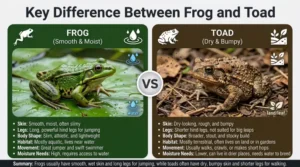
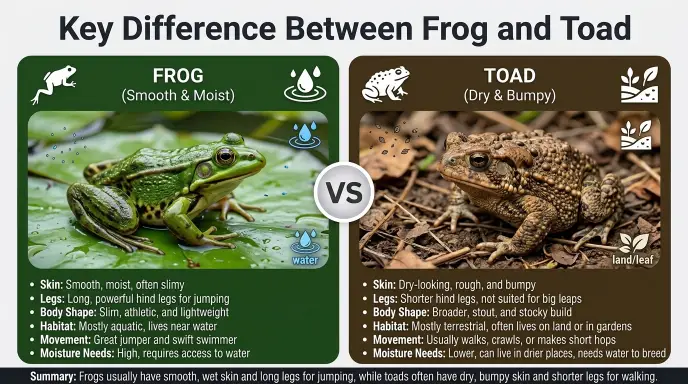
Key Difference Between Frog and Toad
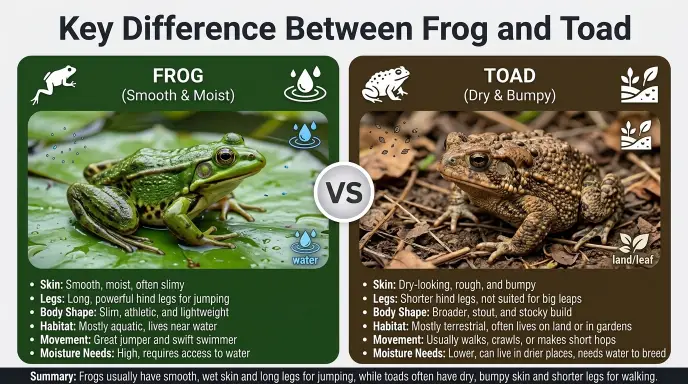
The biggest difference is their skin and body structure.
| Feature | Frog | Toad |
| Skin | Usually smooth and moist | Usually dry and bumpy |
| Body | Slim and athletic | Shorter and wider |
| Legs | Long and powerful | Shorter |
| Jumping | Excellent jumper | Usually weaker jumper |
| Skin moisture | Needs moist conditions | Better at living on land |
| Habitat | Often near water | Often on land |
| Feet | Often webbed | Less webbed |
| Eyes | Often more prominent | Usually less prominent |
| Eggs | Usually laid in clusters | Often laid in long strings |
| Movement | Jumps and swims | Walks and makes short hops |
| Poison glands | Usually absent | Often has glands behind eyes |
| Water dependence | Usually greater | Usually lower |
What Is a Frog?
A frog is an amphibian that usually has smooth, moist skin.
Frogs have long back legs. These legs help them jump far and swim well.
Many frogs live near ponds, lakes, streams, wetlands, or other damp areas.
Frogs spend different amounts of time in water and on land. Their exact behavior depends on the species.
Most frogs eat insects and other small animals.
Frogs can have many colors. Some are green or brown, while others may have bright colors.
What Is a Toad?
A toad is also an amphibian.
Toads usually have dry, rough, or bumpy skin. They often have shorter legs than frogs.
Many toads spend more time on land. They may live in gardens, forests, fields, and other areas.
Toads often move by walking or making short hops.
Many toads have large glands behind their eyes. These glands can produce substances that discourage predators.
Toads also eat many insects and other small creatures.
Frog vs Toad: Skin
Skin is one of the easiest ways to compare them.
Frogs usually have smooth and moist skin. Their skin needs to stay wet or damp because frogs can absorb water through it.
Toads usually have dry-looking, rough, and bumpy skin.
The bumps on a toad are often mistaken for warts. However, touching a toad does not give you human warts.
The skin difference is a useful clue, but it is not a perfect rule. Some frog species have textured skin, and some toads may have smoother skin.
Frog vs Toad: Body Shape
Frogs usually have slimmer bodies.
Their body shape supports jumping and swimming.
Toads often have wider and more compact bodies.
They can look heavier than frogs because of their shorter legs and broader shape.
However, body shape varies between species.
Frog vs Toad: Legs
Frogs usually have long and powerful hind legs.
These legs allow frogs to make large jumps. They also help frogs swim quickly.
Toads generally have shorter hind legs.
They can still jump, but their movement is usually less dramatic.
Many toads prefer walking or making short hops.
Frog vs Toad: Jumping
Frogs are generally better jumpers.
Their long hind legs give them strong jumping power.
A frog may quickly jump away when it feels threatened.
Toads usually do not make the same long jumps.
They often walk, crawl, or make short hops instead.
This makes movement another helpful clue when identifying them.
Frog vs Toad: Habitat
Frogs are often found close to water.
Common frog habitats include:
- Ponds
- Lakes
- Streams
- Wetlands
- Marshes
- Rainforests
Toads often spend more time on land.
They may live in:
- Gardens
- Forests
- Fields
- Grasslands
- Woodland areas
- Near homes
Both frogs and toads need moisture at important stages of their lives.
Frog vs Toad: Water
Frogs generally have a stronger connection with water.
Many frogs live near water and are strong swimmers.
Toads are often better adapted to land.
However, toads still need water or moisture to reproduce. Their eggs and young usually develop in water.
So, neither animal is completely independent of water.
Frog vs Toad: Feet
Frogs often have webbed feet.
Webbing helps them move through water.
Toads usually have less webbing because they spend more time on land.
Some frogs have little or no webbing, so this feature can vary.
Still, webbed feet are a useful clue when comparing common frogs and toads.
Frog vs Toad: Eyes
Frogs often have large, prominent eyes.
These eyes help them see predators and prey.
Toads also have prominent eyes, but their appearance can differ by species.
Toads often have a more rounded and rugged face.
Eye shape alone should not be used to identify an animal. It is better to look at several features together.
Frog vs Toad: Eggs
Their eggs can look very different.
Many frogs lay eggs in clusters or masses.
The eggs often float or attach to plants in water.
Many toads lay eggs in long strings.
These strings may wrap around water plants.
This is one of the easiest differences to notice during breeding season.
However, egg patterns vary between species.
Frog vs Toad: Tadpoles
Both frogs and toads begin life as young aquatic animals called tadpoles.
Frog tadpoles often have a more rounded body and may have a longer tail.
Toad tadpoles are often darker and may swim in groups.
Their exact appearance varies between species.
Both types of tadpoles eventually develop legs and lose their tails as they become adults.
Frog vs Toad: Diet
Both frogs and toads are mostly carnivorous as adults.
They commonly eat small creatures such as:
- Insects
- Flies
- Beetles
- Moths
- Spiders
- Worms
- Small invertebrates
Some larger species can eat bigger prey.
Frogs often catch prey with their sticky tongues.
Toads also use their tongues to catch food.
Both animals help control insect populations.
Frog vs Toad: Tongue
Frogs have long, sticky tongues.
A frog can quickly extend its tongue to catch insects.
Toads also have sticky tongues.
They use the same basic hunting method.
Their tongues can move very quickly.
This means both frogs and toads are skilled insect hunters.
Frog vs Toad: Movement
Frogs are usually strong jumpers and swimmers.
Their long legs help them move quickly.
Toads are usually slower.
They often walk across the ground or make small hops.
This difference reflects their body structure and lifestyle.
Frog vs Toad: Defense
Frogs and toads use different defensive strategies.
A frog may quickly jump into water or vegetation when threatened.
A toad may stay still and use camouflage.
Many toads also have glands behind their eyes that produce irritating substances.
These substances can discourage predators.
Some frogs also have chemical defenses, especially species with brightly colored skin.
Frog vs Toad: Poison
This topic often causes confusion.
Many people call toads “poisonous.” More accurately, many toads produce defensive chemicals from their skin glands.
These substances can make predators sick or uncomfortable.
Some frogs can also produce powerful toxins.
Therefore, it is not correct to say that all frogs are harmless and all toads are poisonous.
Species matter.
People should avoid handling unknown amphibians, especially brightly colored species.
Frog vs Toad: Skin Moisture
Frogs usually need very moist skin.
Their skin plays an important role in water exchange and breathing.
Toads often have skin that appears drier.
Their bodies are generally better suited to spending time away from open water.
However, toads still need moisture to avoid dehydration.
Both animals can be sensitive to dry conditions.
Frog vs Toad: Breathing
Adult frogs and toads use their lungs.
They can also exchange gases through their skin.
This is why keeping their skin moist is important.
Their tadpoles breathe differently while living in water.
As they grow, their bodies change during metamorphosis.
Frog vs Toad: Life Cycle
Both frogs and toads have a similar basic life cycle.
It usually follows these stages:
Egg → Tadpole → Young amphibian → Adult
Eggs are usually laid in water.
The eggs hatch into tadpoles.
Tadpoles develop legs as they grow.
Their tails gradually disappear.
Eventually, they become adult frogs or toads.
Frog vs Toad: Breeding
Frogs and toads usually return to water to reproduce.
Males may call to attract females.
Frog calls can sound like croaks, chirps, or other sounds.
Toad calls can also be loud and distinctive.
Breeding behavior varies greatly between species.
Some species gather in large numbers around ponds during breeding season.
Frog vs Toad: Sound
Both frogs and toads make sounds.
Frogs are well known for their calls.
Toads also make strong calls, especially during breeding.
Their sounds help males attract females.
They can also help animals identify members of their species.
The exact sound depends on the species.
Frog vs Toad: Day and Night
Many frogs and toads are active at night.
Nighttime activity can help them avoid heat and reduce water loss.
It can also make hunting safer.
However, some species are active during the day.
Their activity depends on species, weather, temperature, and habitat.
Frog vs Toad: Swimming
Frogs are generally better swimmers.
Their long legs and webbed feet help them move through water.
Toads can swim when needed.
However, they are usually more comfortable moving on land.
This is why frogs are often found around ponds and streams.
Frog vs Toad: Climbing
Some frogs are excellent climbers.
Tree frogs have special toe pads that help them climb plants and smooth surfaces.
Most toads are mainly ground-dwelling.
They are not known for climbing like many tree frogs.
This is another reason the term “frog” covers a wider range of body types.
Frog vs Toad: Size
Frog and toad sizes vary greatly.
Some frogs are tiny.
Others can become quite large.
Toad size also depends on the species.
There is no simple rule that says all frogs are smaller than all toads.
Other features are more useful for identification.
Frog vs Toad: Color
Frogs can have many colors.
Common colors include:
- Green
- Brown
- Yellow
- Gray
- Black
Some species have very bright colors.
Toads are often brown, gray, or olive.
Their colors can help them blend into soil, leaves, and vegetation.
Color alone is not enough to identify either animal.
Frog vs Toad: Main Differences
1. Skin
Frogs usually have smooth, moist skin.
Toads usually have dry, bumpy skin.
2. Body
Frogs often have slimmer bodies.
Toads often have wider bodies.
3. Legs
Frogs usually have long hind legs.
Toads usually have shorter legs.
4. Movement
Frogs often jump far.
Toads usually walk or make short hops.
5. Habitat
Frogs are often closely associated with water.
Toads often spend more time on land.
6. Feet
Frogs often have more webbing.
Toads usually have less webbing.
7. Eggs
Frogs often lay eggs in clusters.
Toads often lay eggs in strings.
8. Skin Glands
Many toads have large glands behind their eyes.
These glands can release defensive substances.
9. Swimming
Frogs are generally stronger swimmers.
Toads can swim but are more land-based.
10. Appearance
Frogs often look slim and smooth.
Toads often look rough and bulky.
Quick Comparison: Frog vs Toad
| Category | Frog | Toad |
| Skin | Smooth and moist | Dry and bumpy |
| Body | Slim | Wider |
| Legs | Long | Shorter |
| Jumping | Strong | Limited |
| Swimming | Usually strong | Usually weaker |
| Habitat | Often near water | Often on land |
| Feet | Often webbed | Less webbed |
| Eggs | Usually clusters | Often strings |
| Movement | Jumps | Walks or hops |
| Defense | Escape and camouflage | Camouflage and skin secretions |
| Activity | Often nocturnal | Often nocturnal |
| Diet | Insects and small animals | Insects and small animals |
Are Frogs and Toads the Same?
No.
Frogs and toads are different types of amphibians.
However, the word “toad” does not represent one single scientific group. Many animals called toads belong to different families.
In everyday language, people often use body features to separate frogs from toads.
Scientists may use more detailed classifications.
So, the common frog-toad comparison is useful, but nature has many exceptions.
Can a Frog Turn Into a Toad?
No.
A frog does not grow into a toad.
A frog begins life as a frog and develops through its own life cycle.
A toad begins life as a toad and develops through its own life cycle.
Both may start as eggs and tadpoles, but they remain different animals.
Which Is Better at Jumping?
Frogs are generally better jumpers.
Their long hind legs provide powerful jumping ability.
Toads have shorter legs and usually move with smaller hops.
Some toads can still make impressive jumps, but frogs are generally known for their jumping skills.
Which Lives More on Land?
Toads generally spend more time on land.
Their bodies are well adapted for moving across soil, leaves, gardens, and other land environments.
Frogs often stay closer to water.
However, many frogs also spend significant time on land.
The exact lifestyle depends on the species.
Which Is More Dangerous?
Most frogs and toads are not dangerous to humans.
However, some species produce toxins or irritating chemicals.
Some brightly colored frogs can be especially dangerous.
People should not touch unknown amphibians.
It is also important to wash your hands after handling amphibians or objects that may have contacted them.
Easy Way to Remember the Difference
Use these simple rules:
Frog = smooth, moist, long legs, strong jumper.
Toad = bumpy, dry, short legs, land lover.
For eggs, remember:
Frog → clusters
Toad → strings
These clues can help you quickly identify them.
Frequently Asked Questions
1. What is the main difference between a frog and a toad?
Frogs usually have smooth, moist skin and long legs. Toads usually have dry, bumpy skin and shorter legs.
2. Are frogs and toads the same?
No. They are different amphibians, although they are closely related.
3. Can toads swim?
Yes. Toads can swim when needed, but many spend more time on land.
4. Can frogs live on land?
Yes. Many frogs spend time on land, even though they often stay near water.
5. Do frogs have smooth skin?
Most common frogs have smooth, moist skin, but some frog species have textured skin.
6. Why do toads have bumps?
Many toads have glands and textured skin that help protect them and reduce water loss.
7. Do toads cause warts?
No. Handling a toad does not cause human warts.
8. Which is a better jumper, frog or toad?
Frogs are generally better jumpers because they have longer and stronger hind legs.
9. How can you tell frog eggs from toad eggs?
Frog eggs are often found in clusters. Toad eggs are often found in long strings.
10. Do frogs and toads eat insects?
Yes. Both commonly eat insects and other small animals.
Final Conclusion
The difference between frog and toad becomes easier to understand when you compare their skin, legs, body shape, habitat, and movement.
Frogs usually have smooth, moist skin, long legs, and strong jumping abilities. They are often found close to water and are generally good swimmers.
Toads usually have dry, bumpy skin, shorter legs, and wider bodies. They often spend more time on land and usually move by walking or making short hops.
Their eggs can also provide a useful clue. Frogs often lay eggs in clusters, while many toads lay eggs in long strings.
Still, nature has many exceptions. Not every frog or toad follows every common rule. The best approach is to look at several features together.
The easiest memory trick is:
Frog = smooth, long-legged, and strong jumper.
Toad = bumpy, short-legged, and more land-based.
Meta Description:🐸 Difference Between Frog and Toad: Complete Guide
Frogs and toads are both small amphibians. They can look very similar at first. Both have four legs, wide mouths, and live in places with water or moisture. However, frogs and toads are not exactly the same.
The main difference between frog and toad is their skin, body shape, habitat, and behavior. Frogs usually have smooth, moist skin and long legs. Toads usually have dry, bumpy skin and shorter legs. Frogs are often better jumpers, while toads usually walk or make short hops.
Both animals are important parts of nature. They eat insects and other small animals. They also provide food for many predators.
Understanding the difference between frog and toad can help students, children, writers, and nature lovers identify them more easily. In this guide, we will compare frogs and toads by appearance, skin, legs, habitat, eggs, movement, diet, behavior, and more.
Key Difference Between Frog and Toad
The biggest difference is their skin and body structure.
| Feature | Frog | Toad |
| Skin | Usually smooth and moist | Usually dry and bumpy |
| Body | Slim and athletic | Shorter and wider |
| Legs | Long and powerful | Shorter |
| Jumping | Excellent jumper | Usually weaker jumper |
| Skin moisture | Needs moist conditions | Better at living on land |
| Habitat | Often near water | Often on land |
| Feet | Often webbed | Less webbed |
| Eyes | Often more prominent | Usually less prominent |
| Eggs | Usually laid in clusters | Often laid in long strings |
| Movement | Jumps and swims | Walks and makes short hops |
| Poison glands | Usually absent | Often has glands behind eyes |
| Water dependence | Usually greater | Usually lower |
What Is a Frog?
A frog is an amphibian that usually has smooth, moist skin.
Frogs have long back legs. These legs help them jump far and swim well.
Many frogs live near ponds, lakes, streams, wetlands, or other damp areas.
Frogs spend different amounts of time in water and on land. Their exact behavior depends on the species.
Most frogs eat insects and other small animals.
Frogs can have many colors. Some are green or brown, while others may have bright colors.
What Is a Toad?
A toad is also an amphibian.
Toads usually have dry, rough, or bumpy skin. They often have shorter legs than frogs.
Many toads spend more time on land. They may live in gardens, forests, fields, and other areas.
Toads often move by walking or making short hops.
Many toads have large glands behind their eyes. These glands can produce substances that discourage predators.
Toads also eat many insects and other small creatures.
Frog vs Toad: Skin
Skin is one of the easiest ways to compare them.
Frogs usually have smooth and moist skin. Their skin needs to stay wet or damp because frogs can absorb water through it.
Toads usually have dry-looking, rough, and bumpy skin.
The bumps on a toad are often mistaken for warts. However, touching a toad does not give you human warts.
The skin difference is a useful clue, but it is not a perfect rule. Some frog species have textured skin, and some toads may have smoother skin.
Frog vs Toad: Body Shape
Frogs usually have slimmer bodies.
Their body shape supports jumping and swimming.
Toads often have wider and more compact bodies.
They can look heavier than frogs because of their shorter legs and broader shape.
However, body shape varies between species.
Frog vs Toad: Legs
Frogs usually have long and powerful hind legs.
These legs allow frogs to make large jumps. They also help frogs swim quickly.
Toads generally have shorter hind legs.
They can still jump, but their movement is usually less dramatic.
Many toads prefer walking or making short hops.
Frog vs Toad: Jumping
Frogs are generally better jumpers.
Their long hind legs give them strong jumping power.
A frog may quickly jump away when it feels threatened.
Toads usually do not make the same long jumps.
They often walk, crawl, or make short hops instead.
This makes movement another helpful clue when identifying them.
Frog vs Toad: Habitat
Frogs are often found close to water.
Common frog habitats include:
- Ponds
- Lakes
- Streams
- Wetlands
- Marshes
- Rainforests
Toads often spend more time on land.
They may live in:
- Gardens
- Forests
- Fields
- Grasslands
- Woodland areas
- Near homes
Both frogs and toads need moisture at important stages of their lives.
Frog vs Toad: Water
Frogs generally have a stronger connection with water.
Many frogs live near water and are strong swimmers.
Toads are often better adapted to land.
However, toads still need water or moisture to reproduce. Their eggs and young usually develop in water.
So, neither animal is completely independent of water.
Frog vs Toad: Feet
Frogs often have webbed feet.
Webbing helps them move through water.
Toads usually have less webbing because they spend more time on land.
Some frogs have little or no webbing, so this feature can vary.
Still, webbed feet are a useful clue when comparing common frogs and toads.
Frog vs Toad: Eyes
Frogs often have large, prominent eyes.
These eyes help them see predators and prey.
Toads also have prominent eyes, but their appearance can differ by species.
Toads often have a more rounded and rugged face.
Eye shape alone should not be used to identify an animal. It is better to look at several features together.
Frog vs Toad: Eggs
Their eggs can look very different.
Many frogs lay eggs in clusters or masses.
The eggs often float or attach to plants in water.
Many toads lay eggs in long strings.
These strings may wrap around water plants.
This is one of the easiest differences to notice during breeding season.
However, egg patterns vary between species.
Frog vs Toad: Tadpoles
Both frogs and toads begin life as young aquatic animals called tadpoles.
Frog tadpoles often have a more rounded body and may have a longer tail.
Toad tadpoles are often darker and may swim in groups.
Their exact appearance varies between species.
Both types of tadpoles eventually develop legs and lose their tails as they become adults.
Frog vs Toad: Diet
Both frogs and toads are mostly carnivorous as adults.
They commonly eat small creatures such as:
- Insects
- Flies
- Beetles
- Moths
- Spiders
- Worms
- Small invertebrates
Some larger species can eat bigger prey.
Frogs often catch prey with their sticky tongues.
Toads also use their tongues to catch food.
Both animals help control insect populations.
Frog vs Toad: Tongue
Frogs have long, sticky tongues.
A frog can quickly extend its tongue to catch insects.
Toads also have sticky tongues.
They use the same basic hunting method.
Their tongues can move very quickly.
This means both frogs and toads are skilled insect hunters.
Frog vs Toad: Movement
Frogs are usually strong jumpers and swimmers.
Their long legs help them move quickly.
Toads are usually slower.
They often walk across the ground or make small hops.
This difference reflects their body structure and lifestyle.
Frog vs Toad: Defense
Frogs and toads use different defensive strategies.
A frog may quickly jump into water or vegetation when threatened.
A toad may stay still and use camouflage.
Many toads also have glands behind their eyes that produce irritating substances.
These substances can discourage predators.
Some frogs also have chemical defenses, especially species with brightly colored skin.
Frog vs Toad: Poison
This topic often causes confusion.
Many people call toads “poisonous.” More accurately, many toads produce defensive chemicals from their skin glands.
These substances can make predators sick or uncomfortable.
Some frogs can also produce powerful toxins.
Therefore, it is not correct to say that all frogs are harmless and all toads are poisonous.
Species matter.
People should avoid handling unknown amphibians, especially brightly colored species.
Frog vs Toad: Skin Moisture
Frogs usually need very moist skin.
Their skin plays an important role in water exchange and breathing.
Toads often have skin that appears drier.
Their bodies are generally better suited to spending time away from open water.
However, toads still need moisture to avoid dehydration.
Both animals can be sensitive to dry conditions.
Frog vs Toad: Breathing
Adult frogs and toads use their lungs.
They can also exchange gases through their skin.
This is why keeping their skin moist is important.
Their tadpoles breathe differently while living in water.
As they grow, their bodies change during metamorphosis.
Frog vs Toad: Life Cycle
Both frogs and toads have a similar basic life cycle.
It usually follows these stages:
Egg → Tadpole → Young amphibian → Adult
Eggs are usually laid in water.
The eggs hatch into tadpoles.
Tadpoles develop legs as they grow.
Their tails gradually disappear.
Eventually, they become adult frogs or toads.
Frog vs Toad: Breeding
Frogs and toads usually return to water to reproduce.
Males may call to attract females.
Frog calls can sound like croaks, chirps, or other sounds.
Toad calls can also be loud and distinctive.
Breeding behavior varies greatly between species.
Some species gather in large numbers around ponds during breeding season.
Frog vs Toad: Sound
Both frogs and toads make sounds.
Frogs are well known for their calls.
Toads also make strong calls, especially during breeding.
Their sounds help males attract females.
They can also help animals identify members of their species.
The exact sound depends on the species.
Frog vs Toad: Day and Night
Many frogs and toads are active at night.
Nighttime activity can help them avoid heat and reduce water loss.
It can also make hunting safer.
However, some species are active during the day.
Their activity depends on species, weather, temperature, and habitat.
Frog vs Toad: Swimming
Frogs are generally better swimmers.
Their long legs and webbed feet help them move through water.
Toads can swim when needed.
However, they are usually more comfortable moving on land.
This is why frogs are often found around ponds and streams.
Frog vs Toad: Climbing
Some frogs are excellent climbers.
Tree frogs have special toe pads that help them climb plants and smooth surfaces.
Most toads are mainly ground-dwelling.
They are not known for climbing like many tree frogs.
This is another reason the term “frog” covers a wider range of body types.
Frog vs Toad: Size
Frog and toad sizes vary greatly.
Some frogs are tiny.
Others can become quite large.
Toad size also depends on the species.
There is no simple rule that says all frogs are smaller than all toads.
Other features are more useful for identification.
Frog vs Toad: Color
Frogs can have many colors.
Common colors include:
- Green
- Brown
- Yellow
- Gray
- Black
Some species have very bright colors.
Toads are often brown, gray, or olive.
Their colors can help them blend into soil, leaves, and vegetation.
Color alone is not enough to identify either animal.
Frog vs Toad: Main Differences
1. Skin
Frogs usually have smooth, moist skin.
Toads usually have dry, bumpy skin.
2. Body
Frogs often have slimmer bodies.
Toads often have wider bodies.
3. Legs
Frogs usually have long hind legs.
Toads usually have shorter legs.
4. Movement
Frogs often jump far.
Toads usually walk or make short hops.
5. Habitat
Frogs are often closely associated with water.
Toads often spend more time on land.
6. Feet
Frogs often have more webbing.
Toads usually have less webbing.
7. Eggs
Frogs often lay eggs in clusters.
Toads often lay eggs in strings.
8. Skin Glands
Many toads have large glands behind their eyes.
These glands can release defensive substances.
9. Swimming
Frogs are generally stronger swimmers.
Toads can swim but are more land-based.
10. Appearance
Frogs often look slim and smooth.
Toads often look rough and bulky.
Quick Comparison: Frog vs Toad
| Category | Frog | Toad |
| Skin | Smooth and moist | Dry and bumpy |
| Body | Slim | Wider |
| Legs | Long | Shorter |
| Jumping | Strong | Limited |
| Swimming | Usually strong | Usually weaker |
| Habitat | Often near water | Often on land |
| Feet | Often webbed | Less webbed |
| Eggs | Usually clusters | Often strings |
| Movement | Jumps | Walks or hops |
| Defense | Escape and camouflage | Camouflage and skin secretions |
| Activity | Often nocturnal | Often nocturnal |
| Diet | Insects and small animals | Insects and small animals |
Are Frogs and Toads the Same?
No.
Frogs and toads are different types of amphibians.
However, the word “toad” does not represent one single scientific group. Many animals called toads belong to different families.
In everyday language, people often use body features to separate frogs from toads.
Scientists may use more detailed classifications.
So, the common frog-toad comparison is useful, but nature has many exceptions.
Can a Frog Turn Into a Toad?
No.
A frog does not grow into a toad.
A frog begins life as a frog and develops through its own life cycle.
A toad begins life as a toad and develops through its own life cycle.
Both may start as eggs and tadpoles, but they remain different animals.
Which Is Better at Jumping?
Frogs are generally better jumpers.
Their long hind legs provide powerful jumping ability.
Toads have shorter legs and usually move with smaller hops.
Some toads can still make impressive jumps, but frogs are generally known for their jumping skills.
Which Lives More on Land?
Toads generally spend more time on land.
Their bodies are well adapted for moving across soil, leaves, gardens, and other land environments.
Frogs often stay closer to water.
However, many frogs also spend significant time on land.
The exact lifestyle depends on the species.
Which Is More Dangerous?
Most frogs and toads are not dangerous to humans.
However, some species produce toxins or irritating chemicals.
Some brightly colored frogs can be especially dangerous.
People should not touch unknown amphibians.
It is also important to wash your hands after handling amphibians or objects that may have contacted them.
Easy Way to Remember the Difference
Use these simple rules:
Frog = smooth, moist, long legs, strong jumper.
Toad = bumpy, dry, short legs, land lover.
For eggs, remember:
Frog → clusters
Toad → strings
These clues can help you quickly identify them.
Frequently Asked Questions
1. What is the main difference between a frog and a toad?
Frogs usually have smooth, moist skin and long legs. Toads usually have dry, bumpy skin and shorter legs.
2. Are frogs and toads the same?
No. They are different amphibians, although they are closely related.
3. Can toads swim?
Yes. Toads can swim when needed, but many spend more time on land.
4. Can frogs live on land?
Yes. Many frogs spend time on land, even though they often stay near water.
5. Do frogs have smooth skin?
Most common frogs have smooth, moist skin, but some frog species have textured skin.
6. Why do toads have bumps?
Many toads have glands and textured skin that help protect them and reduce water loss.
7. Do toads cause warts?
No. Handling a toad does not cause human warts.
8. Which is a better jumper, frog or toad?
Frogs are generally better jumpers because they have longer and stronger hind legs.
9. How can you tell frog eggs from toad eggs?
Frog eggs are often found in clusters. Toad eggs are often found in long strings.
10. Do frogs and toads eat insects?
Yes. Both commonly eat insects and other small animals.
Final Conclusion
The difference between frog and toad becomes easier to understand when you compare their skin, legs, body shape, habitat, and movement.
Frogs usually have smooth, moist skin, long legs, and strong jumping abilities. They are often found close to water and are generally good swimmers.
Toads usually have dry, bumpy skin, shorter legs, and wider bodies. They often spend more time on land and usually move by walking or making short hops.
Their eggs can also provide a useful clue. Frogs often lay eggs in clusters, while many toads lay eggs in long strings.
Still, nature has many exceptions. Not every frog or toad follows every common rule. The best approach is to look at several features together.
The easiest memory trick is:
Frog = smooth, long-legged, and strong jumper.
Toad = bumpy, short-legged, and more land-based.
Read More!
Who vs Whom Differences: When to Use Each Correctly in English
Affect vs Effect: What’s the Difference? Complete Grammar Guide