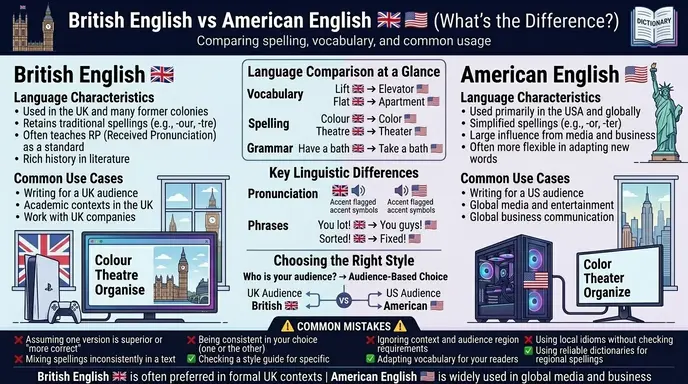
Many English learners, writers, students, and professionals search for British vs American English differences because both versions of English are widely used around the world.
While they share the same roots and remain mutually understandable, they differ in spelling, vocabulary, pronunciation, grammar, punctuation, and everyday expressions.
In simple words, British English is the standard form of English used primarily in the United Kingdom, while American English is the version commonly used in the United States.
The differences are usually small, but they can affect communication, writing style, education, business documents, and content creation.
This guide explains British vs American English differences clearly, including spelling rules, grammar variations, vocabulary changes, pronunciation differences, similarities, real-world examples, and expert insights.
Quick Answer: British vs American English Differences
The main difference between British English and American English is how certain words are spelled, pronounced, and used.
Examples:
| British English | American English |
| Colour | Color |
| Favourite | Favorite |
| Centre | Center |
| Holiday | Vacation |
| Flat | Apartment |
Both versions are correct. The preferred form depends on the country and audience.
Definition of British English and American English
- British English: The standard variety of English primarily used in the United Kingdom and many Commonwealth countries.
- American English: The standard variety of English primarily used in the United States.
Simple Example
- British English = “I live in a flat.”
- American English = “I live in an apartment.”
Both sentences mean the same thing.
Pronunciation of Both
| Term | Pronunciation |
| British English | BRIT-ish ING-glish |
| American English | uh-MER-ih-kuhn ING-glish |
Now let’s understand how these two major forms of English differ in everyday use.
British vs American English Comparison Table
| Feature | British English | American English | Similarity |
| Spelling | Colour | Color | Same meaning |
| Vocabulary | Lift | Elevator | Same function |
| Grammar | Have got | Have | Both correct |
| Pronunciation | Often non-rhotic | Usually rhotic | Same language |
| Date Format | Day/Month/Year | Month/Day/Year | Both express dates |
| Collective Nouns | Team are winning | Team is winning | Same idea |
| Punctuation | Different quotation preferences | Different quotation preferences | Same purpose |
| Usage Region | UK and Commonwealth | United States | Both globally understood |
This table clearly shows the difference and similarity between British and American English for quick understanding.
Key Differences Explained Between British and American English
Spelling Differences
One of the most noticeable differences is spelling.
| British English | American English |
| Colour | Color |
| Honour | Honor |
| Favourite | Favorite |
| Labour | Labor |
| Behaviour | Behavior |
British English often retains the “u” found in older spellings.
“-re” vs “-er” Endings
Many words end differently.
| British English | American English |
| Centre | Center |
| Theatre | Theater |
| Metre | Meter |
| Fibre | Fiber |
The meaning remains identical.
“-ise” vs “-ize”
British English often uses:
- organise
- realise
- recognise
American English usually prefers:
- organize
- realize
- recognize
Both forms are accepted in many situations.
Vocabulary Differences
Many everyday words differ.
| British English | American English |
| Flat | Apartment |
| Lift | Elevator |
| Lorry | Truck |
| Holiday | Vacation |
| Biscuit | Cookie |
| Petrol | Gasoline |
| Football | Soccer |
| Queue | Line |
This is one of the most noticeable British vs American English differences.
Why Do British and American English Exist?
English was brought to North America by British settlers during the 17th century.
Over time:
- Language evolved independently.
- Different spelling standards emerged.
- Regional vocabulary developed.
- Pronunciation changed.
As a result, modern British and American English became slightly different while remaining largely compatible.
How British English Works
Traditional Spellings
British English often preserves older spellings inherited from historical English and French influences.
Examples:
- Colour
- Honour
- Jewellery
- Travelling
Collective Nouns
British English commonly treats collective nouns as plural.
Example:
- The team are playing well.
Formal Tone
Many learners perceive British English as slightly more formal in certain contexts.
How American English Works
Simplified Spellings
American English frequently uses shorter spellings.
Examples:
- Color
- Honor
- Jewelry
- Traveling
Singular Collective Nouns
American English usually treats collective nouns as singular.
Example:
- The team is playing well.
Global Influence
American English has become highly influential through media, technology, and entertainment.
Companies like Google, Microsoft, and Netflix often use American English as their default language standard.
British vs American English Pronunciation Differences
R Sound
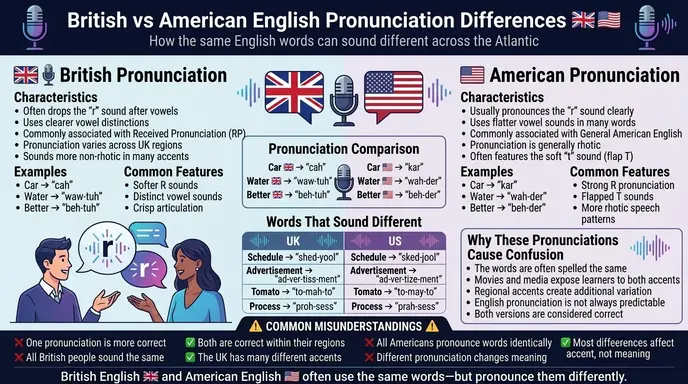
One major pronunciation difference involves the letter “R.”
British English often drops the final “R” sound.
Example:
- Car → “cah”
American English usually pronounces the “R.”
Example:
- Car → “car”
Vowel Sounds
Many vowel sounds differ.
Examples:
- Dance
- Bath
- Tomato
These words are often pronounced differently in British and American accents.
British vs American English Grammar Differences
Present Perfect Usage
British English commonly uses the present perfect tense.
Example:
- I have just eaten.
American English may use either:
- I have just eaten.
- I just ate.
Have Got vs Have
British English:
- I have got a car.
American English:
- I have a car.
Both are correct.
British vs American English in Real Life
Education
Schools typically teach the version used in their country.
International Business
Companies often choose one style guide for consistency.
Content Creation
Writers should match language style to their audience.
For example:
- UK audience → British English
- US audience → American English
Social Media and Technology
Platforms such as YouTube and Meta expose users to both forms daily.
Real Life Examples of British vs American English
Travel
British English:
- Underground
- Holiday
American English:
- Subway
- Vacation
Food
British English:
- Biscuit
- Crisps
American English:
- Cookie
- Chips
Transportation
British English:
- Lorry
- Motorway
American English:
- Truck
- Highway
Housing
British English:
- Flat
American English:
- Apartment
Shopping
British English:
- Queue
American English:
- Line
Difference + Similarity Between British and American English
| Feature | British English | American English | Similarity |
| Language Family | English | English | Same language |
| Grammar | Slight variations | Slight variations | Mostly identical |
| Vocabulary | Regional terms | Regional terms | Same meanings |
| Pronunciation | Different accents | Different accents | Mutually understandable |
| Writing Style | UK standard | US standard | Same communication goal |
| Global Use | Very widespread | Very widespread | International influence |
This table clearly shows the difference and similarity between British and American English for quick understanding.
Why People Get Confused Between British and American English
Shared Language
Both are forms of English.
Similar Grammar
Most grammar rules remain identical.
International Media
People regularly encounter both styles online.
Mixed Learning Resources
Students often learn from books, websites, movies, and teachers using different standards.
Common Mistakes with British and American English
| Mistake | Correct Understanding |
| Mixing spellings in one document | Choose one style and stay consistent |
| Thinking one version is wrong | Both are correct |
| Assuming vocabulary always matches | Some words differ significantly |
| Ignoring audience location | Audience determines best choice |
| Mixing date formats | Follow regional standards |
Quick Memory Tip
- British English → colour, centre, holiday
- American English → color, center, vacation
When to Use Each
Use British English When:
- Writing for UK audiences
- Following UK academic standards
- Creating content for Commonwealth countries
Use American English When:
- Writing for US audiences
- Following American business standards
- Creating content aimed at US markets
Consistency matters more than choosing one over the other.
Why People Get Confused in British vs American English
Similar Meanings
Most words communicate the same idea.
Global Internet Usage
People encounter both versions daily.
International Business
Companies often use employees from multiple countries.
Entertainment Influence
Movies, TV shows, books, and social media expose audiences to both styles.
Expert Insight
From a linguistic perspective, British English and American English are not separate languages but regional varieties of the same language.
The differences are generally minor and rarely prevent communication. In professional writing, however, consistency is extremely important.
Mixing British spellings like “colour” with American spellings like “center” can make content appear unprofessional.
For publishing, education, and business communication, the best approach is to choose the version that matches your target audience.
For example, content targeting the United States should use American English, while content aimed at the United Kingdom should use British English. This improves user experience and audience trust.
Frequently Asked Questions
What is the main difference between British and American English?
The biggest differences involve spelling, vocabulary, pronunciation, and some grammar usage.
Is British English more correct than American English?
No. Both are correct forms of English.
Why does British English use “colour”?
It retains older spelling conventions that include the letter “u.”
Why does American English use “color”?
American spelling reforms simplified many words.
Which English should I learn?
Choose the version most relevant to your goals and audience.
Can I mix British and American English?
It is generally better to remain consistent within a document.
Which version is more common globally?
Both are widely used, although American English has significant influence through media and technology.
Do search engines recognize both spellings?
Yes. Search engines understand both British and American English variations.
Conclusion
Understanding British vs American English differences helps writers, students, professionals, and language learners communicate more effectively.
While both forms share the same foundation, they differ in spelling, vocabulary, pronunciation, grammar, and regional preferences.
British English uses forms such as “colour,” “centre,” and “holiday,” while American English prefers “color,” “center,” and “vacation.”
Despite these differences, both versions remain mutually understandable and equally correct. The most important rule is consistency.
If you choose British English or American English, matching your audience’s expectations creates a better reading experience and more professional communication.
As English continues to evolve through global media, business, education, and technology, understanding these differences will remain valuable for anyone using the language professionally or academically.
Discover More Articles!
Difference Between Anesthetist and Anesthesiologist: Explained
Difference Between HDMI and DisplayPort: With Simple Examples

labdiff.com is my English grammar comparison website where I simplify confusing words, spelling differences, and usage rules through clear explanations and examples. My goal is to help learners, writers, and students understand English easily and use correct grammar with confidence.