Many biology students, genetics learners, and beginners search for the difference between homozygous and heterozygous because these terms are essential for understanding heredity, DNA, and inherited traits.
The words sound technical and very similar, which often causes confusion in genetics classes and exam preparation. However, the concepts become simple once you understand how genes and alleles work together.
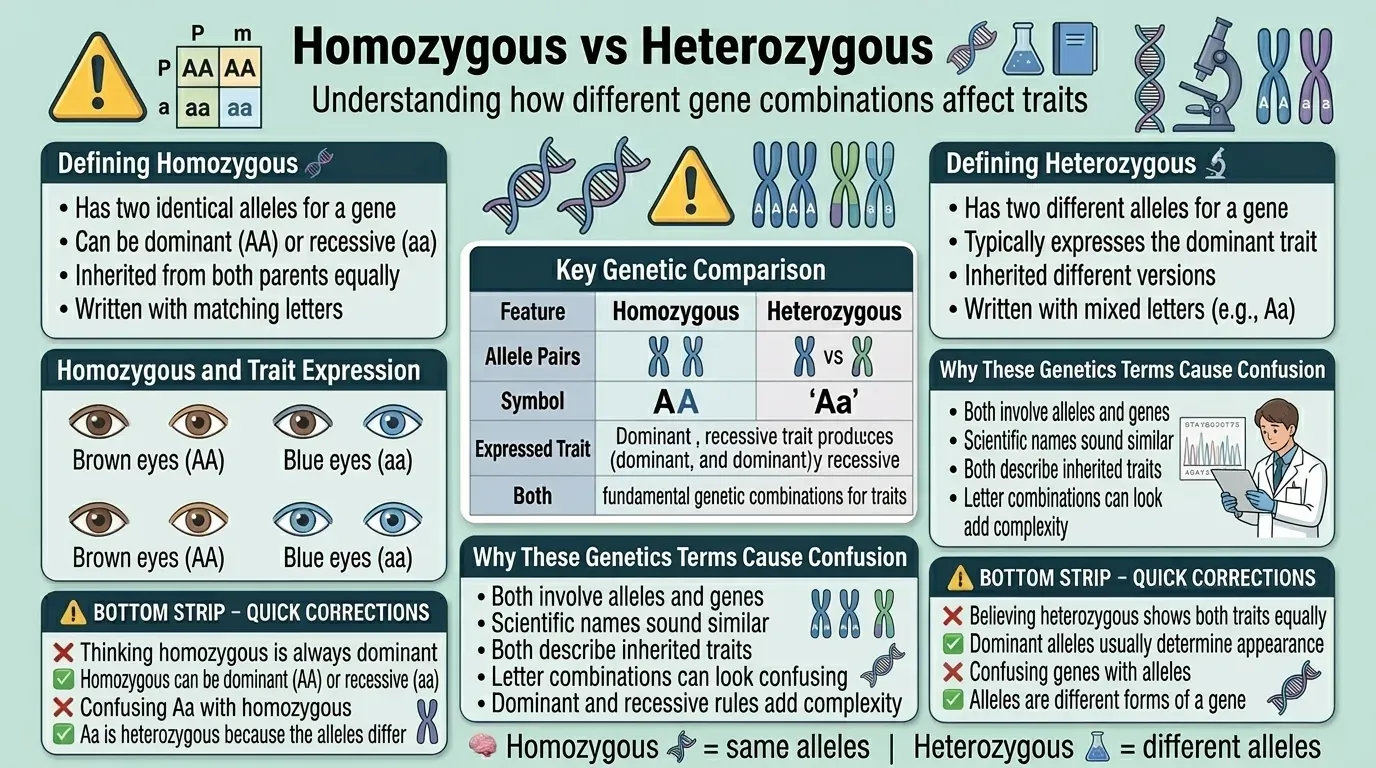
In simple words, homozygous means an organism has two identical alleles for a gene, while heterozygous means it has two different alleles for a gene.
The difference between homozygous and heterozygous is important in genetics, inheritance patterns, dominant and recessive traits, and Punnett square analysis.
This guide explains both terms clearly using real-life examples, inheritance logic, comparison tables, DNA concepts, and expert insights to make genetics easier to understand.
Quick Answer: Difference Between Homozygous and Heterozygous
The main difference between homozygous and heterozygous is the type of alleles inherited for a gene.
- Homozygous means both alleles are the same
- Heterozygous means the alleles are different
For example:
- AA or aa = homozygous
- Aa = heterozygous
Definition of Homozygous and Heterozygous
- Homozygous: Having two identical alleles for a specific gene.
- Heterozygous: Having two different alleles for a specific gene.
Simple Example
- Homozygous = same gene pair
- Heterozygous = mixed gene pair
Pronunciation of Both (US & UK)
| Term | US Pronunciation | UK Pronunciation |
| Homozygous | hoh-moh-zai-gus | hoh-moh-zai-gus |
| Heterozygous | het-er-oh-zai-gus | het-er-oh-zai-gus |
Now let’s understand this clearly through alleles, inheritance, dominant traits, and genetic combinations.
Difference Between Homozygous and Heterozygous Comparison Table
| Feature | Homozygous | Heterozygous | Similarity |
| Alleles | Same alleles | Different alleles | Both involve genes |
| Genetic Combination | AA or aa | Aa | Both inherited from parents |
| Trait Expression | Pure trait | Mixed allele trait | Both affect characteristics |
| Dominant/Recessive Role | Can be dominant or recessive | Usually shows dominant trait | Both influence inheritance |
| Genetic Diversity | Lower | Higher | Both exist naturally |
| Punnett Square Outcome | Identical allele pairing | Different allele pairing | Both used in genetics |
| Example | Blue eyes gene pair | Brown/blue mixed allele pair | Both determine traits |
| Biology Context | Pure breeding traits | Hybrid traits | Both studied in genetics |
This table clearly shows the difference and similarity between homozygous and heterozygous for quick understanding.
Key Differences Explained Between Homozygous and Heterozygous
Allele Combination Difference
The biggest difference involves allele pairing.
- Homozygous = same alleles
- Heterozygous = different alleles
Examples:
- AA = homozygous dominant
- aa = homozygous recessive
- Aa = heterozygous
Trait Expression
In heterozygous combinations, the dominant allele usually controls the visible trait.
A + a \rightarrow A
This simplified relationship shows how dominant alleles often determine appearance.
Genetic Variation
Heterozygous combinations increase genetic diversity within populations.
Homozygous combinations are genetically more uniform.
Dominant and Recessive Traits
Homozygous organisms can express:
- Dominant traits
- Recessive traits
Heterozygous organisms usually express only the dominant trait.
Inheritance Patterns
Genetics studies inheritance patterns through allele combinations passed from parents to offspring.
This became widely understood after the experiments of Gregor Mendel.
Why Do Homozygous and Heterozygous Conditions Exist?
Genes are inherited from both parents. Each parent contributes one allele for many traits. Different allele combinations naturally occur during reproduction, creating variation within populations.
This variation is important for:
- Evolution
- Adaptation
- Biological diversity
- Survival of species
How Homozygous and Heterozygous Genetics Work
Alleles and Genes
Genes contain instructions for traits such as:
- Eye color
- Hair texture
- Blood type
- Height tendencies
Alleles are different versions of the same gene.
Dominant vs Recessive
Some alleles dominate over others.
Example:
- Brown eye allele may dominate blue eye allele.
A heterozygous person may carry both alleles but visibly show only the dominant trait.
Punnett Square Genetics
Punnett squares help predict inheritance probabilities.
Aa \times Aa
This genetic cross can produce:
- AA
- Aa
- aa
Difference Between Homozygous and Heterozygous in Real Life
| Real-Life Example | Homozygous | Heterozygous |
| Eye color inheritance | Same eye-color alleles | Mixed eye-color alleles |
| Plant breeding | Pure breeding plants | Hybrid plants |
| Genetic disorders | Some recessive disorders appear | Carriers may not show disorder |
| Animal breeding | Consistent traits | Trait variation |
Genetic inheritance influences both humans and many other living organisms.
Difference Between Homozygous and Heterozygous in Biology
Homozygous in Biology
Homozygous organisms often produce predictable inherited traits.
This is important in:
- Selective breeding
- Agricultural genetics
- Laboratory research
Heterozygous in Biology
Heterozygous organisms contribute more genetic variation.
This helps populations adapt better to environmental changes.
Modern DNA analysis platforms supported by Google and advanced biotechnology systems help scientists study gene inheritance more accurately than ever.
Real Life Examples with Homozygous and Heterozygous
Flower Color Genetics
A flower with:
- RR = homozygous red
- Rr = heterozygous red
- rr = homozygous recessive
Human Genetic Traits
Certain inherited diseases require homozygous recessive combinations before symptoms appear.
Agriculture
Farmers often use homozygous breeding to maintain stable crop traits.
Animal Breeding
Heterozygous breeding may improve genetic diversity and reduce inherited health risks.
Medical Genetics
Modern genetic testing companies and research organizations analyze allele combinations to study inherited conditions and ancestry patterns.
Difference + Similarity Between Homozygous and Heterozygous
| Feature | Homozygous | Heterozygous | Similarity |
| Alleles | Identical | Different | Both involve paired genes |
| Trait Outcome | Pure trait | Mixed allele trait | Both affect phenotype |
| Genetic Diversity | Lower | Higher | Both inherited from parents |
| Example Forms | AA or aa | Aa | Both studied in heredity |
| Role in Evolution | Stable traits | Variable traits | Both important biologically |
| Inheritance Function | Predictable combinations | Diverse combinations | Both follow genetic rules |
This table clearly shows the difference and similarity between homozygous and heterozygous for quick understanding.
Why People Get Confused Between Homozygous and Heterozygous
Similar Terminology
Both words sound scientific and nearly identical.
Genetics Complexity
Beginners often struggle with allele notation like AA, Aa, and aa.
Dominant and Recessive Confusion
People sometimes incorrectly assume heterozygous means “half trait.”
Classroom Memorization
Students often memorize terms without understanding how inheritance actually works.
Common Mistakes with Homozygous and Heterozygous
| Mistake | Correct Understanding |
| Thinking heterozygous means weak trait | Dominant traits still appear |
| Assuming homozygous always means dominant | It can also be recessive |
| Confusing genes with alleles | Alleles are versions of genes |
| Forgetting parental inheritance | One allele comes from each parent |
| Treating AA and Aa as identical | They represent different combinations |
Quick Memory Tip
- Homo = same
- Hetero = different
When to Use Homozygous or Heterozygous Concepts
Homozygous Concepts Are Important In:
- Genetic disorders
- Pure breeding
- Agricultural genetics
- Biological research
Heterozygous Concepts Are Important In:
- Genetic diversity
- Evolutionary biology
- Inheritance studies
- Population genetics
Both concepts are foundational in modern genetics.
Expert Insight
In real genetics research, understanding homozygous and heterozygous combinations is far more important than simple classroom memorization.
These allele patterns influence inherited diseases, evolutionary adaptation, crop breeding, animal genetics, and personalized medicine.
Most beginners focus only on visible traits, but modern genetics also studies hidden carrier traits that may not appear physically in heterozygous individuals. This becomes especially important in medical genetics and hereditary disease screening.
Advances in DNA sequencing and biotechnology continue improving scientists’ ability to analyze allele combinations, making genetics one of the fastest-growing fields in modern science.
Frequently Asked Questions
What is the main difference between homozygous and heterozygous?
Homozygous means identical alleles, while heterozygous means different alleles.
Is AA homozygous or heterozygous?
AA is homozygous dominant.
Is Aa homozygous?
No. Aa is heterozygous because the alleles differ.
Can homozygous be recessive?
Yes. aa is homozygous recessive.
Why is heterozygous important?
It increases genetic diversity and affects inheritance patterns.
Who discovered inheritance genetics?
Gregor Mendel is considered the founder of modern genetics.
Are humans heterozygous for many traits?
Yes. Humans commonly carry many heterozygous gene combinations.
Why do scientists study allele combinations?
Allele combinations help explain inheritance, evolution, and genetic disorders.
Conclusion
Understanding the difference between homozygous and heterozygous becomes much easier once you understand alleles and inheritance patterns.
Homozygous means having two identical alleles for a gene, while heterozygous means having two different alleles.
These combinations influence trait expression, genetic diversity, inheritance probabilities, and biological variation.
Both concepts are fundamental in genetics because they help explain how characteristics pass from parents to offspring.
Homozygous combinations often produce stable inherited traits, while heterozygous combinations contribute to variation and adaptability within populations.
In real-world biology, these genetic principles influence medicine, agriculture, evolution, breeding, and disease research.
Once you fully understand the difference between homozygous and heterozygous, many advanced genetics topics become far easier to analyze and connect together.
Discover More Articles!
Difference Between Zucchini and Squash:With Examples
Difference Between Magazine and Clip:With Simple Examples

James Whitmore. Labdiff.com is my english grammar comparision website. I explore the history and evolution of English words. I write detailed comparisons explaining why spellings change over time and how British and American English diverged. My articles add depth and credibility to grammar comparison topics.