Many students, biology learners, and science enthusiasts search for the difference between archaea and bacteria because both organisms look very similar under a microscope.
For many years, scientists even grouped them together because they are both single-celled microorganisms without a nucleus.
However, modern biology discovered that archaea and bacteria are fundamentally different in genetics, cell structure, evolution, and survival mechanisms.
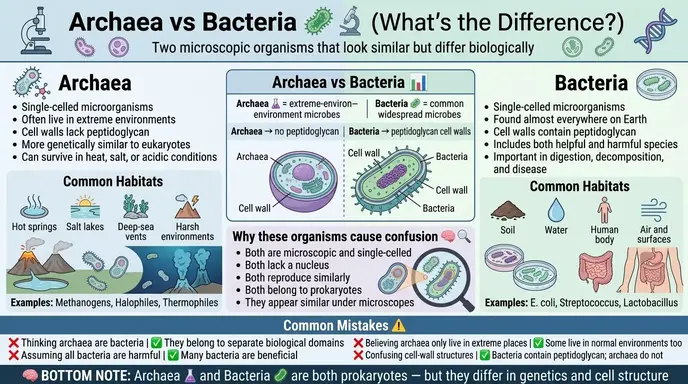
In simple words, bacteria are common microorganisms found almost everywhere, while archaea are unique microorganisms with distinct genetic and biochemical properties that often survive in extreme environments.
The difference between archaea and bacteria becomes especially important in microbiology, evolution, medicine, genetics, and environmental science.
This guide explains archaea and bacteria clearly, including definitions, structure, reproduction, habitats, similarities, real-world examples, scientific discoveries, and expert insights.
Quick Answer: Difference Between Archaea and Bacteria
The main difference between archaea and bacteria is their cellular chemistry and evolutionary origin.
- Bacteria are microorganisms with common prokaryotic cell structures found in everyday environments
- Archaea are genetically distinct microorganisms with unique membranes and molecular systems often adapted to extreme conditions
For example:
Bacteria commonly live in soil and the human body, while some archaea survive in volcanic hot springs or highly salty lakes.
Definition of Archaea and Bacteria
- Archaea: Single-celled microorganisms with unique genetic and biochemical characteristics different from bacteria and eukaryotes.
- Bacteria: Single-celled prokaryotic organisms found in nearly every environment on Earth.
Simple Example
- Bacteria = common microorganisms around us
- Archaea = unique ancient microorganisms with specialized survival systems
Pronunciation of Both (US & UK)
| Term | US Pronunciation | UK Pronunciation |
| Archaea | ar-kee-uh | ar-kee-uh |
| Bacteria | bak-teer-ee-uh | bak-teer-ee-uh |
Now let’s understand this clearly through cell biology, genetics, habitats, and real-world science applications.
Difference Between Archaea and Bacteria Comparison Table
| Feature | Archaea | Bacteria | Similarity |
| Cell Type | Prokaryotic | Prokaryotic | Both lack a nucleus |
| Cell Wall Composition | No peptidoglycan | Usually contains peptidoglycan | Both have protective walls |
| Membrane Structure | Unique lipids | Standard fatty acid lipids | Both have cell membranes |
| Habitat | Often extreme environments | Nearly all environments | Both are microscopic |
| Genetics | More similar to eukaryotes in some processes | Simpler bacterial systems | Both contain DNA |
| Reproduction | Asexual reproduction | Asexual reproduction | Both reproduce rapidly |
| Disease Association | Rarely pathogenic | Many pathogenic species | Both are microorganisms |
| Evolutionary Group | Separate biological domain | Separate biological domain | Both are ancient life forms |
This table clearly shows the difference and similarity between archaea and bacteria for quick understanding.
Key Differences Explained Between Archaea and Bacteria
Cell Wall Difference
One of the biggest differences involves the cell wall.
- Most bacteria contain peptidoglycan in their cell walls
- Archaea do not contain true peptidoglycan
This chemical difference is one reason scientists separated them into different biological domains.
Membrane Structure
Archaeal cell membranes contain unusual lipid bonds that help them survive extreme conditions.
Bacterial membranes use more common fatty acid structures.
Genetic Machinery
Archaea have some genetic systems surprisingly similar to eukaryotes, including humans.
This discovery changed evolutionary biology significantly.
Scientists using advanced genetic analysis tools supported by Google and genomic research databases discovered major molecular differences between archaea and bacteria.
Habitat Differences
Bacteria live almost everywhere:
- Soil
- Water
- Human body
- Food surfaces
Archaea are famous for surviving extreme environments such as:
- Hot springs
- Salt lakes
- Deep-sea vents
- Highly acidic environments
However, some archaea also live in normal environments today.
Disease Relationship
Many bacteria can cause disease in humans.
Examples include:
- Tuberculosis
- Strep throat
- Food poisoning
Archaea are rarely linked to human disease.
Why Do Archaea and Bacteria Exist?
Microorganisms evolved billions of years ago as some of Earth’s earliest life forms. Over time, different survival strategies caused evolutionary separation between bacteria and archaea.
Archaea developed specialized biochemical systems that allowed survival in harsh environments, while bacteria diversified into countless ecological roles across Earth.
How Archaea and Bacteria Work
Energy Production
Both organisms generate energy from chemical reactions, but archaea often use unusual metabolic pathways.
Some archaea produce methane through biological processes called methanogenesis.
Reproduction
Both archaea and bacteria mainly reproduce through binary fission.
1 \rightarrow 2 \rightarrow 4 \rightarrow 8
This simplified pattern shows how microbial populations can multiply rapidly.
Genetic Exchange
Some bacteria exchange genetic material through processes like conjugation.
Archaea also exchange genes but through different mechanisms that scientists still study actively.
Difference Between Archaea and Bacteria in Evolution
| Evolution Feature | Archaea | Bacteria |
| Evolutionary Domain | Archaea | Bacteria |
| Similarity to Eukaryotes | Higher in some systems | Lower |
| Ancient Origins | Extremely ancient | Extremely ancient |
| Genetic Complexity | More complex molecular machinery | Simpler molecular systems |
Modern evolutionary research suggests archaea may share important ancestry connections with eukaryotic organisms.
Difference Between Archaea and Bacteria in Real Life
Human Digestion
Certain archaea live inside the human digestive system and help process gases.
Food and Medicine
Bacteria play major roles in:
- Yogurt production
- Antibiotics
- Fermentation
- Human infections
Extreme Environment Research
Scientists study archaea to understand how life may survive on other planets.
Organizations like NASA research extremophile archaea for astrobiology insights.
Biotechnology
Bacterial enzymes and archaeal enzymes are widely used in laboratories and industrial science.
DNA Research
Modern genetic sequencing platforms and bioinformatics systems supported by Microsoft and scientific cloud computing help researchers analyze microbial genomes faster than ever.
Difference + Similarity Between Archaea and Bacteria
| Feature | Archaea | Bacteria | Similarity |
| Cell Structure | Prokaryotic | Prokaryotic | Both lack nucleus |
| DNA Presence | Yes | Yes | Both use genetic material |
| Reproduction | Binary fission | Binary fission | Both reproduce asexually |
| Cell Wall | Unique composition | Peptidoglycan walls | Both protected by walls |
| Habitats | Often extreme | Extremely widespread | Both microscopic organisms |
| Scientific Importance | Evolutionary research | Medical and industrial research | Both vital in biology |
This table clearly shows the difference and similarity between archaea and bacteria for quick understanding.
Why People Get Confused Between Archaea and Bacteria
Similar Appearance
Under microscopes, both look like simple prokaryotic cells.
Both Lack a Nucleus
Since both are prokaryotes, many textbooks initially group them together.
Historical Classification
Scientists originally classified archaea as bacteria before advanced genetic studies revealed major differences.
Complex Scientific Terminology
Biochemical differences can seem difficult for beginners to visualize.
Common Mistakes with Archaea and Bacteria
| Mistake | Correct Understanding |
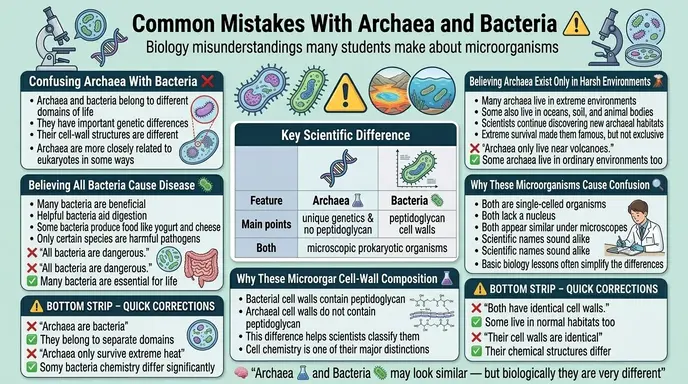
| Thinking archaea are bacteria | They belong to different domains |
| Assuming all archaea live in extreme places | Some live in normal environments |
| Believing bacteria are always harmful | Many bacteria are beneficial |
| Ignoring membrane differences | Membrane chemistry is important |
| Assuming prokaryotes are identical | Major molecular differences exist |
Quick Memory Tip
- Bacteria = common prokaryotes
- Archaea = unique ancient prokaryotes with specialized chemistry
When to Study Archaea or Bacteria
Study Bacteria When:
- Learning about disease
- Studying antibiotics
- Exploring fermentation
- Understanding microbiomes
Study Archaea When:
- Studying evolution
- Researching extreme environments
- Exploring astrobiology
- Investigating ancient life forms
Both groups are extremely important in modern biology and biotechnology.
Expert Insight
One of the most important discoveries in microbiology was realizing that archaea are not simply unusual bacteria.
Genetic sequencing revealed that archaea possess molecular systems surprisingly closer to eukaryotes in several ways, which completely changed scientific understanding of evolutionary history.
In practical research, bacteria receive more public attention because of their role in disease and medicine, but archaea are equally important for understanding how life adapts to extreme conditions.
Their unique enzymes and survival systems are valuable in biotechnology, industrial science, and even space research.
Modern microbiology increasingly studies both groups together because they influence ecosystems, climate systems, digestion, and evolutionary biology on a global scale.
Frequently Asked Questions
What is the main difference between archaea and bacteria?
Archaea have unique genetics and membrane chemistry different from bacteria.
Are archaea bacteria?
No. Archaea belong to a separate biological domain.
Do archaea cause disease?
Archaea are rarely associated with human disease.
Where do archaea live?
Many live in extreme environments, though some live in ordinary habitats.
Are bacteria harmful?
Some are harmful, but many bacteria are beneficial and essential for life.
Why are archaea important?
They help scientists understand evolution, extreme survival, and biotechnology.
Do archaea and bacteria have nuclei?
No. Both are prokaryotes without nuclei.
Which came first, archaea or bacteria?
Both evolved extremely early in Earth’s history, and scientists still study their evolutionary relationships.
Conclusion
Understanding the difference between archaea and bacteria becomes much easier once you focus on their molecular biology, evolutionary history, and cellular chemistry.
Although both are prokaryotic microorganisms without nuclei, they differ significantly in membrane structure, genetic systems, cell wall composition, and environmental adaptation.
Bacteria are widespread microorganisms that play major roles in medicine, digestion, industry, and ecosystems.
Archaea, meanwhile, are unique ancient organisms known for unusual biochemical systems and remarkable survival abilities in extreme conditions.
Modern genetic research revealed that archaea are fundamentally different from bacteria, leading scientists to classify them into separate biological domains.
In real-world science, both groups are incredibly important for microbiology, biotechnology, environmental research, and evolutionary studies.
Once you fully understand the difference between archaea and bacteria, many advanced biology concepts become much easier to understand and connect together.
Discover More Articles!
Difference Between Diamond and Moissanite:With Examples
Difference Between Zucchini and Squash:With Examples

James Whitmore. Labdiff.com is my english grammar comparision website. I explore the history and evolution of English words. I write detailed comparisons explaining why spellings change over time and how British and American English diverged. My articles add depth and credibility to grammar comparison topics.