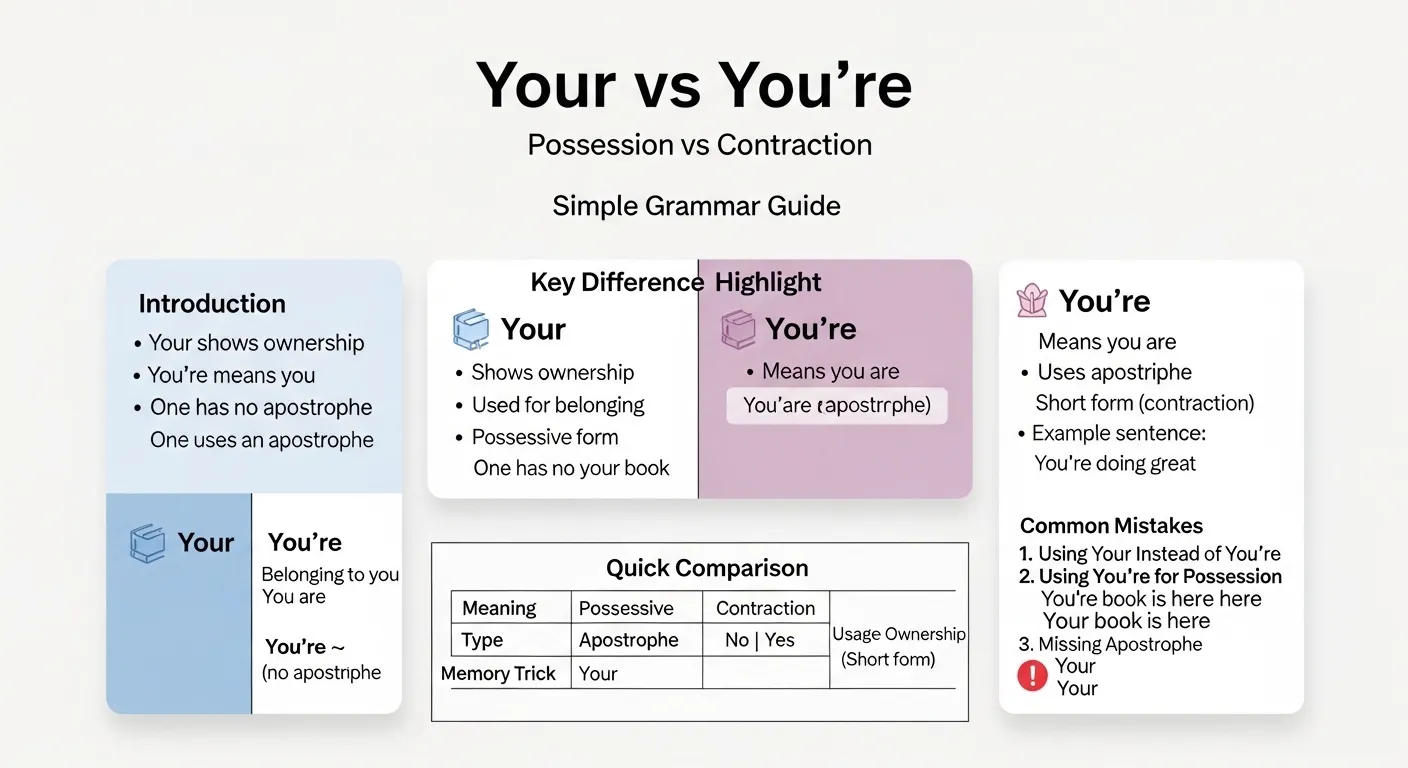
Many users get confused about the difference between your and you’re with examples because both words sound the same in spoken English.
You’ll often see mistakes in emails, school assignments, and even posts on platforms like Google Docs or Instagram captions.
In simple words, the difference between your and you’re with examples comes down to ownership vs contraction.
One shows possession, while the other is a short form of two words. Once you understand this basic logic, you’ll never mix them again.
In this guide, you’ll learn meanings, rules, examples, mistakes, and real life usage everything in one place so you don’t need another article.
🟢 Quick Answer: Difference Between Your and You’re With Examples
Your shows possession (something belongs to you).
You’re is a short form of “you are.”
👉 Example:
- This is your book.
- You’re very kind.
🟢 Definition of Your and You’re
- Your: A possessive adjective used to show ownership.
- You’re: A contraction of “you are.”
👉 Quick clarity:
If you can replace it with “you are,” then you’re is correct.
🟢 Pronunciation (US & UK)
Both words sound almost the same:
- Your: /jʊr/ (US), /jɔː/ (UK)
- You’re: /jʊr/ (US), /jɔː/ (UK)
👉 That’s why confusion happens the meaning depends on grammar, not sound.
🟢 Comparison Table: Your vs You’re
| Feature | Your | You’re | Similarity |
| Meaning | Shows ownership | Means “you are” | Sound the same |
| Type | Possessive adjective | Contraction | Used in daily English |
| Usage | Before a noun | Before verb/adjective | Common in writing |
| Example | Your phone is ringing | You’re late again | Used in sentences |
| Grammar Role | Modifier | Subject + verb | Often confused |
| Context | Belonging | Action/state | Everyday usage |
🟢 Key Differences Explained Between Your and You’re With Examples
1. Ownership vs Action
- Your = something belongs to you
- You’re = you are doing something
👉 Example: Your car is fast. / You’re driving fast.
2. Grammar Role
- “Your” modifies a noun
- “You’re” acts like a subject + verb
👉 Example: Your idea is great. / You’re amazing.
3. Replacement Trick
- Replace with “you are”
👉 If it fits → use you’re
👉 Example: You’re happy (You are happy ✔)
4. Sentence Structure
- “Your” always comes before a noun
👉 Example: Your bag is here.
5. Common Writing Usage
Seen in emails, blogs, school work, and even tools like Google Docs and messaging apps.
🟢 Difference and Similarity Table
| Feature | Your | You’re | Similarity |
| Meaning | Ownership | “You are” | Similar pronunciation |
| Grammar | Adjective | Contraction | Basic English words |
| Usage Area | Objects/people | Actions/states | Daily communication |
| Example | Your house | You’re home | Used in sentences |
| Confusion Reason | Sound | Sound | Homophones |
This table clearly shows the difference and similarity between your and you’re with examples for quick understanding.
🟢 Common Mistakes with Your and You’re
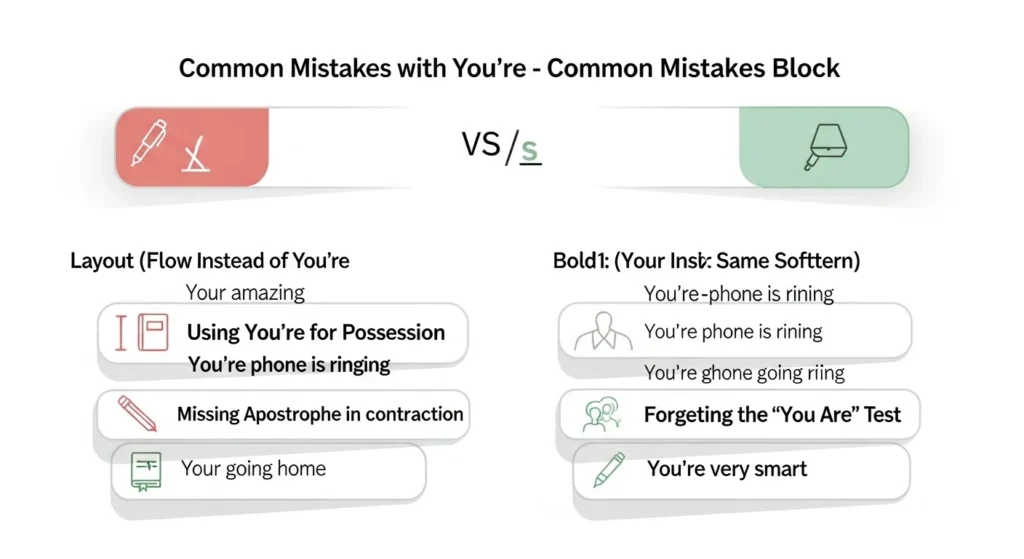
❌ 1. Wrong contraction use
“Your welcome.”
✔ Correct: You’re welcome
❌ 2. Wrong possession use
“You’re book is here.”
✔ Correct: Your book is here
❌ 3. Social media mistakes
Fast typing leads to mixing both words.
❌ 4. Ignoring grammar rules
People rely on sound instead of meaning.
❌ 5. Auto-correct confusion
Sometimes even smart tools don’t fix context.
🟢 Real-Life Examples with Your and You’re
📌 Personal Use
- Your shoes are dirty.
- You’re looking tired.
📌 Academic Use
- Your assignment is due tomorrow.
- You’re improving in English.
Business Use
- Your report is ready.
- You’re doing great work.
Social Media Use
- Your post looks amazing.
- You’re trending today.
🟢 When to Use Each
Use Your when:
- Showing ownership
- Talking about something that belongs to someone
Use You’re when:
- You mean “you are”
- Describing a person or action
🟢 Why People Get Confused
The confusion in the difference between your and you’re with examples happens because:
- Both sound identical
- English spelling rules are tricky
- Informal texting habits
- Lack of grammar awareness
- Fast typing on phones
🟢 How Search Engines Understand Your vs You’re
Search engines like Google use NLP (Natural Language Processing) to detect intent:
- “Your” → ownership-related queries
- “You’re” → action or state
That’s why when users search for the difference between your and you’re with examples, Google shows grammar guides, comparisons, and examples.
🟢 Expert Insight
In real-world communication, small grammar mistakes like confusing your and you’re can impact professionalism. In emails, job applications, or academic writing, such errors can reduce credibility.
Language experts recommend using the “you are” test regularly. Over time, your brain automatically recognizes the correct usage without thinking.
🟢 FAQ:
1. What is the difference between your and you’re?
Your shows ownership; you’re means “you are.”
2. How can I remember the difference?
Use the “you are” test.
3. Is “your welcome” correct?
No, correct is “you’re welcome.”
4. Are your and you’re homophones?
Yes, they sound the same.
5. Can they be used interchangeably?
No, meanings are completely different.
6. Where are they used most?
In writing, emails, and social media.
🟢 Conclusion
Understanding the difference between your and you’re with examples is essential for correct English writing.
While both words sound the same, their meanings are completely different. “Your” shows possession, and “you’re” means “you are.”
In everyday life If you’re writing emails, posting on social media, or doing school work using the correct word improves clarity and professionalism.
Many users struggle because of pronunciation, but with simple tricks like replacing with “you are,” the confusion disappears.
With practice, this small grammar rule becomes natural. And once you master it, your writing instantly looks more polished and accurate.
Discover More Articals!
Difference Between Mono and Strep: Symptoms, Causes & Treatment
Difference Between Affect and Effect (Simple Words + Examples)

James Whitmore. Labdiff.com is my english grammar comparision website. I explore the history and evolution of English words. I write detailed comparisons explaining why spellings change over time and how British and American English diverged. My articles add depth and credibility to grammar comparison topics.