Many car buyers and drivers search for the difference between AWD and FWD when choosing a vehicle for daily driving, bad weather, fuel efficiency, or road performance.
Since both systems send power to the wheels differently, beginners often get confused about which one is better for snow, rain, highways, or city driving.
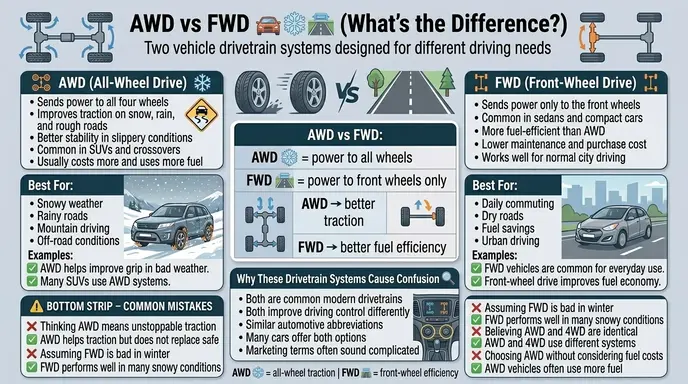
In simple words, AWD (All Wheel Drive) sends power to all four wheels for better traction and stability, while FWD (Front Wheel Drive) sends power only to the front wheels for better fuel economy and simpler everyday driving.
The difference between AWD and FWD becomes especially important when driving in snow, wet roads, mountains, or fuel conscious urban environments.
This guide explains AWD and FWD clearly, including definitions, traction systems, fuel economy, weather performance, maintenance costs, similarities, real life examples, and expert driving insights.
Quick Answer: Difference Between AWD and FWD
The main difference between AWD and FWD is how engine power is delivered to the wheels.
- AWD (All Wheel Drive) powers all four wheels for improved traction and control
- FWD (Front Wheel Drive) powers only the front wheels for efficiency and lower operating costs
For example:
An AWD SUV performs better on snowy roads, while a FWD sedan is often more fuel efficient for daily city driving.
Definition of AWD and FWD
- AWD (All Wheel Drive): A drivetrain system that automatically sends power to all four wheels for better traction and stability.
- FWD (Front Wheel Drive): A drivetrain system where the engine powers only the front wheels.
Simple Example
- AWD = all four wheels help move the car
- FWD = only front wheels drive the car
Pronunciation of Both (US & UK)
| System | US Pronunciation | UK Pronunciation |
| AWD | ay double u dee | ay double u dee |
| FWD | ef double u dee | ef double u dee |
Now let’s understand this clearly through traction systems, road conditions, fuel efficiency, and driving performance.
Difference Between AWD and FWD Comparison Table
| Feature | AWD | FWD | Similarity |
| Powered Wheels | All four wheels | Front wheels only | Both move the vehicle |
| Traction | Higher traction | Moderate traction | Both support daily driving |
| Snow Performance | Better | Acceptable in mild snow | Both usable in winter |
| Fuel Economy | Usually lower | Usually higher | Both use gasoline or hybrid systems |
| Maintenance Cost | Higher | Lower | Both require maintenance |
| Vehicle Type | SUVs and crossovers common | Sedans and compact cars common | Both available in many vehicles |
| Driving Stability | Better on slippery roads | Better in lightweight city driving | Both improve road control |
| Complexity | More mechanical parts | Simpler system | Both are drivetrain systems |
This table clearly shows the difference and similarity between AWD and FWD for quick understanding.
Key Differences Explained Between AWD and FWD
Power Distribution
The biggest difference is how power reaches the wheels.
- AWD distributes power to all four wheels
- FWD sends power only to the front wheels
This changes traction, handling, and driving behavior.
Traction and Road Grip
AWD provides stronger traction on:
- Snow
- Ice
- Mud
- Wet roads
FWD performs well in normal weather but may struggle more in slippery conditions.
Fuel Efficiency
FWD vehicles usually get better fuel economy because:
- The drivetrain is lighter
- Fewer moving parts reduce energy loss
Fuel\ Efficiency \propto \frac{1}{Vehicle\ Weight}
This simplified relationship shows how heavier systems can reduce efficiency.
Vehicle Weight and Complexity
AWD systems add:
- Extra driveshafts
- Differentials
- Mechanical components
This increases:
- Vehicle weight
- Maintenance complexity
- Repair costs
Driving Feel
FWD cars often feel lighter and easier to maneuver in city traffic.
AWD vehicles usually feel more stable during difficult road conditions.
Why Do AWD and FWD Systems Exist?
Different driving environments require different traction systems. Urban commuters often prioritize fuel economy and affordability, while drivers in snowy or mountainous areas need better traction and stability.
Car manufacturers design drivetrain systems to match different weather conditions, budgets, and driving preferences.
How AWD Works
Automatic Power Distribution
AWD systems automatically send power where traction is needed most.
For example:
- If one wheel slips on ice, power shifts to wheels with better grip.
Better Stability
AWD improves:
- Cornering stability
- Wet road control
- Off road traction
Vehicles like the Subaru Outback are well known for AWD performance in snowy climates.
Common AWD Vehicles
AWD is common in:
- SUVs
- Crossovers
- Luxury vehicles
- Performance cars
How FWD Works
Front Wheel Power
In FWD vehicles, the front wheels:
- Pull the vehicle forward
- Handle steering and driving force
Simpler Engineering
FWD systems require fewer drivetrain components, making them:
- Lighter
- Cheaper
- Easier to maintain
Everyday Efficiency
FWD is ideal for:
- City commuting
- Highway driving
- Warm climates
Popular FWD vehicles include models like the Honda Civic and Toyota Corolla.
Difference Between AWD and FWD in Real Life
| Driving Situation | AWD | FWD |
| Snowy roads | Better traction | Moderate traction |
| Heavy rain | Strong stability | Good for normal driving |
| Fuel savings | Lower efficiency | Better efficiency |
| Off road driving | Better capability | Limited capability |
| Daily commuting | Good but costlier | Excellent and affordable |
Most drivers choose based on climate, budget, and driving habits.
Difference Between AWD and FWD in Winter Driving
AWD Winter Benefits
AWD improves:
- Snow acceleration
- Slippery road control
- Hill climbing in winter
FWD Winter Performance
FWD still performs reasonably well because engine weight sits above the front wheels, improving grip.
However, AWD generally handles severe winter conditions better.
Tire Importance
Even with AWD, proper winter tires remain extremely important for safety.
Real Life Examples with AWD and FWD
City Driving
FWD vehicles are popular in cities because of:
- Lower cost
- Better mileage
- Easier maintenance
Mountain Regions
Drivers in snowy regions often prefer AWD SUVs for improved traction.
Family Crossovers
Many modern crossovers from Toyota and Honda offer both AWD and FWD versions depending on buyer needs.
Performance Vehicles
Some sports cars use AWD to improve acceleration and handling.
Online Car Research
Automotive reviews on YouTube frequently compare AWD and FWD driving tests in rain and snow.
Difference + Similarity Between AWD and FWD
| Feature | AWD | FWD | Similarity |
| Drive Wheels | Four wheels | Front wheels | Both provide mobility |
| Fuel Economy | Lower | Higher | Both available in modern cars |
| Weather Handling | Better in bad weather | Good in normal weather | Both used worldwide |
| Cost | Higher | Lower | Both require maintenance |
| Daily Use | Excellent versatility | Excellent efficiency | Both practical for drivers |
| Technology | More complex | Simpler | Both improve transportation |
This table clearly shows the difference and similarity between AWD and FWD for quick understanding.
Why People Get Confused Between AWD and FWD
Similar Vehicle Appearance
Cars with AWD and FWD may look almost identical externally.
Marketing Terms
Manufacturers use many drivetrain terms like:
- AWD
- 4WD
- FWD
- RWD
This creates confusion for beginners.
Modern Electronic Systems
Traction control and stability systems sometimes make FWD vehicles feel more capable than older models.
Mixed Online Advice
Different climates and driving needs lead to conflicting recommendations online.
Common Mistakes with AWD and FWD
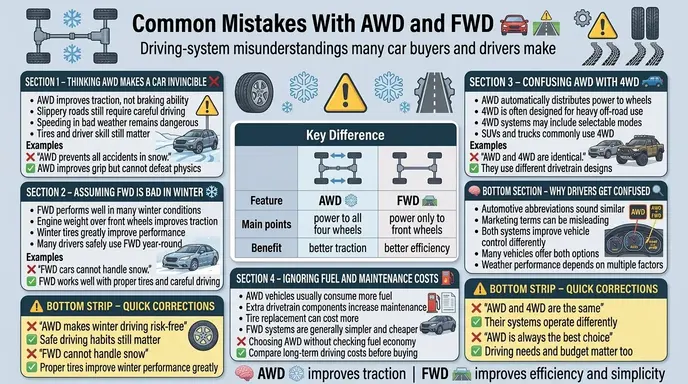
| Mistake | Correct Understanding |
| Thinking AWD improves braking | Tires and brakes matter more |
| Assuming AWD is always necessary | Many drivers do fine with FWD |
| Ignoring fuel economy differences | AWD often uses more fuel |
| Confusing AWD with 4WD | They operate differently |
| Believing AWD replaces winter tires | Proper tires are still essential |
Quick Memory Tip
- AWD = all wheels powered
- FWD = front wheels powered
When to Choose AWD or FWD
Choose AWD When:
- You drive in snow or mountains
- Roads are frequently slippery
- You want maximum traction
- You drive off road occasionally
Choose FWD When:
- Fuel economy matters most
- You mainly drive in cities
- Weather conditions are mild
- You want lower maintenance costs
The best choice depends on climate, driving style, and budget.
Expert Insight
In real world driving, many people overestimate how much AWD alone improves safety. AWD mainly helps vehicles accelerate and maintain traction, especially in snow or rain, but it does not automatically shorten braking distance. Tires, driver behavior, and road conditions remain extremely important.
For most urban drivers, modern FWD vehicles provide excellent reliability, fuel efficiency, and daily practicality.
However, drivers in snowy climates often appreciate the added confidence AWD provides during winter weather and steep road driving.
Automakers increasingly offer both systems across the same vehicle lineup because modern consumers have very different driving needs depending on geography and lifestyle.
Frequently Asked Questions
What is the main difference between AWD and FWD?
AWD powers all four wheels, while FWD powers only the front wheels.
Is AWD better than FWD in snow?
Yes. AWD generally provides better traction and stability in snow.
Does AWD use more fuel?
Usually yes, because AWD systems add weight and drivetrain complexity.
Is FWD good for daily driving?
Yes. FWD is highly practical for commuting and city driving.
Is AWD the same as 4WD?
No. AWD and 4WD operate differently and serve different purposes.
Which is cheaper to maintain, AWD or FWD?
FWD is usually cheaper to maintain.
Do AWD vehicles need winter tires?
Yes. Winter tires are still important for maximum safety.
Why do SUVs often use AWD?
AWD improves traction, stability, and versatility in different road conditions.
Conclusion
Understanding the difference between AWD and FWD helps drivers choose the right vehicle for their climate, budget, and driving habits.
AWD systems power all four wheels for improved traction and stability, especially in snow, rain, and rough road conditions.
FWD systems power only the front wheels, offering better fuel efficiency, lower maintenance costs, and practical everyday driving performance.
Both drivetrain systems have advantages depending on real world needs. AWD is valuable for difficult weather and increased traction, while FWD remains highly efficient and affordable for most commuters and city drivers.
Modern vehicles continue improving both technologies through advanced traction control, safety systems, and fuel saving engineering.
Once you fully understand the difference between AWD and FWD, choosing the right car becomes easier, more practical, and better aligned with your driving environment.
Discover More Articles!
Difference Between Zucchini and Squash:With Examples
Difference Between Magazine and Clip:With Simple Examples

labdiff.com is my English grammar comparison website where I simplify confusing words, spelling differences, and usage rules through clear explanations and examples. My goal is to help learners, writers, and students understand English easily and use correct grammar with confidence.