Many English learners, students, writers, and professionals search for who vs whom differences because these two pronouns often cause confusion.
They look similar and refer to people, but they serve different grammatical purposes in a sentence.
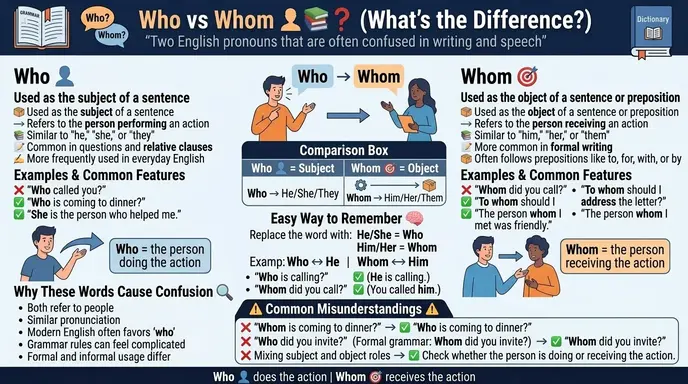
In simple words, who is used as the subject of a sentence, while whom is used as the object of a verb or preposition.
Understanding the difference between who and whom can make your writing more accurate and professional, especially in formal communication.
This guide explains who vs whom differences clearly, including definitions, grammar rules, examples, common mistakes, real-life usage, and simple tricks to remember the correct choice.
Quick Answer: Who vs Whom Differences
The main difference between who and whom is their grammatical role.
- Who = subject (the person doing the action)
- Whom = object (the person receiving the action)
Simple Example
✅ Who called you?
(Who is performing the action.)
✅ Whom did you call?
(Whom is receiving the action.)
A quick trick:
- If you can replace the word with they, use who.
- If you can replace the word with him/her, use whom.
Definition of Who and Whom
- Who: A pronoun used as the subject of a sentence or clause.
- Whom: A pronoun used as the object of a verb or preposition.
Quick Definitions
Who: The person performing the action.
Whom: The person receiving the action.
Example
- Who wrote the email?
- Whom did you email?
Pronunciation of Both (US & UK)
| Term | US Pronunciation | UK Pronunciation |
| Who | hoo | hoo |
| Whom | hoom | hoom |
Now let’s understand the grammar behind who and whom.
Who vs Whom Comparison Table
| Feature | Who | Whom | Similarity |
| Grammar Role | Subject | Object | Both refer to people |
| Action Relationship | Performs action | Receives action | Both are pronouns |
| Formality | Common in speech | More formal | Both are grammatically correct |
| Replacement Test | He/She | Him/Her | Both identify people |
| Modern Usage | Very common | Less common | Used in English writing |
| Question Usage | Who is coming? | Whom did you invite? | Both ask about people |
| Sentence Position | Subject position | Object position | Same overall purpose |
| Academic Writing | Common | Common in formal writing | Both accepted |
This table clearly shows the difference and similarity between who and whom for quick understanding.
Key Differences Explained Between Who and Whom
Subject vs Object
The most important difference is grammatical function.
Who acts as the subject.
Example:
✅ Who ate the cake?
Here, “who” is doing the eating.
Whom acts as the object.
Example:
✅ Whom did you invite?
Here, “whom” receives the action of being invited.
They vs Him/Her Trick
One of the easiest ways to choose correctly is the substitution test.
If the answer would be:
- they → use Who
- Him or Her → use Whom
Example:
Who called?
Answer:
“He called.”
Therefore, use who.
Example:
Whom did you call?
Answer:
“I called him.”
Therefore, use whom.
Formal vs Informal English
In modern spoken English, many people use who instead of whom.
Example:
Informal:
✅ Who did you invite?
Formal:
✅ Whom did you invite?
Both are widely understood, but the second is more grammatically traditional.
Why Do Who and Whom Exist?
English inherited these forms from older grammatical systems that distinguished subjects and objects more clearly.
Similar distinctions still exist today:
- He → Him
- She → Her
- They → Them
- Who → Whom
The purpose is to show the role a person plays in a sentence.
How Who Works
Used as the Subject
Who performs the action.
Examples:
✅ Who opened the door?
✅ Who wants pizza?
Who is speaking?
In each sentence, the person is doing something.
Used in Relative Clauses
Examples:
✅ The teacher who helped me was kind.
✅ The student who won the award was excited.
The person performs the action.
How Whom Works
Used as the Object
Whom receives the action.
Examples:
✅ Whom did you meet?
✅ Whom are you calling?
Used After Prepositions
Examples:
✅ To whom should I send the letter?
✅ With whom are you traveling?
Formal writing often preserves whom after prepositions.
Who vs Whom in Everyday English
Casual Conversation
Most native speakers commonly use “who.”
Example:
✅ Who are you talking to?
Although “whom” may be technically correct, “who” sounds more natural in everyday speech.
Academic Writing
Formal writing often follows traditional grammar rules.
Example:
✅ The applicant whom we interviewed was qualified.
Business Communication
Professional emails may occasionally use whom.
Example:
✅ To whom it may concern
This remains one of the most common uses of whom today.
Who vs Whom in Questions
Using Who
Examples:
- Who called?
- Who won the game?
- Who wants coffee?
Using Whom
Examples:
- Whom did you call?
- Whom should we contact?
- Whom did they select?
The distinction depends on subject versus object.
Difference + Similarity Between Who and Whom
| Feature | Who | Whom | Similarity |
| Refers to People | Yes | Yes | Same purpose |
| Subject Role | Yes | No | Both are pronouns |
| Object Role | No | Yes | Both identify people |
| Common in Speech | Very common | Less common | Both understood |
| Formal Writing | Yes | Yes | Accepted grammar |
| Question Formation | Yes | Yes | Used in questions |
This table clearly shows the difference and similarity between who and whom for quick understanding.
Real Life Examples with Who and Whom
Example 1
✅ Who sent the package?
The person performed the action.
Example 2
✅ Whom did you send the package to?
The person received the action.
Example 3
✅ Who is responsible for this project?
The person is the subject.
Example 4
✅ With whom are you meeting today?
The person is the object of the preposition “with.”
Example 5
✅ To whom should I address this letter?
A common formal business phrase.
Common Mistakes with Who and Whom
Using Whom as a Subject
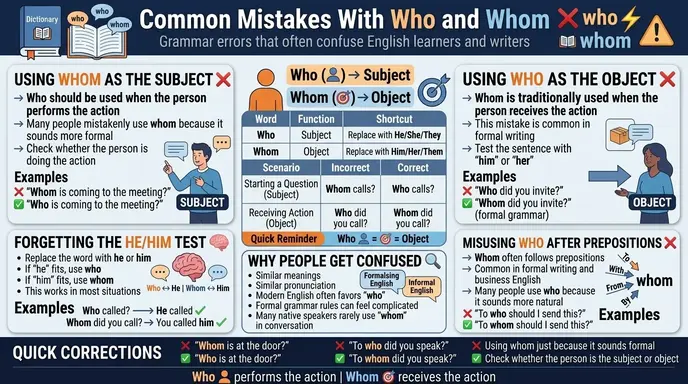
❌ Whom called you?
✅ Who called you?
Using Who as an Object in Formal Writing
Informal:
✅ Who did you invite?
Formal:
✅ Whom did you invite?
Overusing Whom
Many learners try to sound formal by using whom everywhere.
This often creates mistakes.
Forgetting the He/Him Test
The simplest solution is often the substitution method.
Quick Memory Tip
- they = Who
- Him/Her = Whom
When to Use Each
Use Who When:
- The person performs the action.
- The pronoun acts as a subject.
- Writing casual English.
- Asking who did something.
Examples:
- Who called?
- Who won?
Use Whom When:
- The person receives the action.
- The pronoun acts as an object.
- Writing formal English.
- Following a preposition.
Examples:
- Whom did you call?
- To whom should I write?
Why People Get Confused Between Who and Whom
Similar Meaning
Both refer to people.
Modern Usage Changes
Many native speakers rarely use whom in conversation.
Grammar Terminology
Subject and object rules can feel confusing to beginners.
Informal Language Trends
Modern English increasingly favors who in many situations where whom was once required.
Expert Insight
From a practical writing perspective, understanding the difference between who and whom is useful, but modern English is becoming more flexible. In everyday speech, native speakers often use “who” even when traditional grammar suggests “whom.”
However, formal writing, academic work, legal documents, and professional communication still benefit from using whom correctly.
In real-world situations, clarity matters more than sounding overly formal. Most beginners improve quickly once they learn the simple they versus him/her test. This remains one of the most reliable grammar shortcuts for distinguishing who from whom.
Frequently Asked Questions
What is the main difference between who and whom?
Who is used as a subject, while whom is used as an object.
Is whom still used today?
Yes, especially in formal writing and professional communication.
Why do people rarely use whom?
Modern spoken English often favors who because it sounds more natural.
How can I remember who vs whom?
Use they versus him/her substitution test.
Is “Who did you call?” wrong?
No. It is widely accepted in everyday English.
What does “To whom it may concern” mean?
It is a formal phrase used when the recipient is unknown.
Can I always replace whom with who?
In casual speech, often yes. In formal writing, not always.
Which is more common in modern English?
Who is much more common than whom.
Conclusion
Understanding who vs whom differences becomes much easier when you focus on one key rule: who is the subject, and whom is the object. If the person is performing the action, use who. If the person is receiving the action, use whom. The simple they versus him/her test can help you choose correctly in almost every situation.
Although modern English increasingly favors who in everyday conversation, whom still plays an important role in formal writing, professional communication, academic work, and traditional grammar. Knowing when to use each helps improve clarity, accuracy, and confidence in your writing.
If you’re writing an email, preparing a report, or improving your English skills, mastering the difference between who and whom will make your communication more polished and grammatically correct.
Discover More Articles!
Difference Between HDMI and DisplayPort: With Simple Examples
British vs American English: A Complete Guide for Learners
Affect vs Effect: What’s the Difference? Complete Grammar Guide

James Whitmore. Labdiff.com is my english grammar comparision website. I explore the history and evolution of English words. I write detailed comparisons explaining why spellings change over time and how British and American English diverged. My articles add depth and credibility to grammar comparison topics.