“Affect” and “effect” are among the most commonly confused words in English. They look similar, sound somewhat alike, and are closely related in meaning.
However, they serve different grammatical functions and should not be used interchangeably.
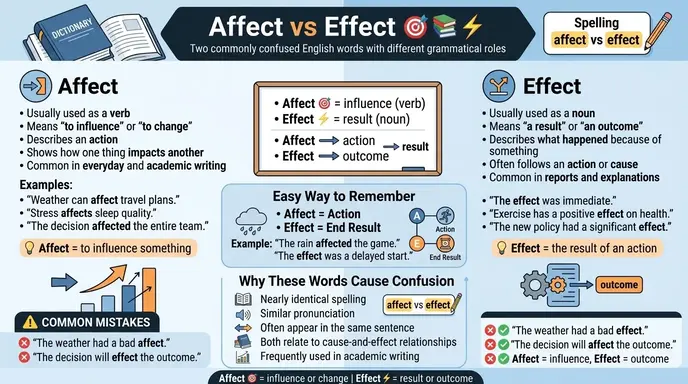
In most cases, affect is a verb meaning to influence or change something, while effect is a noun meaning a result or consequence.
Strong rule:
Affect = Action (Verb) | Effect = End Result (Noun)
People often search:
- affect vs effect
- difference between affect and effect
- when to use affect
- when to use effect
- affect or effect examples
This guide explains the meanings, grammar rules, examples, memory tricks, common mistakes, FAQs, and usage tips so you can confidently choose the correct word every time.
Affect vs Effect: Quick Answer ✅
The simplest difference is:
| Word | Usually Functions As | Meaning |
| Affect | Verb | To influence or change something |
| Effect | Noun | The result of a change |
Examples
✅ Lack of sleep can affect your concentration.
✅ The effect of lack of sleep can be serious.
👉 In the first sentence, affect is the action.
👉 In the second sentence, effect is the result.
What Does Affect Mean?
Affect is usually a verb that means:
- to influence
- to impact
- to change
- to alter
Examples
✅ Weather can affect travel plans.
✅ Stress affects mental health.
The new policy affected employee productivity.
Influence concept:
Cause→Affect→Change\text{Cause} \rightarrow \text{Affect} \rightarrow \text{Change}Cause→Affect→Change
Affect in Everyday Life
You use affect when something changes or influences something else.
Examples
✅ Exercise affects energy levels.
✅ Social media affects communication habits.
Rising prices affect consumer spending.
Affect in Business
Businesses often discuss factors that affect performance.
Examples
✅ Inflation affects purchasing power.
✅ Market trends affect investment decisions.
What Does Effect Mean?
Effect is usually a noun that means:
- result
- consequence
- outcome
- impact
Examples
✅ The effect of the medicine was immediate.
✅ The new law had a positive effect.
Climate change has significant effects worldwide.
Result concept:
Cause→Effect\text{Cause} \rightarrow \text{Effect}Cause→Effect
Effect in Everyday Life
Examples
✅ The effect of caffeine varies from person to person.
✅ One effect of exercise is improved health.
The effect was noticeable within days.
Effect in Science
Scientists frequently discuss effects and outcomes.
Examples
✅ Researchers studied the effect of sunlight on plant growth.
✅ The greenhouse effect influences Earth’s temperature.
Scientific concept example:
Greenhouse Effect
Affect vs Effect: The Core Difference
Quick Formula
Affect = Influence
Effect = Result
Example
✅ The storm affected traffic.
✅ The effect of the storm was widespread delays.
In the first sentence:
- affect = action
In the second:
- effect = result
Comparison Table
| Feature | Affect | Effect |
| Usually a Verb | ✔ | ❌ |
| Usually a Noun | ❌ | ✔ |
| Means Influence | ✔ | ❌ |
| Means Result | ❌ | ✔ |
| Example | Affect a decision | Effect of a decision |
Why People Confuse Affect and Effect
Similar Spelling
Only one letter differs.
- affect
- effect
Related Meanings
The words often appear together.
Example:
✅ Smoking affects health.
✅ The effect of smoking can be severe.
Similar Pronunciation
Their pronunciation is similar, especially in casual speech.
Easy Memory Trick
Affect = Action
Both words start with A.
Affect = Action
If something is actively influencing something else, use affect.
Effect = End Result
Both words start with E.
Effect = End Result
If you’re talking about a consequence, use effect.
Simple Formula
A → Action → Affect
E → End Result → Effect
Common Examples of Affect
Education
✅ Attendance affects academic performance.
Health
✅ Diet affects overall wellness.
Environment
✅ Pollution affects air quality.
Business
✅ Interest rates affect borrowing costs.
Common Examples of Effect
Education
✅ One effect of regular studying is better grades.
Health
✅ The medicine had no noticeable effect.
Environment
✅ The effect of pollution can be long-lasting.
Business
✅ The policy produced a positive effect.
Special Cases: When Affect Is a Noun
Although rare, affect can be a noun in psychology.
It refers to:
- emotional expression
- observable mood
Example
✅ The patient displayed a flat affect.
Psychology example:
Psychology
Special Cases: When Effect Is a Verb
Less commonly, effect can be a verb.
It means:
- to bring about
- to accomplish
- to cause
Examples
✅ The organization hopes to effect change.
✅ The agreement effected several reforms.
This usage is more formal and less common.
Common Mistakes with Affect and Effect ❌
Mistake #1
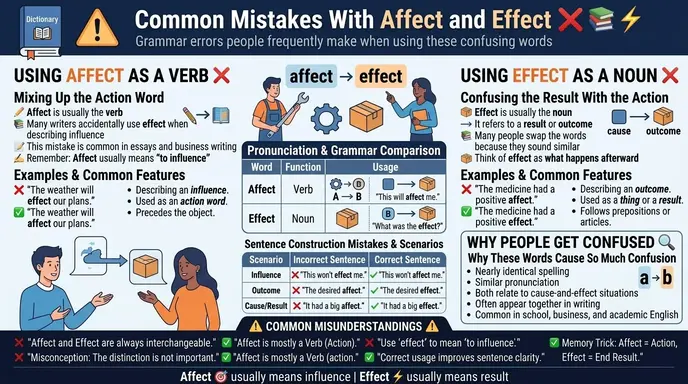
❌ The weather had a bad affect.
✅ The weather had a bad effect.
Reason:
A noun is needed.
Mistake #2
❌ The weather will effect our plans.
✅ The weather will affect our plans.
Reason:
A verb is needed.
Mistake #3
❌ The medicine affected a positive result.
Usually better:
✅ The medicine had a positive effect.
Mistake #4
❌ Using them interchangeably.
Always identify If you need:
- an action
- a result
Affect and Effect in Business
Affect
✅ Economic conditions affect company profits.
Effect
✅ The effect of inflation can be significant.
Inflation example:
Inflation
Affect and Effect in Healthcare
Affect
✅ Exercise affects heart health.
Effect
✅ The effect of exercise is improved fitness.
Affect and Effect in Education
Affect
✅ Technology affects learning habits.
Effect
✅ One effect of technology is increased accessibility.
Common Phrases with Affect
- affect behavior
- affect performance
- affect health
- affect outcomes
- affect decisions
Examples
✅ Stress affects sleep quality.
✅ Weather affects travel.
Common Phrases with Effect
- side effect
- cause and effect
- adverse effect
- positive effect
- long-term effect
Examples
✅ The medication caused a side effect.
✅ Students learn about cause and effect relationships.
Common User Queries
- What is the difference between affect and effect?
- Is affect a verb?
- Is effect a noun?
- How do I remember affect vs effect?
- What is a side effect?
- Can effect be a verb?
- Can affect be a noun?
- Which is correct: affect change or effect change?
- Why are affect and effect confusing?
- What are some examples of affect and effect?
FAQs
Is affect always a verb?
Usually yes, but it can be a noun in psychology.
Is effect always a noun?
Usually yes, but it can occasionally be a verb meaning “to bring about.”
Which is more common?
The common pattern is:
✔ Affect = verb
✔ Effect = noun
What is the easiest memory trick?
Affect = Action
Effect = End Result
Which sentence is correct?
✔ The weather affected our plans.
✔ The effect of the weather was severe.
Can I use them interchangeably?
❌ No.
What is “cause and effect”?
A relationship where one thing causes another result.
Conclusion
Affect and effect are closely related but serve different purposes in English. In most situations, affect is a verb meaning to influence, while effect is a noun meaning a result or consequence.
Remember this simple rule:
- Affect = Action
- Effect = End Result
Once you identify If you’re describing an influence or a result, choosing the correct word becomes much easier.
👉 Final takeaway: If something changes or influences another thing, use affect. If you’re talking about the outcome of that change, use effect.
Discover More Artcles!
Difference Between Dressing and Stuffing:With Examples
Difference Between Anesthetist and Anesthesiologist: Explained

James Whitmore. Labdiff.com is my english grammar comparision website. I explore the history and evolution of English words. I write detailed comparisons explaining why spellings change over time and how British and American English diverged. My articles add depth and credibility to grammar comparison topics.