Many beginners interested in shooting sports get confused about the difference between skeet and trap.
Both involve shooting clay targets with a shotgun, and both are popular worldwide in recreational shooting and professional marksmanship. However, the target movement, shooting positions, and gameplay are very different.
The difference between skeet and trap mainly comes down to how the clay targets are launched and where shooters stand.
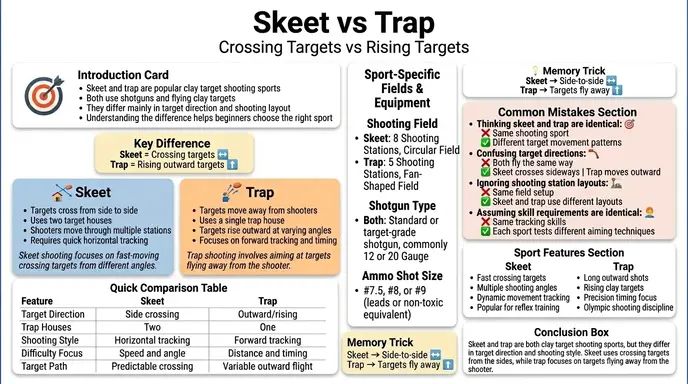
In trap shooting, targets move away from the shooter from a single machine. In skeet shooting, targets cross in front of the shooter from two different houses at varying angles.
For example:
- Trap targets fly outward and away.
- Skeet targets move side to side across the field.
Organizations like International Shooting Sport Federation and Amateur Trapshooting Association regulate these sports professionally, while events like the Olympic Games include shotgun shooting competitions that use trap and skeet formats.
In this guide, you will learn:
- What skeet and trap mean
- Their key differences
- Field layouts and shooting rules
- Real world competition examples
- Beginner mistakes
- Which shooting sport may suit you better
By the end, you will clearly understand the difference between skeet and trap in simple words.
Quick Answer: Difference Between Skeet and Trap
The difference between skeet and trap is that trap shooting launches targets away from the shooter from one central machine, while skeet shooting launches crossing targets from two side houses.
Simple Example
- Target flying straight away = trap
- Target crossing sideways = skeet
In simple words:
- Trap = outgoing targets
- Skeet = crossing targets
Definition of Skeet and Trap
What Is Skeet Shooting?
Skeet is a shotgun sport where clay targets are launched from two houses positioned on opposite sides of the field.
Shooters move through different stations while shooting crossing targets at various angles.
Example
A clay target flies from left to right across the shooter’s field of vision.
What Is Trap Shooting?
Trap is a shotgun sport where clay targets are launched away from shooters from a single trap house.
Targets move outward at varying angles and speeds.
Example
A target suddenly flies away from the shooter into the distance.
Pronunciation of Both Terms
| Word | US Pronunciation | UK Pronunciation |
| Skeet | SKEET | SKEET |
| Trap | TRAP | TRAP |
Now let’s understand the deeper difference between skeet and trap.
Comparison Table: Difference Between Skeet and Trap
| Feature | Skeet | Trap |
| Target Direction | Crosses sideways | Moves away |
| Launch Machines | Two houses | One trap house |
| Shooter Movement | Circular stations | Straight line stations |
| Difficulty Style | Fast crossing shots | Long outgoing shots |
| Target Path | Predictable crossing angles | Variable outward angles |
| Olympic Event | Yes | Yes |
| Shot Timing | Faster reactions needed | Distance judgment important |
| Common Skill Focus | Swing tracking | Lead and distance control |
| Field Layout | Semi circle | Straight arc line |
Key Differences Explained Between Skeet and Trap
Skeet Uses Crossing Targets
One of the biggest differences is target direction.
In skeet shooting, targets move sideways across the shooter’s field of view.
Real Life Example
A shooter tracks a fast moving clay disc crossing from left to right.
This requires quick reaction and smooth shotgun movement.
Trap Targets Fly Away
Trap targets launch outward from a single machine.
The shooter must track targets moving farther away quickly.
Example
A clay target suddenly angles upward and away into the distance.
Skeet Uses Two Launch Houses
Skeet fields contain:
- a high house
- a low house
Targets launch from both sides.
Trap Uses One Central Trap House
Trap shooting uses a single hidden launch machine positioned ahead of shooters.
The machine throws targets at slightly different outward angles.
Skeet Requires Faster Swing Motion
Because targets cross horizontally, shooters often need rapid side to side tracking.
Trap Requires Better Distance Judgment
Trap targets move away rapidly, making lead distance and timing critical.
Field Layouts Are Different
Skeet Layout
Shooters move around a semi circular field.
Trap Layout
Shooters stand behind the trap house in a straight or curved line.
Difference and Similarity Table Between Skeet and Trap
| Feature | Skeet | Trap | Similarity |
| Sport Type | Shotgun sport | Shotgun sport | Both use clay targets |
| Target Style | Crossing targets | Outgoing targets | Both involve moving targets |
| Equipment | Shotguns | Shotguns | Both require eye protection |
| Competition Use | Olympic sport | Olympic sport | Both involve scoring hits |
| Skill Requirement | Tracking speed | Distance timing | Both require accuracy |
| Shooting Stations | Circular movement | Fixed line movement | Both use multiple stations |
| Target Material | Clay discs | Clay discs | Both use clay pigeons |
| Popularity | Recreational and competitive | Recreational and competitive | Both are shooting disciplines |
This table clearly shows the difference and similarity between skeet and trap for quick understanding.
How Skeet and Trap Fields Work
Skeet Field Structure
A skeet field uses:
- 8 shooting stations
- 2 launch houses
- crossing target patterns
Shooters rotate through positions while targets change direction.
Trap Field Structure
Trap fields usually use:
- 5 shooting stations
- 1 trap machine
- outward target angles
Shooters rotate positions after shots.
Why People Get Confused Between Skeet and Trap
Many beginners think all clay shooting sports are identical because they all use:
- shotguns
- clay pigeons
- outdoor ranges
However, the easiest way to identify them is:
Skeet Check
Do targets cross sideways?
Trap Check
Do targets fly away?
That simple rule removes most confusion.
What Causes the Difference Between Skeet and Trap?
Target Direction Design
Skeet simulates crossing bird shots.
Trap simulates birds flying away from hunters.
Skill Focus
Skeet emphasizes tracking speed.
Trap emphasizes timing and distance control.
Historical Development
Trap shooting evolved earlier from bird hunting practice.
Skeet later developed as a more dynamic crossing target sport.
Real Life Examples With Skeet and Trap
Olympic Competition Example
The Olympic Games include both trap and skeet shotgun competitions.
Professional shooters train differently for each discipline.
Recreational Shooting Example
Many shooting clubs offer both activities because players enjoy different challenge styles.
Hunting Practice Example
Trap
Helps hunters practice outgoing bird shots.
Skeet
Helps hunters practice crossing bird shots.
Beginner Training Example
Some instructors recommend trap first because outgoing targets may feel easier initially.
Others prefer skeet because target paths are more predictable.
When to Choose Skeet or Trap
Choose Skeet If:
- you enjoy fast moving crossing shots
- you like movement between stations
- you want dynamic target angles
- you prefer rhythm based shooting
Good For
- reflex development
- bird hunting practice
- quick target acquisition
Choose Trap If:
- you prefer straightforward target presentation
- you want distance judgment practice
- you like consistent field layouts
- you enjoy precision timing
Good For
- long range tracking
- competition focus
- shooting fundamentals
Common Mistakes With Skeet and Trap
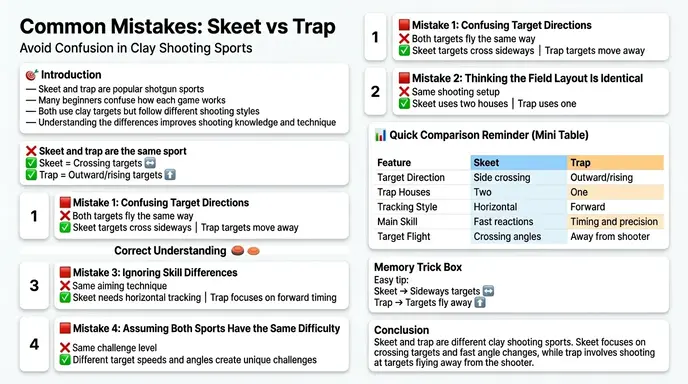
| Mistake | Why It Is Wrong | Correct Understanding |
| Thinking they are identical sports | Target movement differs greatly | Skeet crosses, trap moves away |
| Confusing field layouts | Stations are arranged differently | Skeet uses a semi circle |
| Assuming same shooting technique | Swing mechanics vary | Lead timing changes |
| Ignoring target speed differences | Skeet often feels faster | Trap emphasizes distance |
| Believing one is always easier | Difficulty depends on shooter style | Both require skill |
How Search Engines Understand “Difference Between Skeet and Trap”
Search engines like Google recognize this as a sports education and beginner shooting query.
Common searches include:
- skeet vs trap
- trap shooting explained
- skeet shooting basics
- clay shooting differences
- trap vs skeet for beginners
Google prioritizes content that:
- explains rules clearly
- compares field layouts
- includes beginner examples
- discusses equipment and technique
- satisfies educational sports intent
Organizations like the ISSF and ATA frequently publish training and competition information related to both sports.
Expert Insight: Which Sport Is Harder?
In practical use, difficulty depends heavily on the shooter’s strengths.
Most beginners assume trap is easier because targets move away predictably.
However:
- some shooters struggle with long distance lead timing
- others struggle with rapid crossing shots in skeet
Experienced shotgun instructors usually analyze:
- reaction speed
- hand eye coordination
- target acquisition
- swing consistency
- mental focus
Professional competitors often specialize because mastering both sports at elite level requires different techniques.
Can You Use the Same Shotgun for Both?
Yes, many shooters use the same shotgun for both skeet and trap.
However, competitive shooters often customize:
- barrel length
- choke type
- stock fit
- sight setup
to optimize performance for each discipline.
Is Skeet or Trap Better for Beginners?
Both can work well for beginners.
Skeet Advantages
- predictable crossing paths
- engaging movement
- fast paced learning
Trap Advantages
- simpler field setup
- straightforward target direction
- easier starting fundamentals for some shooters
The best choice often depends on personal comfort and coaching style.
FAQ:
What is the main difference between skeet and trap?
Skeet uses crossing targets from two houses, while trap launches outgoing targets from one central machine.
Which sport is harder: skeet or trap?
Difficulty depends on the shooter’s skills and preferences.
Do both sports use shotguns?
Yes. Both skeet and trap use shotguns and clay targets.
Is skeet shooting in the Olympics?
Yes. Skeet is an Olympic shooting event.
What are clay pigeons?
Clay pigeons are disc shaped targets launched during shooting sports.
Can beginners learn both sports?
Yes. Many shooting clubs teach both disciplines to beginners.
Why is it called trap shooting?
The name comes from early target launching trap devices used in hunting practice.
Which sport helps bird hunting more?
Both help, but trap often simulates outgoing birds while skeet simulates crossing birds.
Conclusion
Understanding the difference between skeet and trap becomes much easier once you focus on target movement and field layout.
Skeet uses crossing targets launched from two houses, requiring fast tracking and swing control. Trap uses outgoing targets launched from one trap house, emphasizing distance judgment and timing.
In simple words:
- skeet = crossing shots
- trap = outgoing shots
Both are highly respected shotgun sports used for recreation, competition, and hunting practice around the world.
Once you understand how the targets move, identifying the difference between skeet and trap becomes simple.
Discover More Articles!
Difference Between Bid and Ask:With Simple Examples
Difference Between Jam and Marmalade: With Real Examples

James Whitmore. Labdiff.com is my english grammar comparision website. I explore the history and evolution of English words. I write detailed comparisons explaining why spellings change over time and how British and American English diverged. My articles add depth and credibility to grammar comparison topics.