Many students, professionals, and everyday learners search for the difference between mean and average because the two terms are often used interchangeably in mathematics, statistics, business, and daily conversation.
While they are closely related, they are not always exactly the same depending on context. This confusion is common in classrooms, financial reports, data analysis, and exam preparation.
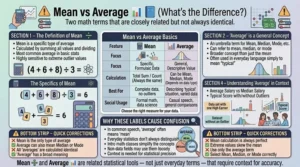
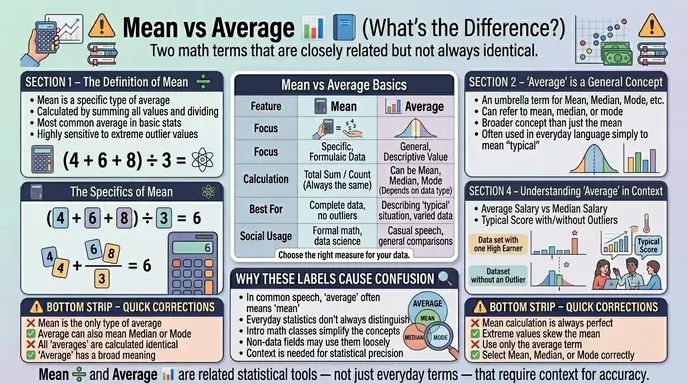
In simple words, the mean is a specific mathematical method used to calculate a central value, while average is a broader general term that can refer to different types of calculations, including mean, median, and mode.
The difference between mean and average becomes especially important in statistics, data interpretation, finance, economics, and scientific research.
This guide explains mean and average clearly, including definitions, formulas, real world examples, similarities, statistical applications, common mistakes, and expert insights.
Quick Answer: Difference Between Mean and Average
The main difference between mean and average is specificity.
- Mean is a mathematical calculation found by adding all values and dividing by the total number of values
- Average is a broader term used to describe a typical or central value in a dataset
For example:
If test scores are 70, 80, and 90:
\frac{70+80+90}{3}=80
The mean is 80, and this value is also considered the average.
Definition of Mean and Average
- Mean: A statistical value calculated by dividing the total sum of numbers by the number of values.
- Average: A general term describing a central or typical value within a group of numbers.
Simple Example
- Mean = exact mathematical formula
- Average = general central value idea
Pronunciation of Both (US & UK)
| Term | US Pronunciation | UK Pronunciation |
| Mean | meen | meen |
| Average | av er ij | av er ij |
Now let’s understand this clearly through mathematics, statistics, business analysis, and real world examples.
Difference Between Mean and Average Comparison Table
| Feature | Mean | Average | Similarity |
| Definition | Specific statistical calculation | General central value term | Both describe data centers |
| Mathematical Precision | Exact formula | Broader concept | Both summarize data |
| Formula Requirement | Yes | Not always | Both used in statistics |
| Includes Median/Mode | No | Sometimes yes | Both analyze datasets |
| Usage in Math | Highly technical | More conversational | Both used in education |
| Data Interpretation | Numerical focus | General understanding | Both simplify information |
| Everyday Use | Less casual | Very common | Both describe “typical” values |
| Statistical Context | Formal calculation | General category | Both support analysis |
This table clearly shows the difference and similarity between mean and average for quick understanding.
Key Differences Explained Between Mean and Average
Specific vs General Meaning
The biggest difference is that mean is a precise mathematical term, while average is broader.
- Mean always follows a fixed calculation method
- Average may refer to mean, median, or mode depending on context
Formula Difference
The arithmetic mean uses this formula:
Mean=\frac{\sum x}{n}
Where:
- Σx = total of all numbers
- n = number of values
Average does not always require this exact formula.
Statistical Flexibility
Average can sometimes mean:
- Mean
- Median
- Mode
depending on how data is analyzed.
Everyday Language
People often say:
- “average salary”
- “average score”
- “average height”
Even when they technically mean arithmetic mean.
Technical Accuracy
In statistics and scientific research, professionals usually prefer the term “mean” for precision.
Platforms supported by Google and data analysis tools frequently distinguish clearly between mean, median, and mode during statistical processing.
Why Do Mean and Average Exist as Separate Terms?
Statistics and mathematics require precise calculations, while everyday communication often prefers simpler language.
The word “average” became widely used because it is easier for general audiences, while “mean” provides technical accuracy in mathematics and scientific analysis.
This distinction helps professionals communicate data more clearly depending on audience and context.
How Mean Works
Arithmetic Mean
The arithmetic mean is calculated by:
- Adding all numbers
- Dividing by the number of values
Example:
\frac{10+20+30+40}{4}=25
Sensitivity to Extreme Values
Mean can be affected heavily by unusually high or low numbers.
Example:
- Income data with billionaires can distort the mean.
Common Statistical Use
Mean is widely used in:
- Economics
- Science
- Finance
- Education
- Research studies
How Average Works
General Data Summary
Average simply describes what is “typical” or “central.”
Multiple Calculation Types
Average may refer to:
- Mean
- Median
- Mode
depending on the dataset.
Everyday Communication
Average is more common in:
- News reports
- Business discussions
- Casual conversation
Difference Between Mean and Average in Statistics
| Statistics Feature | Mean | Average |
| Technical Precision | High | Moderate |
| Calculation Method | Fixed formula | Flexible meaning |
| Research Usage | Very common | Less precise |
| Public Understanding | More technical | Easier for beginners |
| Central Tendency Type | Specific | General category |
Understanding this distinction improves statistical interpretation.
Difference Between Mean and Average in Real Life
School Grades
Teachers often calculate the mean score of students.
Students casually call it the average score.
Business and Finance
Economists analyze:
- Mean income
- Average market growth
- Average inflation rates
Sports Statistics
Sports analysts discuss average performance while often using arithmetic mean calculations.
Social Media Analytics
Platforms like YouTube and Instagram use statistical averages to analyze audience engagement and performance metrics.
Scientific Research
Scientists prefer precise statistical terms like:
- Mean
- Median
- Standard deviation
for accurate reporting.
Real Life Examples with Mean and Average
Classroom Example
Scores:
- 60
- 70
- 80
\frac{60+70+80}{3}=70
The mean is 70, which is also the average score.
Income Example
A city’s average income may actually represent the mean income unless stated otherwise.
Sports Performance
Batting averages and scoring averages often rely on mean calculations.
Weather Data
Meteorologists calculate average temperatures using arithmetic means over time periods.
Difference + Similarity Between Mean and Average
| Feature | Mean | Average | Similarity |
| Main Purpose | Exact calculation | General central value | Both summarize data |
| Formula Use | Required | Sometimes optional | Both simplify analysis |
| Statistical Role | Specific measurement | Broader category | Both help comparisons |
| Technical Accuracy | Higher | Lower | Both used in statistics |
| Everyday Popularity | Less casual | Very common | Both widely understood |
| Data Interpretation | Precise | Flexible | Both explain datasets |
This table clearly shows the difference and similarity between mean and average for quick understanding.
Why People Get Confused Between Mean and Average
Interchangeable Usage
Many teachers, media outlets, and conversations use the terms interchangeably.
Similar Results
In many datasets, the average and mean produce the same number.
Simplified Education
Basic math classes often simplify the distinction for beginners.
Broad Meaning of Average
Average can include several statistical measures, creating confusion.
Common Mistakes with Mean and Average
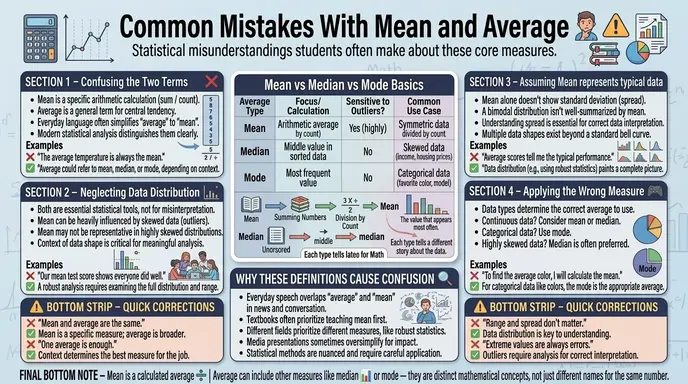
| Mistake | Correct Understanding |
| Thinking mean and average are always identical | Average can refer to other measures too |
| Ignoring outliers in mean calculations | Extreme values affect means heavily |
| Assuming average always means arithmetic mean | Context matters |
| Confusing median with mean | They are different calculations |
| Treating all averages equally | Different averages serve different purposes |
Quick Memory Tip
- Mean = exact formula
- Average = general central value
When to Use Mean or Average
Use “Mean” When:
- Writing technical reports
- Studying statistics
- Doing scientific calculations
- Performing mathematical analysis
Use “Average” When:
- Speaking casually
- Explaining general trends
- Communicating with beginners
- Discussing typical values broadly
In many everyday situations, both words still overlap naturally.
Expert Insight
In professional statistics and data science, precision matters greatly. Although average is convenient in everyday communication, statisticians often prefer the term “mean” because it identifies the exact calculation being used.
This becomes especially important when comparing datasets, analyzing trends, or interpreting research findings.
Modern analytics systems used by businesses, financial institutions, and technology companies rely heavily on statistical means for forecasting, machine learning, and performance analysis.
However, experts also recognize that the mean is not always the best measure, especially when extreme values distort results. In those cases, median or mode may provide a clearer picture.
Understanding the distinction between mean and average helps improve mathematical literacy and data interpretation in real world situations.
Frequently Asked Questions
What is the main difference between mean and average?
Mean is a specific mathematical calculation, while average is a broader term for a central value.
Is mean always an average?
Yes. Mean is a type of average.
Is average always mean?
No. Average can also refer to median or mode.
What is the formula for mean?
Mean=\frac{\sum x}{n}
Why do people use average more often?
Because it is simpler and easier for general conversation.
Can outliers affect the mean?
Yes. Very large or small values can distort the mean significantly.
Which is more accurate in statistics?
Mean is more technically precise when describing the arithmetic calculation.
Where is mean commonly used?
Mean is widely used in science, economics, education, and research.
Conclusion
Understanding the difference between mean and average becomes easier once you recognize that mean is a specific mathematical calculation, while average is a broader term describing a central or typical value.
The arithmetic mean is calculated by adding all numbers and dividing by the number of values, whereas average may refer to several statistical measures depending on context.
Although the two terms are often used interchangeably in everyday conversation, technical fields like statistics, finance, economics, and scientific research usually prefer “mean” for greater precision and clarity.
Both concepts are extremely useful because they help summarize large amounts of information into understandable values.
In real world situations, understanding the difference between mean and average improves data interpretation, statistical literacy, and decision making.
Once you fully understand these concepts, mathematics and statistics become much easier to analyze and apply correctly.
Discover More Articles!
Difference Between Clip and Magazine:In 30 Seconds
Roth vs 401(k) Explained Clearly: Which One Should You Choose?

labdiff.com is my English grammar comparison website where I simplify confusing words, spelling differences, and usage rules through clear explanations and examples. My goal is to help learners, writers, and students understand English easily and use correct grammar with confidence.