Many beginners entering the stock market, cryptocurrency trading, or forex investing get confused about the difference between bid and ask.
These two prices appear on almost every trading platform, but understanding what they actually mean is essential for buying and selling assets correctly.
The difference between bid and ask is simple:
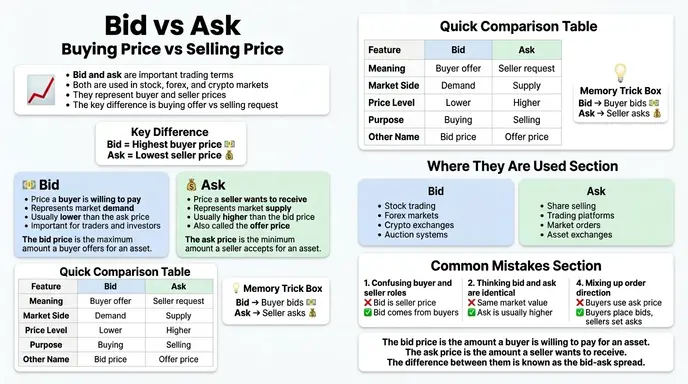
- The bid price is the highest price a buyer is willing to pay.
- The ask price is the lowest price a seller is willing to accept.
This small gap between the two prices is called the spread, and it plays a major role in trading costs, market liquidity, and order execution.
For example:
- If a stock has a bid price of $100 and an ask price of $101:
- buyers want to pay $100
- sellers want at least $101
Trading platforms constantly display bid and ask prices because they are the foundation of modern financial markets.
In this guide, you will learn:
- What bid and ask mean
- How the spread works
- Real-world trading examples
- Why prices change constantly
- Common beginner mistakes
- How professional traders use bid and ask data
By the end, you will clearly understand the difference between bid and ask and how they affect trading decisions.
Quick Answer: Difference Between Bid and Ask
The difference between bid and ask is that the bid is the price buyers are willing to pay, while the ask is the price sellers want to receive.
Simple Example
| Type | Price |
| Bid | $50 |
| Ask | $51 |
This means:
- buyers are offering $50
- sellers want $51
The $1 difference is called the spread.
Definition of Bid and Ask
What Is a Bid?
A bid is the maximum price a buyer is willing to pay for an asset like:
- stocks
- cryptocurrency
- forex currency pairs
- commodities
Example
A trader offers $200 for a company share.
That $200 becomes the bid price.
What Is an Ask?
An ask, also called the offer price, is the minimum price a seller is willing to accept.
Example
A seller lists the same share for $202.
That $202 becomes the ask price.
Pronunciation of Both Terms
| Word | US Pronunciation | UK Pronunciation |
| Bid | BID | BID |
| Ask | ASK | AH-sk |
Now let’s understand the deeper difference between bid and ask in financial markets.
Comparison Table: Difference Between Bid and Ask
| Feature | Bid | Ask |
| Meaning | Buyer’s offer price | Seller’s requested price |
| Market Side | Demand side | Supply side |
| Controlled By | Buyers | Sellers |
| Trading Purpose | Purchase offers | Selling offers |
| Price Position | Usually lower | Usually higher |
| Impact on Traders | Helps buyers enter cheaply | Helps sellers maximize profit |
| Order Type | Buy order | Sell order |
| Market Psychology | Buying interest | Selling interest |
| Example | “I will pay $100” | “I want $101” |
Key Differences Explained Between Bid and Ask
Bid Represents Buying Interest
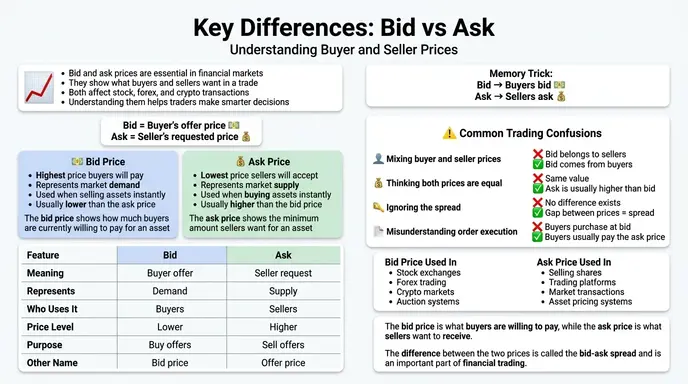
The bid price shows what buyers currently believe an asset is worth.
Real-Life Example
If traders think a stock is undervalued, bid prices may rise quickly.
Higher bids often indicate strong demand.
Ask Represents Selling Interest
The ask price reflects what sellers believe the asset should sell for.
Example
A Bitcoin holder may refuse to sell below a certain price.
That requested amount becomes the ask.
The Ask Is Usually Higher Than the Bid
In most markets:
Ask > Bid
This difference creates the spread.
The Spread Represents Trading Cost
The spread is calculated as:
Spread = Ask – Bid
Example
If:
- Bid = $99
- Ask = $100
Then:
100 – 99 = 1
The spread equals $1.
Smaller Spreads Usually Mean Higher Liquidity
Popular assets like:
- Apple stock
- Bitcoin
- major forex pairs
often have small spreads because many buyers and sellers participate.
Large Spreads Often Signal Lower Market Activity
Smaller or risky assets may have larger spreads due to lower liquidity and uncertainty.
Market Orders Interact With Bid and Ask Automatically
When traders place:
- a market buy order → they usually pay the ask price
- a market sell order → they usually receive the bid price
Difference and Similarity Table Between Bid and Ask
| Feature | Bid | Ask | Similarity |
| Purpose | Buy offer | Sell request | Both determine market price |
| User Type | Buyer | Seller | Both involve traders |
| Market Function | Creates demand | Creates supply | Both support trading activity |
| Position in Market | Lower price | Higher price | Both appear in order books |
| Trading Role | Entry price for sellers | Entry price for buyers | Both affect execution |
| Relationship | Competes with ask | Competes with bid | Both move constantly |
| Visibility | Shown on exchanges | Shown on exchanges | Both displayed in real time |
| Financial Use | Used in buying | Used in selling | Both are core trading concepts |
This table clearly shows the difference and similarity between bid and ask for quick understanding.
What Is the Bid-Ask Spread?
The bid-ask spread is the difference between the highest buying price and the lowest selling price.
Formula
Spread = Ask – Bid
Example
| Bid | Ask | Spread |
| $150 | $151 | $1 |
The spread often acts as an indirect transaction cost.
Why Bid and Ask Prices Change Constantly
Markets move continuously because buyers and sellers constantly update their orders.
Factors include:
- breaking news
- earnings reports
- economic data
- social media sentiment
- supply and demand
- algorithmic trading
Platforms track these changes in real time.
Real-Life Examples With Bid and Ask
Stock Market Example
Bid
Investors offer $300 for a stock.
Ask
Sellers want $302.
Trades happen once prices match.
Cryptocurrency Example
On Binance or Coinbase:
- buyers place bids for Bitcoin
- sellers place asks for Bitcoin
The market constantly updates.
Forex Example
Currency pairs like EUR/USD always display bid and ask prices.
Forex traders rely heavily on spreads because profits are often small.
Online Marketplace Example
Even auction sites indirectly use bid-and-ask logic.
Example
- buyer offer = bid
- seller listing price = ask
When to Use Bid or Ask
Use “Bid” When:
- referring to buyer offers
- discussing demand
- placing purchase orders
- analyzing buying pressure
Examples
- bid price
- highest bid
- bid volume
Use “Ask” When:
- referring to seller prices
- discussing supply
- placing sell offers
- analyzing selling pressure
Examples
- ask price
- lowest ask
- ask spread
Why People Get Confused Between Bid and Ask
Many beginners mix them up because both prices appear together on trading screens.
A simple memory trick helps:
Bid = Buyer
Both start with “B.”
Ask = Seller Asking Price
The seller is asking for money.
That simple association helps many new traders remember the difference.
Common Mistakes With Bid and Ask
| Mistake | Why It Is Wrong | Correct Understanding |
| Thinking bid is the selling price | Bid comes from buyers | Buyers create bids |
| Assuming ask is the buying price | Ask comes from sellers | Sellers create asks |
| Ignoring the spread | Spread affects profit | Trading costs matter |
| Using market orders carelessly | Fast markets can move prices | Slippage may occur |
| Thinking spreads stay fixed | Spreads change constantly | Liquidity affects spreads |
How Search Engines Understand “Difference Between Bid and Ask”
Search engines like Google recognize this as a financial education and trading-intent query.
Common searches include:
- bid vs ask
- what is bid price
- ask price meaning
- spread in trading
- stock market bid and ask explained
Google prioritizes content that:
- explains trading concepts clearly
- includes formulas and examples
- simplifies beginner confusion
- uses real-world investing scenarios
- supports educational finance intent
Financial platforms frequently explain bid and ask concepts because they are fundamental to investing.
Expert Insight: Why Professional Traders Watch the Spread
In practical trading, experienced traders pay close attention to spreads because spreads affect profitability directly.
Most beginners only focus on market direction.
Professional traders also monitor:
- liquidity
- order book depth
- bid pressure
- ask pressure
- market volatility
- spread expansion
For example:
A stock may appear profitable, but a wide spread can reduce actual gains significantly.
High-frequency trading firms and institutional investors use advanced algorithms specifically designed to analyze bid and ask behavior in milliseconds.
Can the Bid Ever Be Higher Than the Ask?
Normally, no.
Markets automatically match overlapping prices quickly.
If a bid temporarily becomes higher than the ask, trading systems usually execute trades immediately until balance returns.
Which Price Do You Actually Pay?
If You Buy
You usually pay the ask price.
If You Sell
You usually receive the bid price.
This is one of the first important lessons beginner traders learn.
FAQ:
What is the main difference between bid and ask?
The bid is the buyer’s offer price, while the ask is the seller’s requested price.
Why is the ask higher than the bid?
Sellers want maximum value, while buyers want lower prices. The gap creates the spread.
What is a spread in trading?
The spread is the difference between the bid price and the ask price.
Which price do buyers pay?
Buyers typically pay the ask price.
Which price do sellers receive?
Sellers usually receive the bid price.
Why do spreads change?
Spreads change because market liquidity, volatility, and trading activity constantly change.
Is a smaller spread better?
Usually yes. Smaller spreads often indicate higher liquidity and lower trading costs.
Do all financial markets use bid and ask prices?
Yes. Stocks, crypto, forex, commodities, and many other markets use bid and ask systems.
Conclusion
Understanding the difference between bid and ask is essential for anyone involved in trading, investing, or financial markets.
The bid represents the highest price buyers are willing to pay, while the ask represents the lowest price sellers are willing to accept.
In simple words:
- bid = buyer offer
- ask = seller request
The difference between them creates the spread, which affects liquidity, trade execution, and trading costs.
Once you understand how bid and ask prices interact, reading trading platforms and making investment decisions becomes much easier and more accurate.
Discover More Articles!
Difference Between Bits and Bytes: Easy Guide With Examples
Difference Between 1080p and 4K: Which Resolution Is Better?

labdiff.com is my English grammar comparison website where I simplify confusing words, spelling differences, and usage rules through clear explanations and examples. My goal is to help learners, writers, and students understand English easily and use correct grammar with confidence.