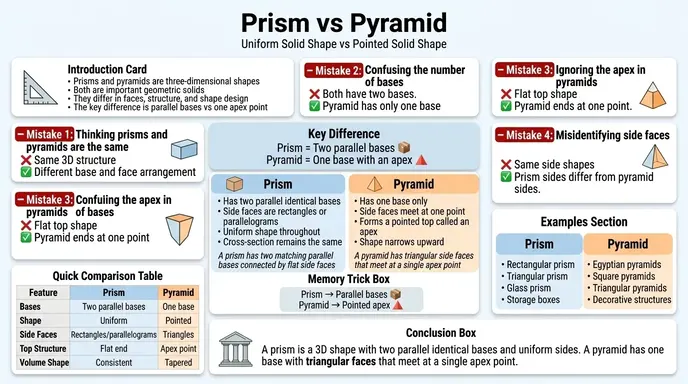
Many students and beginners get confused about the difference between prism and pyramid because both are three dimensional geometric shapes.
They are commonly taught in mathematics, architecture, engineering, construction, and design. At first glance, they may look similar, but their structure and shape are very different.
The difference between prism and pyramid mainly comes down to the number of bases and how the sides connect.
A prism has two identical parallel bases connected by rectangular or parallelogram faces, while a pyramid has one base with triangular faces that meet at a single point called the apex.
For example:
- A cereal box is similar to a rectangular prism.
- The famous Great Pyramid of Giza is a pyramid.
Understanding these shapes is important in geometry, engineering, packaging, 3D modeling, and even video game design. Platforms use geometric concepts like prisms and pyramids in digital design and modeling systems.
In this guide, you will learn:
- What prisms and pyramids mean
- Their key differences
- Real life examples
- Surface area and volume concepts
- Similarities people often miss
- Common geometry mistakes
By the end, you will clearly understand the difference between prism and pyramid in simple words.
Quick Answer: Difference Between Prism and Pyramid
The difference between prism and pyramid is that a prism has two identical parallel bases, while a pyramid has one base and triangular sides meeting at a single top point.
Simple Example
- A box shaped building = prism
- An Egyptian pyramid = pyramid
In simple words:
- Prism = two matching bases
- Pyramid = one base and one apex
Definition of Prism and Pyramid
What Is a Prism?
A prism is a 3D geometric shape with:
- two identical parallel bases
- flat side faces connecting the bases
The side faces are usually rectangles or parallelograms.
Example
A shoe box is a rectangular prism.
What Is a Pyramid?
A pyramid is a 3D shape with:
- one base
- triangular side faces
- all side faces meeting at a single point called the apex
Example
The Great Pyramid of Giza is a square pyramid.
Pronunciation of Both Terms
| Word | US Pronunciation | UK Pronunciation |
| Prism | PRIZ um | PRIZ um |
| Pyramid | PEER uh mid | PIR uh mid |
Now let’s understand the deeper difference between prism and pyramid.
Comparison Table: Difference Between Prism and Pyramid
| Feature | Prism | Pyramid |
| Number of Bases | Two identical bases | One base |
| Shape of Side Faces | Rectangles or parallelograms | Triangles |
| Apex | No apex | Has one apex |
| Cross Section | Same throughout | Narrows toward top |
| Structure | Uniform shape | Tapered shape |
| Volume Formula | Base area × height | One third of prism formula |
| Stability | Even weight distribution | Concentrated toward base |
| Common Example | Box | Egyptian pyramid |
| Surface Shape | Parallel ends | Sloping sides |
Key Differences Explained Between Prism and Pyramid
A Prism Has Two Bases
One of the biggest differences is the number of bases.
A prism always has two identical parallel bases.
Example
A rectangular prism:
V = Bh
Where:
- ( B ) = base area
- ( h ) = height
A Pyramid Has One Base
A pyramid only has one base, and all triangular faces meet at the apex.
Pyramid Volume Formula
V = \frac{1}{3}Bh
This means a pyramid with the same base and height as a prism has one third the volume.
Prism Sides Stay Parallel
The side walls of a prism remain straight and parallel.
Real Life Example
- shipping containers
- bricks
- books
- storage boxes
Pyramid Sides Meet at a Point
Pyramid faces slope inward and connect at the apex.
Real Life Example
- Egyptian pyramids
- decorative roofs
- some tents
Prisms Have Uniform Cross Sections
If you slice a prism horizontally, the cross section remains the same shape throughout.
Pyramids Become Smaller Toward the Top
A pyramid narrows gradually as it rises toward the apex.
Prisms Usually Store More Volume
Because prisms maintain equal width throughout, they hold more volume than pyramids with the same base and height.
Pyramids Are Often Used for Stability and Design
Ancient civilizations used pyramid structures because the wide base distributes weight effectively.
The Louvre Pyramid is a modern architectural example of pyramid geometry.
Difference and Similarity Table Between Prism and Pyramid
| Feature | Prism | Pyramid | Similarity |
| Shape Type | 3D solid | 3D solid | Both are polyhedrons |
| Bases | Two | One | Both have polygon bases |
| Side Faces | Rectangular/parallelogram | Triangular | Both have flat faces |
| Volume | Larger for same dimensions | Smaller for same dimensions | Both occupy space |
| Geometry Use | Packaging and storage | Monuments and structures | Both studied in geometry |
| Surface Type | Straight sides | Sloped sides | Both have edges and vertices |
| Mathematical Formulas | Different volume formulas | Different volume formulas | Both use height and base area |
| Real Life Applications | Boxes and buildings | Monuments and roofs | Both appear in architecture |
This table clearly shows the difference and similarity between prism and pyramid for quick understanding.
Types of Prisms
Rectangular Prism
A box shaped prism with rectangular faces.
Example
A refrigerator box.
Triangular Prism
A prism with triangular bases.
Example
Some camping tents.
Hexagonal Prism
A prism with hexagon shaped bases.
Example
Certain pencils and decorative columns.
Types of Pyramids
Square Pyramid
A pyramid with a square base.
Example
The Great Pyramid of Giza.
Triangular Pyramid
Also called a tetrahedron.
It has triangular faces on all sides.
Pentagonal Pyramid
A pyramid with a pentagon base.
Used in advanced geometry designs.
Why People Get Confused Between Prism and Pyramid
Many students think any 3D shape with flat faces is either a prism or pyramid.
However, the easiest way to identify them is:
Prism Check
Does it have two matching parallel bases?
Pyramid Check
Do all side faces meet at one top point?
That simple rule solves most confusion.
What Causes the Structural Difference Between Prism and Pyramid?
Base Arrangement
Prisms use two equal bases for uniform shape.
Pyramids use one base with converging sides.
Weight Distribution
Prisms distribute weight evenly.
Pyramids concentrate weight downward toward the base.
Geometric Purpose
Prisms are practical for storage and packaging.
Pyramids are often useful for structural stability and visual design.
Real Life Examples With Prism and Pyramid
Packaging Example
Prism
Most cardboard boxes are rectangular prisms because they maximize storage space.
Architecture Example
Pyramid
Ancient Egyptian pyramids were designed for strength and durability.
Classroom Example
Prism
A geometry ruler holder may resemble a triangular prism.
Pyramid
Decorative math models often use pyramid shapes.
Gaming Example
Games like Minecraft use prism like block systems for world building.
Engineering Example
Prisms are common in bridges and buildings because of efficient space usage.
Pyramids appear in monument and roof design.
When to Use Prism or Pyramid
Use “Prism” When:
- there are two matching bases
- side faces stay parallel
- the shape maintains equal width
Examples
- rectangular prism
- triangular prism
- hexagonal prism
Use “Pyramid” When:
- there is one base
- triangular faces meet at an apex
- the structure narrows upward
Examples
- square pyramid
- triangular pyramid
Common Mistakes With Prism and Pyramid
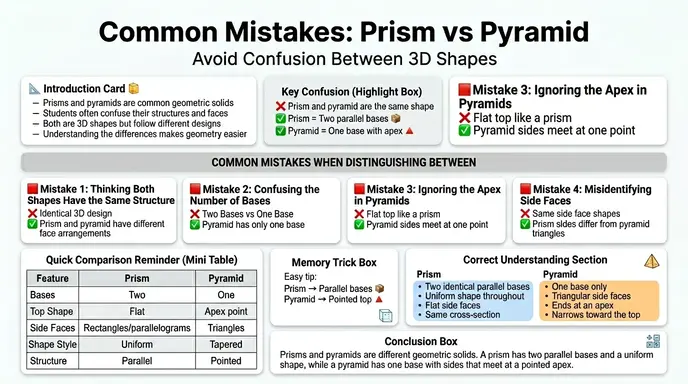
| Mistake | Why It Is Wrong | Correct Understanding |
| Thinking both have one base | Prisms have two bases | Pyramids have one base |
| Confusing triangular prisms with pyramids | Triangular prisms still have two bases | Apex matters |
| Ignoring side face shapes | Side faces differ greatly | Rectangles vs triangles |
| Forgetting the apex | Only pyramids have an apex | Prisms do not |
| Using the wrong volume formula | Formulas are different | Pyramid volume is one third |
How Search Engines Understand “Difference Between Prism and Pyramid”
Search engines like Google recognize this as a strong educational and geometry related query.
Common searches include:
- prism vs pyramid
- prism and pyramid examples
- pyramid shape meaning
- prism geometry definition
- difference between prism and pyramid in math
Google prioritizes content that:
- explains geometry simply
- includes visual comparisons
- uses formulas and examples
- supports beginner understanding
- answers classroom style questions
Educational platforms also organize geometry lessons around these concepts.
Expert Insight: Why Prisms and Pyramids Matter in Real Life
In practical use, prisms are usually preferred when maximum usable space is needed.
That is why:
- buildings
- shipping boxes
- storage containers
often use prism shapes.
Pyramids, however, are valued for structural stability and symbolic design. Ancient civilizations used pyramids because the shape distributes weight efficiently and resists collapse over time.
Most beginners only see shape differences visually. Geometry experts also study:
- volume efficiency
- structural strength
- surface area
- symmetry
- engineering applications
Can a Prism Become a Pyramid?
Not exactly, because their structures are fundamentally different.
However, if the top base of a prism gradually shrinks to a single point, the shape begins to resemble a pyramid.
Which Shape Holds More Volume?
For the same base area and height:
- a prism holds more volume
- a pyramid holds one third as much volume
Formula Relationship
V_{pyramid} = \frac{1}{3}V_{prism}
FAQ:
What is the main difference between prism and pyramid?
A prism has two identical parallel bases, while a pyramid has one base and an apex.
Does a pyramid have two bases?
No. A pyramid only has one base.
Is a triangular prism a pyramid?
No. A triangular prism still has two triangular bases, while a pyramid has one base and an apex.
Which shape has an apex?
Only pyramids have an apex.
Which shape holds more volume?
A prism holds more volume than a pyramid with the same base and height.
Are prisms and pyramids both 3D shapes?
Yes. Both are three dimensional geometric solids.
Why are pyramids strong structures?
Their wide base distributes weight efficiently, improving stability.
Where are prisms used in real life?
Prisms are commonly used in packaging, buildings, containers, and engineering structures.
Conclusion
Understanding the difference between prism and pyramid is important in geometry, engineering, architecture, and real world design.
A prism has two identical parallel bases with straight side faces, while a pyramid has one base with triangular faces meeting at a single apex.
In simple words:
- prisms stay uniform from top to bottom
- pyramids narrow toward one point
This difference affects volume, structure, stability, and practical use in mathematics and construction.
Once you understand the number of bases and the presence of an apex, identifying the difference between prism and pyramid becomes much easier.
Discover More Articles!
Difference Between 1080p and 4K: Which Resolution Is Better?
Difference Between Manslaughter and Murder: Simple Examples

James Whitmore. Labdiff.com is my english grammar comparision website. I explore the history and evolution of English words. I write detailed comparisons explaining why spellings change over time and how British and American English diverged. My articles add depth and credibility to grammar comparison topics.