Many people confuse the difference between manslaughter and murder because both involve the unlawful killing of another person.
However, in criminal law, these terms have very different meanings, punishments, and legal consequences.
The difference between manslaughter and murder mainly depends on intent, planning, and state of mind.
Murder usually involves intentional killing or extreme disregard for human life, while manslaughter typically involves unlawful killing without prior intent to kill.
For example:
- Planning to intentionally kill someone is generally considered murder.
- Causing someone’s death during a reckless accident may be considered manslaughter.
This distinction is important in courts, criminal investigations, self defense cases, and legal sentencing. News organizations and platforms often report on these terms, but many readers still misunderstand the legal difference.
In this guide, you will learn:
- What manslaughter and murder mean
- Key legal differences
- Types of manslaughter and murder
- Real life examples
- Common misconceptions
- Why courts treat them differently
By the end, you will clearly understand the difference between manslaughter and murder in simple language.
Quick Answer: Difference Between Manslaughter and Murder
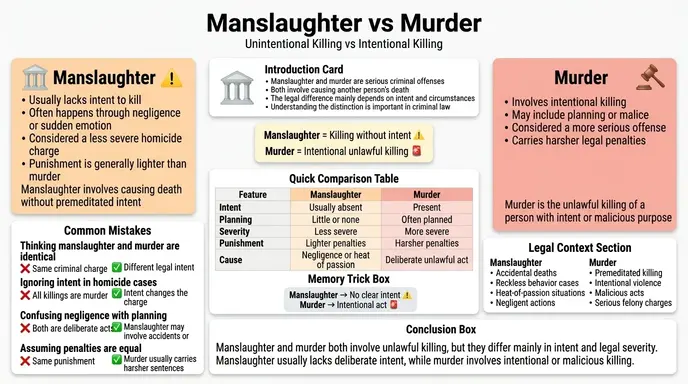
The difference between manslaughter and murder is that murder usually involves intentional killing or malicious intent, while manslaughter involves unlawful killing without premeditated intent to kill.
Simple Example
- Intentionally poisoning someone = murder
- Causing death through reckless driving = manslaughter
In simple words:
- Murder = intentional or malicious killing
- Manslaughter = unlawful killing without full intent
Definition of Manslaughter and Murder
What Is Manslaughter?
Manslaughter is the unlawful killing of another person without premeditation or malicious intent. It often involves recklessness, negligence, or actions committed in the heat of the moment.
Example
A driver causes a fatal accident while driving dangerously.
What Is Murder?
Murder is the intentional killing of another person or killing caused by actions showing extreme disregard for human life.
Example
Planning and carrying out a deliberate killing.
Pronunciation of Both Terms
| Word | US Pronunciation | UK Pronunciation |
| Manslaughter | MAN slaw ter | MAN slaw tuh |
| Murder | MUR der | MUR duh |
Now let’s understand the deeper legal difference between manslaughter and murder.
Comparison Table: Difference Between Manslaughter and Murder
| Feature | Manslaughter | Murder |
| Intent to Kill | Usually absent | Usually present |
| Premeditation | No prior planning | Often planned or intentional |
| Severity | Less severe legally | More severe legally |
| State of Mind | Reckless or emotional | Malicious or intentional |
| Punishment | Generally lighter sentences | Usually harsher penalties |
| Examples | Fatal reckless driving | Planned homicide |
| Emotional Trigger | Heat of passion possible | Intentional violence |
| Legal Classification | Lesser homicide offense | Most serious homicide offense |
| Criminal Intent | Limited or absent | Strong criminal intent |
Key Differences Explained Between Manslaughter and Murder
Murder Usually Involves Intent
One of the biggest differences is intent.
In murder cases, prosecutors often try to prove that the accused intended to kill or seriously harm another person.
Real Life Example
Someone carefully plans an attack before carrying it out.
That level of planning strongly supports a murder charge.
Manslaughter Usually Lacks Premeditation
Manslaughter often happens suddenly or through reckless behavior without a direct intention to kill.
Example
A heated argument turns violent unexpectedly, resulting in death.
The absence of prior planning may reduce the charge from murder to manslaughter.
Murder Carries Harsher Punishment
Because murder involves greater intent or malice, courts usually impose stricter penalties.
Depending on the country or state, punishment may include:
- life imprisonment
- decades in prison
- severe felony sentencing
Manslaughter Sentences Are Usually Lower
Manslaughter is still a serious crime, but penalties are often lighter than murder because intent is reduced.
Sentencing depends on:
- negligence level
- recklessness
- circumstances
- criminal history
Emotional Circumstances Matter More in Manslaughter
Manslaughter sometimes involves “heat of passion” situations.
Example
A person reacts violently during an emotionally intense confrontation without planning beforehand.
Courts may treat this differently from calculated murder.
Murder Often Includes Malice
In legal terms, “malice” refers to intentional harmful conduct or extreme disregard for life.
This element is commonly associated with murder charges.
Recklessness Can Lead to Manslaughter
A person may not intend harm but still behave so dangerously that death occurs.
Examples
- drunk driving fatalities
- unsafe firearm handling
- dangerous street racing
Difference and Similarity Table Between Manslaughter and Murder
| Feature | Manslaughter | Murder | Similarity |
| Meaning | Unlawful killing without full intent | Intentional or malicious killing | Both involve unlawful death |
| Intent | Usually absent | Usually present | Both are criminal offenses |
| Planning | Unplanned | Often planned | Both may involve violence |
| Punishment | Lighter sentencing | Severe sentencing | Both can lead to prison |
| Legal Category | Lesser homicide offense | Serious homicide offense | Both are homicide crimes |
| Emotional Factor | Heat of passion possible | Less emotionally excused | Both involve court trials |
| Examples | Reckless accident death | Deliberate killing | Both involve loss of life |
| Criminal Record | Serious felony | Serious felony | Both carry long term consequences |
This table clearly shows the difference and similarity between manslaughter and murder for quick understanding.
Types of Manslaughter
Voluntary Manslaughter
Voluntary manslaughter usually happens during emotional situations without prior planning.
Example
A sudden fight escalates unexpectedly.
Involuntary Manslaughter
Involuntary manslaughter involves reckless or negligent behavior causing death.
Example
Dangerous driving causing a fatal crash.
Types of Murder
First Degree Murder
Often involves:
- premeditation
- planning
- deliberate intent
Example
Carefully organizing a killing beforehand.
Second Degree Murder
Usually involves intentional harm without extensive planning.
Example
An intentional violent attack occurring during an argument.
Why People Get Confused Between Manslaughter and Murder
Many people think the only difference is punishment. In reality, the biggest difference is mental state and intent.
News headlines sometimes simplify cases before courts determine the exact charges.
Social media discussions on platforms also spread confusion because legal definitions vary by jurisdiction.
What Causes the Legal Difference Between Manslaughter and Murder?
Criminal Intent
Courts examine If the accused intended harm or death.
Premeditation
Planning beforehand often increases charges toward murder.
Recklessness vs Malice
Reckless behavior may support manslaughter charges, while malicious intent supports murder charges.
Emotional Circumstances
Sudden emotional reactions sometimes reduce charges from murder to manslaughter.
Real Life Examples With Manslaughter and Murder
Driving Example
Manslaughter
A drunk driver causes a fatal accident.
Murder
A driver intentionally uses a vehicle to kill someone.
Argument Example
Manslaughter
A sudden physical fight results in an unintended death.
Murder
A person intentionally attacks someone with the goal of killing them.
Weapon Example
Manslaughter
Careless firearm handling causes death accidentally.
Murder
Deliberately shooting someone intentionally.
Business Example
Manslaughter
Extreme workplace negligence causes fatal injuries.
Murder
Intentionally poisoning someone at work.
When to Use Each Term Correctly
Use “Manslaughter” When:
- there was no clear intent to kill
- recklessness caused death
- emotional reactions played a role
- negligence caused fatal harm
Examples
- involuntary manslaughter
- voluntary manslaughter
- reckless homicide
Use “Murder” When:
- intentional killing occurred
- serious malice existed
- planning was involved
- extreme disregard for life was shown
Examples
- first degree murder
- second degree murder
- intentional homicide
Common Mistakes With Manslaughter and Murder
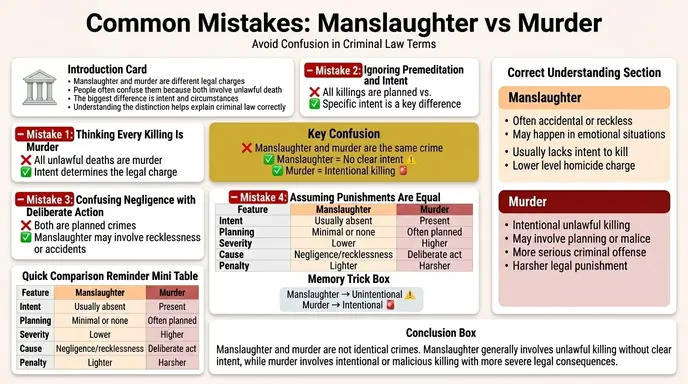
| Mistake | Why It Is Wrong | Correct Understanding |
| Thinking both mean the same thing | Intent differs greatly | Murder usually involves intent |
| Assuming manslaughter is accidental only | Some manslaughter cases involve violence | Intent level matters |
| Ignoring premeditation | Planning strongly affects charges | Premeditation supports murder |
| Believing all killings are murder | Law separates homicide types | Circumstances matter |
| Assuming punishments are equal | Murder penalties are usually harsher | Legal severity differs |
How Search Engines Understand “Difference Between Manslaughter and Murder”
Search engines like Google recognize strong informational and legal intent behind searches such as:
- manslaughter vs murder
- homicide vs murder
- voluntary manslaughter meaning
- first degree murder definition
- legal difference between murder and manslaughter
Google prioritizes content that:
- explains legal concepts clearly
- avoids confusing jargon
- includes examples and comparisons
- answers beginner legal questions
- satisfies educational search intent
Legal education websites, news platforms, and criminal law resources frequently optimize content around these terms because public confusion is common.
Expert Insight: Why Courts Separate Manslaughter and Murder
In practical legal systems, intent matters heavily because criminal law tries to measure both the action and the mindset behind it.
Most beginners focus only on the outcome a person died.
However, courts also analyze:
- intent
- recklessness
- planning
- emotional state
- negligence
- prior behavior
A reckless fatal mistake and a carefully planned killing may both result in death, but the law treats them differently because the mental state behind the act is different.
That distinction is one of the foundations of criminal justice systems worldwide.
Can Manslaughter Become Murder?
Yes, depending on evidence.
If investigators discover planning, malicious intent, or deliberate actions, charges may increase from manslaughter to murder.
Similarly, murder charges can sometimes be reduced to manslaughter if intent cannot be fully proven.
Is Manslaughter Still a Serious Crime?
Absolutely.
Even without intent to kill, manslaughter is still a major criminal offense that can result in:
- prison time
- heavy fines
- felony convictions
- long term legal consequences
FAQ:
What is the main difference between manslaughter and murder?
Murder usually involves intentional killing, while manslaughter involves unlawful killing without full intent or premeditation.
Is manslaughter less serious than murder?
Yes. Manslaughter is generally considered less severe legally because intent is reduced.
What is voluntary manslaughter?
Voluntary manslaughter usually involves emotional situations where someone kills without prior planning.
What is involuntary manslaughter?
Involuntary manslaughter involves reckless or negligent actions causing death unintentionally.
Can reckless driving be manslaughter?
Yes. Fatal reckless driving often leads to manslaughter charges.
Does murder always involve planning?
Not always. Some murder charges involve intentional harm without long term planning.
Can murder charges become manslaughter charges?
Yes. If prosecutors cannot prove intent fully, charges may sometimes be reduced.
Are manslaughter and homicide the same?
No. Homicide is a broad term covering different forms of unlawful killing, including both murder and manslaughter.
Conclusion
Understanding the difference between manslaughter and murder is important because criminal law treats these offenses very differently based on intent, planning, recklessness, and mental state.
Murder usually involves intentional or malicious killing, while manslaughter involves unlawful killing without full intent to kill.
In simple words:
- murder involves deliberate or highly malicious actions
- manslaughter usually involves recklessness, negligence, or emotional situations without premeditation
This distinction affects criminal charges, court decisions, sentencing, and legal outcomes around the world.
Once you understand how intent and state of mind influence criminal law, the difference between manslaughter and murder becomes much easier to recognize.
Discover More Articles!
Difference Between Bits and Bytes: Easy Guide With Examples
Difference Between 1080p and 4K: Which Resolution Is Better?

James Whitmore. Labdiff.com is my english grammar comparision website. I explore the history and evolution of English words. I write detailed comparisons explaining why spellings change over time and how British and American English diverged. My articles add depth and credibility to grammar comparison topics.