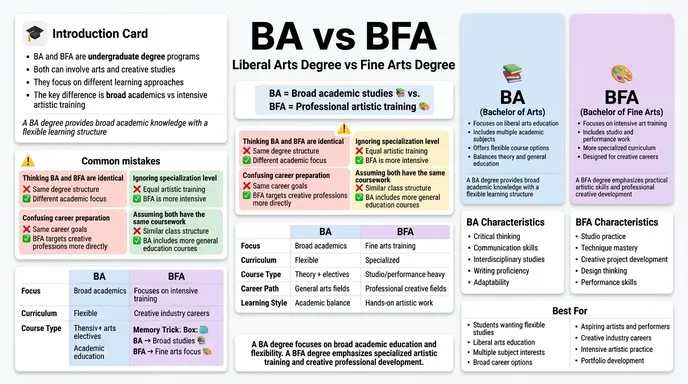
Many students get confused about the difference between BA and BFA when choosing a college degree. Both belong to the arts field, both involve creativity, and both are offered by universities worldwide. But their purpose and career paths are very different.
The difference between BA and BFA mainly comes down to academic focus and practical training. A BA (Bachelor of Arts) offers broader theoretical education, while a BFA (Bachelor of Fine Arts) focuses heavily on professional artistic practice.
For example, a student interested in literature, psychology, or communication may choose a BA. A student planning a career in acting, painting, dance, filmmaking, or graphic design often chooses a BFA.
Universities like Harvard University and New York University offer both types of programs because they serve different goals.
In this guide, you will learn:
- what BA and BFA degrees mean
- key differences between them
- career opportunities
- salary and skill comparisons
- which degree is better for your goals
Let’s understand this clearly.
🟢 Quick Answer: Difference Between BA and BFA
A BA (Bachelor of Arts) is a broader academic degree focused on theory, humanities, and general education.
A BFA (Bachelor of Fine Arts) is a specialized professional degree focused on practical creative and artistic training.
👉 Example:
- Studying English or History = BA
- Studying Acting or Graphic Design = BFA
🟢 Definition of BA and BFA
- BA (Bachelor of Arts): An undergraduate degree focused on liberal arts, humanities, communication, and academic subjects.
- BFA (Bachelor of Fine Arts): An undergraduate degree focused on intensive studio, performance, or creative arts training.
🟢 Pronunciation Guide
- BA → “bee-ay” (US & UK)
- BFA → “bee-eff-ay” (US & UK)
Now let’s explore why colleges separate these two degrees and how they affect careers differently.
🟢 BA vs BFA Comparison Table
| Feature | BA | BFA |
| Full Form | Bachelor of Arts | Bachelor of Fine Arts |
| Focus | Academic & theoretical | Practical & creative |
| Learning Style | Broad education | Specialized training |
| Subjects | Humanities, social sciences | Visual & performing arts |
| Coursework | Balanced/general | Studio-heavy |
| Career Path | Flexible careers | Artistic professions |
| Portfolio Requirement | Usually no | Often required |
| Skill Development | Analytical thinking | Creative performance |
🟢 KEY DIFFERENCES EXPLAINED BETWEEN BA and BFA
1. Academic vs Professional Focus
A BA focuses more on academics and theory.
A BFA focuses more on hands-on artistic work.
👉 Example:
A BA student may write essays about art history.
A BFA student may spend hours creating artwork or rehearsing performances.
2. Course Structure
BA programs include wider general education classes.
BFA programs dedicate most credits to studio or performance work.
This makes BFA programs more intensive creatively.
3. Career Preparation
A BA prepares students for multiple industries.
A BFA prepares students for professional creative careers.
👉 Example:
- BA → marketing, teaching, media
- BFA → animation, acting, fashion design
4. Time Spent Practicing
BFA students spend more time practicing skills physically.
That includes:
- acting rehearsals
- painting
- photography
- music performance
5. Flexibility
BA degrees are usually more flexible for changing careers later.
BFA degrees are more specialized from the start.
6. Portfolio Importance
BFA programs often require:
- auditions
- portfolios
- creative samples
BA programs usually focus more on academic grades.
🟢 What is a BA Degree and How Does It Work?
A BA degree focuses on liberal arts and broad intellectual education.
Common BA majors:
- English
- Psychology
- Sociology
- Political Science
- Communication
Main goal:
Develop:
- critical thinking
- writing ability
- research skills
- communication
Universities like Harvard University emphasize broad academic learning in BA programs.
🟢 What is a BFA Degree and Why is It Different?
A BFA degree focuses heavily on artistic training.
Common BFA majors:
- Acting
- Dance
- Graphic Design
- Film Production
- Painting
- Photography
Main goal:
Prepare students for creative industries through practical experience.
Students often build:
- portfolios
- performances
- exhibitions
- production projects
Schools like Juilliard School are famous for professional-level arts training similar to BFA structures.
🟢 Why BA and BFA Degrees Both Exist
Not all students want the same type of education.
BA exists because:
- students may want flexible careers
- academic study matters
- broad knowledge helps many industries
BFA exists because:
- artistic careers require practice
- creative industries demand portfolios
- technical art skills need intensive training
In real-world hiring, employers often value BFA portfolios more than grades for creative jobs.
🟢 Real-Life Examples of BA and BFA
1. Journalism Career
A student studying communication and writing → BA
2. Acting Career
A student training daily in theater performance → BFA
3. Advertising Industry
Creative directors may come from either degree depending on skills.
4. Film Industry
Film production students often choose BFA for hands-on experience.
Platforms like YouTube and digital media growth have increased demand for creative BFA-related skills.
🟢 Difference and Similarity Table Between BA and BFA
| Feature | BA | BFA | Similarity |
| Meaning | Academic arts degree | Professional arts degree | Both are undergraduate degrees |
| Focus | Theory & humanities | Creative practice | Both involve arts education |
| Learning | Classroom-based | Studio/performance-based | Both teach communication |
| Career Style | Broad career options | Specialized art careers | Both can lead to graduate study |
| Flexibility | High | Moderate | Both build transferable skills |
| Creativity | Moderate emphasis | Heavy emphasis | Both encourage expression |
| Duration | Usually 3–4 years | Usually 4 years | Both require college study |
This table clearly shows the difference and similarity between BA and BFA for quick understanding.
🟢 Common Mistakes with BA and BFA
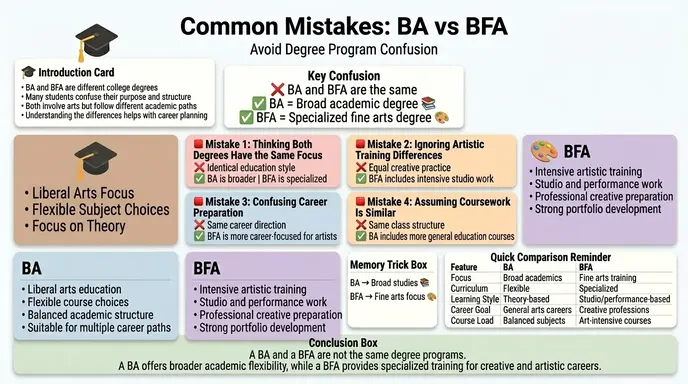
❌ Mistake 1: Assuming BFA Is “Better”
Neither degree is automatically better.
✔ Fix: Match the degree to career goals.
❌ Mistake 2: Ignoring Portfolio Requirements
Many BFA programs require auditions or creative samples.
✔ Fix: Prepare early.
❌ Mistake 3: Thinking BA Is Only Theory
Many BA programs include practical projects too.
✔ Fix: Research course structure carefully.
❌ Mistake 4: Choosing Based Only on Salary
Creative success depends heavily on skill and portfolio quality.
✔ Fix: Focus on strengths and interests.
🟢 Real Life Examples with BA and BFA
- Future teacher studying English → BA
- Aspiring animator building art portfolio → BFA
- Media communication student → BA
- Theater performer training on stage daily → BFA
- Creative marketer → Either degree possible
🟢 When to Choose BA vs BFA
Choose BA When:
- you want broader career flexibility
- you enjoy academics and theory
- you may pursue graduate school later
- you are unsure about one creative specialty
Choose BFA When:
- you want a professional creative career
- you enjoy hands-on artistic work
- you want intensive studio training
- portfolio development matters to your career
🟢 Why People Get Confused Between BA and BFA
Several reasons create confusion:
- both belong to arts education
- university marketing overlaps terms
- some programs combine theory and practice
- modern creative careers blend multiple skills
Social media and online career advice also oversimplify these degrees.
🟢 How Search Engines and Education Systems Understand BA vs BFA
Search engines like Google recognize different search intents:
- “What is a BA degree?” → informational intent
- “BA vs BFA salary” → comparison/career intent
- “Best BFA programs” → educational research intent
Educational platforms and universities optimize content differently because students searching for BFA programs often care more about:
- portfolios
- faculty reputation
- internship opportunities
🟢 Expert Insight
In practical career environments, employers increasingly care about:
- real skills
- portfolio quality
- internships
- communication ability
A strong BFA portfolio can outperform a weak academic record in creative industries. At the same time, BA graduates often adapt more easily across industries because of broader training.
Most successful professionals combine:
- creativity
- communication
- technical skill
- adaptability
That matters more than degree labels alone.
🟢 FAQ
Is a BFA better than a BA?
Not necessarily. It depends on career goals.
What does BFA stand for?
Bachelor of Fine Arts.
Can you become an artist with a BA?
Yes, but BFA programs provide more intensive art training.
Is BA easier than BFA?
BA is often less studio-intensive, but difficulty depends on the subject.
Which degree is better for acting?
BFA is usually better for professional acting training.
Can a BA student work in creative industries?
Yes, many do successfully.
Do BFA programs require portfolios?
Often yes, especially in visual and performing arts.
Which degree is more flexible?
BA generally offers broader flexibility.
🟢 Conclusion
The difference between BA and BFA comes down to breadth versus specialization.
A BA offers broader academic education and flexible career options. A BFA provides focused professional training for creative industries and artistic careers.
Neither degree is universally better. The right choice depends on:
- your career goals
- learning style
- creative interests
- long-term plans
Understanding the difference between BA and BFA helps students make smarter education decisions and choose a path that truly matches their strengths.
Discover More Articles!
Difference Between Simmer and Boil (Cooking Heat Explained)
Difference Between Mayor and Governor (Simple Guide)In 2026

James Whitmore. Labdiff.com is my english grammar comparision website. I explore the history and evolution of English words. I write detailed comparisons explaining why spellings change over time and how British and American English diverged. My articles add depth and credibility to grammar comparison topics.