Many users get confused about the difference between its and it’s with examples because both words look almost identical.
In everyday writing emails, school work, even posts on platforms like Google Docs or Instagram this mistake happens a lot.
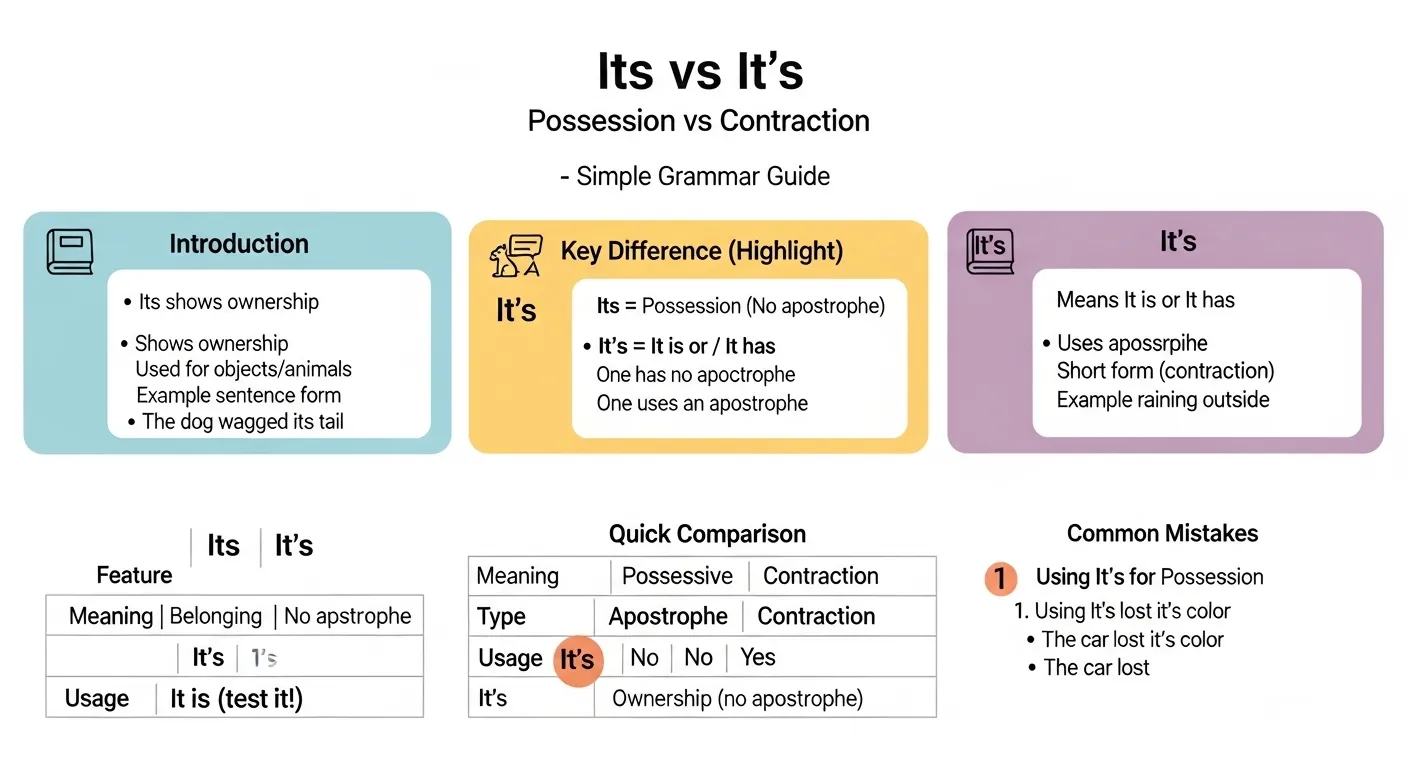
In simple words, the difference between its and it’s with examples comes down to possession vs contraction.
One shows ownership, and the other is a short form of two words. Understanding this small grammar rule can instantly improve your writing.
If you’ve ever wondered “when to use its or it’s?” or “why is it’s wrong here?”, this guide will clear everything step by step. You’ll learn meanings, rules, examples, and real-life usage so you never get confused again.
⚡ Quick Answer: Difference Between Its and It’s
- Its = shows possession (something belongs to “it”)
- It’s = short form of “it is” or “it has”
👉 Example:
- The dog wagged its tail. (correct possession)
- It’s raining outside. (correct it is)
📖 Definition of Difference Between Its and It’s
- Its: A possessive pronoun used to show ownership (belongs to something).
- It’s: A contraction of “it is” or “it has.”
🔊 Pronunciation (US & UK)
- Its → /ɪts/ (US & UK same)
- It’s → /ɪts/ (sounds exactly the same)
👉 Yes, both sound identical. That’s why confusion happens.
Let’s now break down the real difference in detail.
📊 Its vs It’s: Comparison Table
| Feature | Its | It’s | Explanation |
| Meaning | Shows possession | Means “it is” or “it has” | Core difference |
| Type | Possessive pronoun | Contraction | Grammar category |
| Apostrophe | No apostrophe | Has apostrophe | Key visual clue |
| Usage | Ownership | Short form of verb | Functional difference |
| Example | The car lost its wheel | It’s a fast car | Real usage |
| Replaceable | Cannot expand | Can expand to full form | Easy test |
| Common Error | Often mistaken for it’s | Used wrongly in possession | Beginner confusion |
| Context | Objects, animals, ideas | Sentences with verbs | Usage clarity |
This table clearly shows the difference and similarity between its and it’s for quick understanding.
🔍 Key Differences Explained Between Its and It’s
1. Possession vs Contraction
Its shows ownership.
It’s replaces “it is” or “it has.”
👉 Example: The company changed its policy. / It’s changing fast.
2. Apostrophe Rule
Many beginners think apostrophe means possession. Not here.
👉 Example: “John’s book” (correct), but its has no apostrophe.
3. Expand Test
If you can replace it with “it is,” use it’s.
👉 Example: It’s sunny → It is sunny ✔
4. Writing Context
Formal writing (like blogs or emails) requires correct usage.
👉 Example: Google Docs often highlights this mistake.
5. Grammar Role
Its = pronoun
It’s = contraction
👉 Understanding roles avoids confusion.
6. Spoken vs Written Confusion
They sound the same, so mistakes happen in writing not speaking.
🧠 What Is the Rule Behind Its and It’s?
Let’s understand the logic clearly.
In English grammar, possessive pronouns (his, her, its) do NOT use apostrophes.
👉 That’s why:
- its = correct
- it’s = NOT possessive
But contractions always use apostrophes.
👉 Example:
- it’s = it is / it has
This rule exists to keep grammar consistent and readable.
❓ How to Remember the Difference Between Its and It’s
Here’s a simple trick many experts use:
👉 Replace the word with “it is”
- If it makes sense → use it’s
- If not → use its
Example:
- The cat cleaned its fur ❌ (It is fur ❌)
- It’s going to rain ✔ (It is going ✔)
🌍 Real-World Usage (Google, Social Media, Writing)
In real scenarios, this mistake appears everywhere:
- On Google search content, grammar errors reduce trust
- On Instagram captions, wrong usage looks unprofessional
- In emails or business writing, it affects credibility
👉 Example:
A brand writing “The product lost it’s value” looks careless.
Correct grammar improves clarity, authority, and user trust.
📊 Difference + Similarity Table Between Its and It’s
| Feature | Its | It’s | Similarity |
| Meaning | Ownership | “It is/has” | Both relate to “it” |
| Grammar | Pronoun | Contraction | Both used in sentences |
| Apostrophe | No | Yes | Both look similar |
| Sound | Same pronunciation | Same pronunciation | Identical sound |
| Usage | Objects, animals | Actions, states | Common in writing |
| Confusion Level | High | High | Frequently mixed |
| Replacement | Cannot expand | Expandable | Grammar test applies |
This table clearly shows the difference and similarity between its and it’s for quick understanding.
⚠️ Common Mistakes with Its and It’s
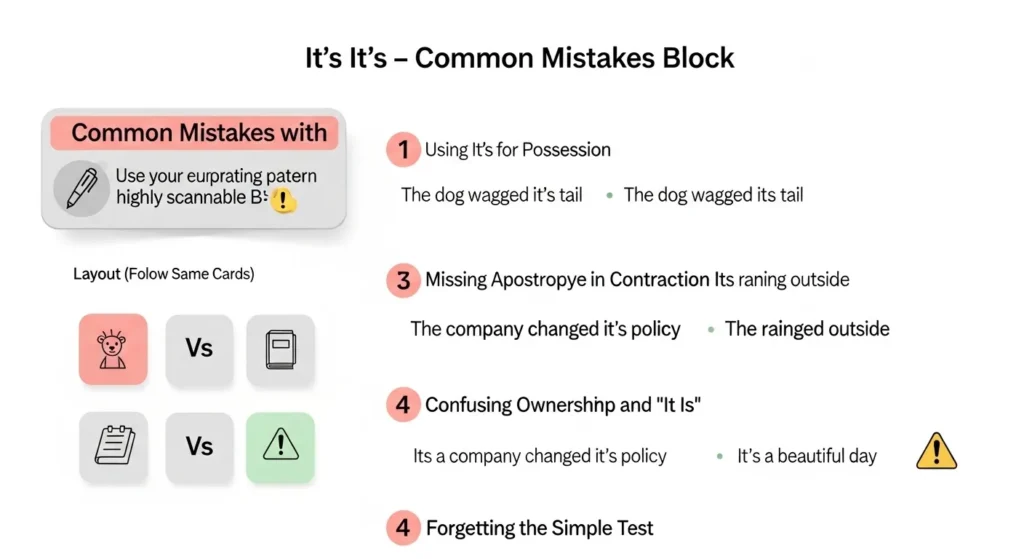
1. Using it’s for possession
❌ The dog hurt it’s leg
✔ The dog hurt its leg
2. Forgetting apostrophe in contraction
❌ Its raining
✔ It’s raining
3. Assuming apostrophe = ownership
Wrong rule here this causes most errors
4. Ignoring context
Always check sentence meaning
5. Overthinking
Sometimes users confuse even simple cases
👉 Fix: Use the “it is” test every time.
🧪 Real-Life Examples with Its and It’s
Personal Use
- The phone lost its signal
- It’s not working properly
Academic Writing
- The system updates its database
- It’s important to check errors
Business Communication
- The company improved its service
- It’s growing rapidly
Social Media
- It’s trending now
- The app changed its design
🎯 When to Use Each
Use Its when:
✔ Showing ownership
✔ Talking about objects, animals, systems
Use It’s when:
✔ You mean “it is”
✔ You mean “it has”
👉 Quick decision rule: Expand it mentally.
🤔 Why People Get Confused in Its and It’s
- Same pronunciation
- Similar spelling
- Misleading apostrophe rule
- Fast typing habits
- Lack of grammar basics
Many beginners assume apostrophe = possession, which is not true here.
🔎 How Search Engines Understand Its and It’s
Search engines like Google analyze grammar to understand content quality.
- Correct usage improves readability signals
- Better grammar = higher trust + engagement
- NLP systems detect sentence meaning
👉 Example:
Content with correct grammar performs better in rankings and user retention.
👨🏫 Expert Insight
In real scenarios, grammar mistakes like confusing its and it’s may seem small but they impact credibility significantly.
Professional writers, editors, and content creators always double-check contractions and possessive forms.
In digital writing especially blogs,content, and academic work this difference matters more than most people realize.
From experience, most errors happen due to speed, not lack of knowledge. Slowing down and applying the “expand test” solves 90% of mistakes instantly.
❓ FAQs
1. What is the main difference between its and it’s?
Its shows possession, while it’s means “it is” or “it has.”
2. Is “it’s” ever possessive?
No. It’s is never possessive.
3. How do I know which one to use?
Replace with “it is.” If it works, use it’s.
4. Why is its used without an apostrophe?
Because possessive pronouns don’t use apostrophes.
5. Is this mistake common?
Yes, even advanced writers make it sometimes.
6. Can grammar tools fix this?
Tools like Google Docs help, but manual understanding is better.
7. Is its formal or informal?
Both its and it’s are used in all writing styles.
8. Do native speakers confuse this?
Yes, especially in fast writing.
🧾 Conclusion
The difference between its and it’s with examples is simple once you understand the core rule: its shows possession, and it’s means “it is” or “it has.”
Many users struggle because both words sound identical and look similar. But with one small trick the “it is” test you can easily avoid mistakes.
In real writing, If you’re creating content, posting online, or sending emails, using the correct form improves clarity and professionalism.
Small grammar details like this build trust with readers and even help content perform better on platforms like Google.
To sum it up:
- Use its for ownership
- Use it’s for “it is” or “it has”
Once you practice with real examples, this confusion disappears completely. And after reading this guide, you won’t need another explanation again.
Discover More Articals!
Difference Between Mono and Strep: Symptoms, Causes & Treatment
Difference Between Pilates and Lagree: Methods, Intensity & Results

James Whitmore. Labdiff.com is my english grammar comparision website. I explore the history and evolution of English words. I write detailed comparisons explaining why spellings change over time and how British and American English diverged. My articles add depth and credibility to grammar comparison topics.