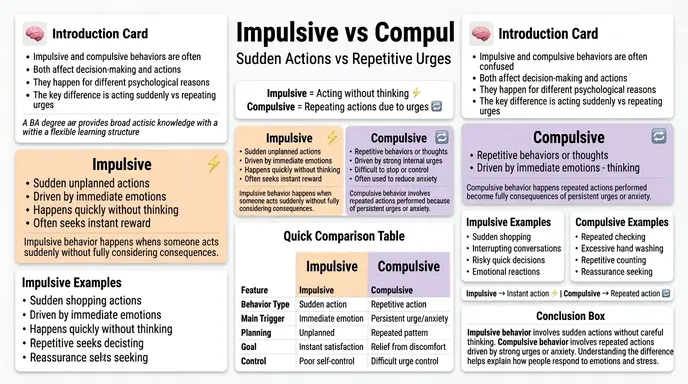
Many people confuse the difference between impulsive and compulsive behavior because both involve actions that can feel difficult to control.
However, they are not the same thing. Understanding this difference can help in daily life, relationships, mental health discussions, and even workplace decisions.
The difference between impulsive and compulsive behavior is mainly about why the action happens.
Impulsive behavior happens suddenly without thinking much about consequences. Compulsive behavior happens repeatedly because a person feels mentally driven or pressured to do it.
For example, buying expensive shoes suddenly because they look exciting is impulsive. Repeatedly checking If the door is locked because of anxiety is compulsive.
Many users search for the difference between impulsive and compulsive because these terms are often used in psychology, social media conversations, self help content, and mental health topics on platforms.
In this guide, you will learn:
- What impulsive and compulsive mean
- Key differences and similarities
- Real life examples
- Common mistakes
- Psychological explanations
- When each behavior becomes unhealthy
By the end, you will clearly understand the difference between impulsive and compulsive behavior in simple words.
Quick Answer: Difference Between Impulsive and Compulsive
The difference between impulsive and compulsive behavior is that impulsive actions happen suddenly without careful thinking, while compulsive actions are repeated behaviors driven by anxiety, obsession, or mental pressure.
Simple Example
- Buying something immediately because you suddenly want it = impulsive
- Repeatedly checking your phone every few minutes because you feel anxious = compulsive
In simple words:
- Impulsive = acting too quickly
- Compulsive = unable to stop repeating
Definition of Impulsive and Compulsive
What Does Impulsive Mean?
Impulsive behavior means acting suddenly without fully thinking about the consequences. These actions are often emotional, spontaneous, and fast.
Example:
Sending an angry text message immediately during an argument.
What Does Compulsive Mean?
Compulsive behavior means repeating actions because of a strong mental urge, anxiety, or obsession, even when the behavior feels unnecessary.
Example:
Checking whether the door is locked over and over again.
Pronunciation of Both Terms
| Word | US Pronunciation | UK Pronunciation |
| Impulsive | im PUHL siv | im PUL siv |
| Compulsive | kuhm PUHL siv | kuhm PUL siv |
Now that the basic meanings are clear, let’s understand the deeper difference between impulsive and compulsive behavior.
Comparison Table: Difference Between Impulsive and Compulsive
| Feature | Impulsive | Compulsive |
| Main Behavior | Sudden action | Repeated behavior |
| Thinking Process | Little planning | Anxiety driven repetition |
| Emotional Trigger | Excitement or emotion | Fear, stress, obsession |
| Goal | Immediate pleasure | Temporary relief from anxiety |
| Control Level | Weak control in the moment | Feeling unable to stop |
| Repetition | May happen once | Usually repetitive |
| Emotional Feeling After | Regret or surprise | Temporary relief then stress |
| Common Examples | Impulse shopping, risky decisions | Repeated checking, obsessive cleaning |
| Mental Health Link | ADHD, emotional dysregulation | OCD, anxiety disorders |
Key Differences Explained Between Impulsive and Compulsive
Impulsive Behavior Happens Quickly
Impulsive actions usually happen within seconds. A person reacts emotionally before logical thinking starts.
Real Life Example
A user sees a flash sale online and buys a phone instantly without checking their budget.
This behavior is common on platforms like Amazon and Instagram because emotional triggers encourage quick decisions.
Compulsive Behavior Is Repetitive
Compulsive actions happen again and again because the brain feels pressured to repeat them.
Real Life Example
A person repeatedly checks if they turned off the stove, even after already checking multiple times.
Impulsive Behavior Seeks Excitement
Impulsivity often involves chasing pleasure, excitement, or emotional release.
Examples
- sudden shopping
- emotional texting
- risky driving
- impulsive eating
These actions focus on immediate satisfaction.
Compulsive Behavior Reduces Anxiety
Compulsions are usually connected to stress or fear.
Example
Someone repeatedly refreshes their email inbox because they worry about missing important updates.
The behavior briefly reduces anxiety, but the stress often returns later.
Impulsive Actions Feel Spontaneous
Impulsive people often describe their behavior as:
“I just did it without thinking.”
These actions are commonly emotional and fast.
Compulsive Actions Feel Hard to Stop
Compulsive behavior often feels mentally exhausting because the person may know the behavior is unnecessary but still feels driven to continue.
Impulsive Behavior May Feel Fun Initially
Many impulsive actions feel exciting at first.
Examples
- surprise trips
- impulsive purchases
- sudden investments
- emotional social media posts
However, consequences may appear later.
Compulsive Behavior Often Creates Stress
Compulsive behavior rarely feels enjoyable long term. Instead, it can create mental fatigue and frustration.
Difference and Similarity Table Between Impulsive and Compulsive
| Feature | Impulsive | Compulsive | Similarity |
| Meaning | Sudden action | Repetitive urge driven action | Both involve self control challenges |
| Motivation | Emotion or pleasure | Anxiety reduction | Both can feel automatic |
| Planning | Unplanned | Repetitive routine | Both may ignore logic |
| Emotional State | Excited or emotional | Nervous or stressed | Emotions influence both |
| Frequency | Occasional | Frequent repetition | Both can become unhealthy |
| Mental Health Link | ADHD, mood disorders | OCD, anxiety disorders | Both affect behavior patterns |
| Awareness | Realized afterward | Often recognized during action | Both may cause regret |
| Consequences | Poor decisions | Mental exhaustion | Both may affect daily life |
This table clearly shows the difference and similarity between impulsive and compulsive for quick understanding.
Why People Get Confused Between Impulsive and Compulsive
Many beginners think both words simply mean “out of control behavior.” That is why confusion happens.
However, the internal motivation is different.
Impulsive Thinking
“I want this right now.”
Compulsive Thinking
“I need to do this or I will feel anxious.”
Modern apps and social media platforms also blur the line between the two. Endless scrolling on Facebook or YouTube may begin impulsively but later become compulsive through repeated habit loops.
What Causes Impulsive Behavior?
Emotional Reactions
Strong emotions like anger, excitement, or sadness can reduce logical thinking.
Example
Sending an emotional message instantly during an argument.
Dopamine Reward Systems
Apps, games, and shopping websites are designed to encourage fast emotional actions.
Platforms like Amazon and Instagram use notifications and limited time offers because impulsive decisions increase engagement and sales.
ADHD and Attention Disorders
Impulsivity is commonly linked with ADHD. People may interrupt conversations, overspend, or make risky decisions quickly.
Difficulty Delaying Rewards
Some individuals struggle to wait for future rewards, causing impulsive choices.
What Causes Compulsive Behavior?
Anxiety and Fear
Compulsions often begin as attempts to reduce stress or fear.
Example
Repeatedly checking whether an email was sent correctly.
Obsessive Thoughts
Compulsive behavior is strongly connected with obsessive compulsive disorder (OCD).
Obsessions create anxiety, while compulsions temporarily reduce it.
Stress Relief Cycles
The brain learns that repetitive behavior provides temporary comfort, which strengthens the habit.
Habit Formation
Over time, compulsive actions may become automatic routines.
Real Life Examples With Impulsive and Compulsive Behavior
Personal Example
Impulsive:
Buying expensive clothes suddenly after feeling stressed.
Compulsive:
Checking the shopping order status every few minutes.
Workplace Example
Impulsive:
Quitting a job immediately after a bad meeting.
Compulsive:
Repeatedly rereading the same email before sending it.
Social Media Example
Impulsive:
Posting emotional content instantly.
Compulsive:
Checking likes and comments constantly.
Financial Example
Impulsive:
Making risky investments emotionally.
Compulsive:
Monitoring stock prices repeatedly throughout the day.
Health Example
Impulsive:
Eating junk food suddenly because of cravings.
Compulsive:
Obsessively counting calories multiple times daily.
When to Use Each Term Correctly
Use “Impulsive” When:
- The action is sudden
- There is little planning
- Emotion drives the behavior
- Immediate pleasure is involved
Examples
- impulsive shopping
- impulsive decisions
- impulsive texting
Use “Compulsive” When:
- The behavior repeats constantly
- Anxiety or obsession is involved
- The person feels unable to stop
- The action becomes ritual like
Examples
- compulsive checking
- compulsive cleaning
- compulsive gambling
🟢 Common Mistakes with Impulsive and Compulsive
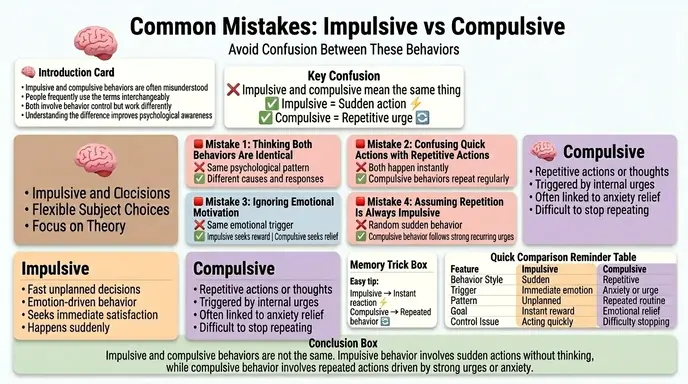
| Mistake | Why It Is Wrong | Correct Understanding |
| Using both words as synonyms | They describe different behaviors | Impulsive is sudden, compulsive is repetitive |
| Thinking compulsions are enjoyable | Many compulsions feel stressful | They usually reduce anxiety temporarily |
| Assuming impulsivity is always intentional | Many impulsive actions are emotional | Emotions can weaken self control |
| Ignoring emotional triggers | Feelings strongly influence both | Context matters |
| Calling every habit compulsive | Normal habits are not compulsions | Compulsions involve mental pressure |
How Search Engines Understand “Difference Between Impulsive and Compulsive”
Search engines like Google analyze user intent carefully when people search terms such as:
- impulsive vs compulsive
- compulsive meaning
- impulsive behavior examples
- compulsive behavior symptoms
- impulsive and compulsive differences
Google’s ranking systems prioritize content that:
- explains concepts clearly
- answers related questions
- includes real life examples
- satisfies beginner confusion
- covers semantic meaning deeply
Platforms like YouTube, Instagram, and Meta also study impulsive and compulsive behavior because user habits affect engagement, scrolling behavior, and watch time.
Behavioral psychology is now important in both mental health research and digital product design.
Expert Insight:
In practical use, professionals focus less on the visible action and more on the reason behind it.
For example:
- Buying something suddenly because of excitement is usually impulsive.
- Repeatedly shopping to reduce anxiety may become compulsive.
Mental health experts also recognize that some people experience both behaviors together, especially in conditions involving anxiety, ADHD, addiction, or emotional regulation problems.
Most beginners only notice the behavior itself. Experts analyze the emotional trigger and psychological pattern behind it.
Can Someone Be Both Impulsive and Compulsive?
Yes. A person can show both impulsive and compulsive behaviors.
Example
Someone may impulsively start gambling for excitement. Over time, that behavior may become compulsive, where the person feels unable to stop.
This overlap is common in behavioral addictions.
Is Impulsive Behavior Always Bad?
No. Some impulsive actions can be positive.
Positive Examples
- spontaneous creativity
- quick emergency reactions
- adventurous experiences
- rapid problem solving
Problems happen when impulsive behavior repeatedly causes harm.
Is Compulsive Behavior Always a Mental Disorder?
Not always. Small repetitive habits are normal.
Compulsive behavior becomes concerning when it:
- disrupts daily life
- causes stress
- harms relationships
- affects work or health
FAQ:
What is the main difference between impulsive and compulsive?
Impulsive behavior is sudden and emotionally driven, while compulsive behavior is repetitive and connected to anxiety or obsession.
Is ADHD impulsive or compulsive?
ADHD is more strongly linked with impulsive behavior.
Is perfectionist impulsive or compulsive?
OCD is mainly associated with compulsive behavior because it involves repetitive actions and obsessive thoughts.
Can impulsive behavior become compulsive?
Yes. Repeated impulsive habits can eventually become compulsive patterns.
Are addictions impulsive or compulsive?
Many addictions begin impulsively and later become compulsive.
Why do people confuse impulsive and compulsive?
Both involve reduced self control and behaviors people may regret later.
Can social media increase impulsive and compulsive behavior?
Yes. Infinite scrolling, notifications, and algorithm based engagement systems can encourage both impulsive and compulsive habits.
Which is more serious: impulsive or compulsive behavior?
Both can become serious depending on how often they happen and how much they affect daily life.
Conclusion
Understanding the difference between impulsive and compulsive behavior is important because the two patterns come from very different psychological causes.
Impulsive behavior is fast, emotional, and focused on immediate reward. Compulsive behavior is repetitive, anxiety driven, and difficult to stop even when the person wants to stop.
In simple words:
- impulsive behavior happens because someone acts too quickly
- compulsive behavior happens because someone feels mentally pressured to repeat an action
This distinction matters in mental health, relationships, education, work environments, and even digital platforms like Google, Instagram, and YouTube that study user behavior patterns and engagement systems.
Once you understand the motivation behind the action, recognizing the difference between impulsive and compulsive becomes much easier in real life situations.
Discover More Articles!
Difference Between Simmer and Boil (Cooking Heat Explained)
Difference Between Mayor and Governor (Simple Guide)In 2026

labdiff.com is my English grammar comparison website where I simplify confusing words, spelling differences, and usage rules through clear explanations and examples. My goal is to help learners, writers, and students understand English easily and use correct grammar with confidence.