Many people search for the difference between checking and savings accounts when opening a bank account, managing money, or planning personal finances.
Since both accounts are offered by banks and credit unions, beginners often assume they work the same way. However, each account is designed for a very different financial purpose.
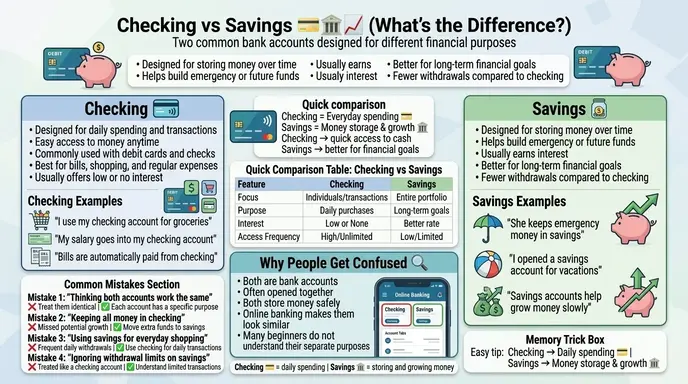
In simple words, a checking account is mainly used for everyday spending and transactions, while a savings account is designed for storing money and earning interest over time.
The difference between checking and savings becomes important when managing bills, budgeting, emergency funds, digital payments, and long-term financial goals.
This guide explains everything clearly, including definitions, features, interest rates, debit card usage, similarities, real-world banking examples, common mistakes, and expert financial insights.
Quick Answer: Difference Between Checking and Savings
The main difference between checking and savings accounts is how the money is intended to be used.
- A checking account is used for daily transactions like payments, shopping, and withdrawals
- A savings account is used for saving money and earning interest over time
For example:
You may use checking to pay utility bills and savings to build an emergency fund.
Definition of Checking and Savings Accounts
- Checking Account: A bank account designed for regular deposits, spending, withdrawals, and daily financial transactions.
- Savings Account: A bank account designed to store money securely while earning interest over time.
Simple Example
- Checking = spending money
- Savings = stored future money
Pronunciation of Both (US & UK)
| Term | US Pronunciation | UK Pronunciation |
| Checking | chek-ing | chek-ing |
| Savings | sey-vings | sey-vings |
Now let’s understand this clearly through banking features, interest systems, and practical money management examples.
Difference Between Checking and Savings Comparison Table
| Feature | Checking Account | Savings Account | Similarity |
| Main Purpose | Daily spending | Saving money | Both store money safely |
| Debit Card Access | Usually included | Sometimes limited | Both linked to banks |
| Interest Earnings | Low or none | Higher interest | Both may earn some interest |
| Withdrawals | Frequent unlimited use | Often limited | Both allow withdrawals |
| Bill Payments | Commonly used | Rarely used | Both support transfers |
| ATM Usage | Regular access | Available but limited | Both accessible digitally |
| Spending Function | High transaction activity | Low transaction activity | Both hold deposits |
| Financial Goal | Convenience | Growth and security | Both support money management |
This table clearly shows the difference and similarity between checking and savings accounts for quick understanding.
Key Differences Explained Between Checking and Savings
Daily Usage vs Saving Purpose
A checking account is designed for money you use regularly. It supports:
- Debit card purchases
- Online payments
- ATM withdrawals
- Direct deposits
A savings account is meant for money you want to keep and grow gradually.
Interest Earnings
Savings accounts usually pay more interest than checking accounts.
A = P(1 + rt)
This simple interest relationship shows how savings can grow over time.
Many banks encourage long-term saving by offering higher interest rates on savings balances.
Transaction Limits
Checking accounts generally allow unlimited everyday transactions.
Savings accounts may limit:
- Monthly transfers
- Withdrawals
- Certain payment activities
This encourages saving behavior rather than constant spending.
Debit Card and Payment Access
Checking accounts commonly include:
- Debit cards
- Checks
- Mobile payment integration
- Automatic bill payment tools
Savings accounts often provide more restricted payment access.
Financial Goal Difference
Checking accounts focus on convenience and spending management.
Savings accounts focus on:
- Emergency funds
- Long-term goals
- Financial stability
- Interest growth
Why Do Checking and Savings Accounts Exist?
Banks separate accounts because people manage money in different ways. Everyday spending money requires fast access, while long-term savings benefit from protection and interest accumulation.
By separating spending and saving functions, banks help users organize finances more effectively and avoid overspending.
How Checking Accounts Work
Everyday Transactions
Checking accounts are used for:
- Grocery shopping
- Paying rent
- Utility bills
- Salary deposits
- Digital purchases
Platforms like PayPal and Apple commonly integrate with checking accounts for payments and mobile wallets.
Direct Deposit
Employers frequently deposit salaries directly into checking accounts because of fast accessibility.
ATM and Debit Usage
Checking accounts support regular cash withdrawals and card payments.
How Savings Accounts Work
Interest Growth
Savings accounts reward users for storing money longer by paying interest.
Emergency Funds
Financial experts often recommend keeping emergency savings separate from daily spending money.
Goal-Based Saving
People commonly use savings accounts for:
- Vacations
- Education
- Home purchases
- Medical emergencies
Difference Between Checking and Savings in Online Banking
| Online Feature | Checking | Savings |
| Online bill pay | Common | Limited |
| Mobile wallet use | Frequent | Less common |
| Debit card linking | Standard | Sometimes unavailable |
| Interest tracking | Low focus | High focus |
| Budgeting tools | Common | Goal-focused |
Modern banks supported by Google and fintech apps increasingly provide advanced mobile banking for both account types.
Difference Between Checking and Savings in Real Life
Paying Monthly Bills
Checking accounts are best for rent, subscriptions, and utilities.
Building an Emergency Fund
Savings accounts help separate emergency money from daily spending.
Online Shopping
Most online purchases connect directly to checking accounts through debit cards.
Financial Planning
People often move money from checking into savings regularly to build financial security.
Digital Banking Apps
Apps like Cash App and Venmo commonly connect to checking accounts for fast transfers and payments.
Difference + Similarity Between Checking and Savings
| Feature | Checking | Savings | Similarity |
| Main Use | Spending | Saving | Both are bank accounts |
| Access Speed | Immediate | Moderate | Both accessible online |
| Interest | Usually lower | Usually higher | Both may earn interest |
| Transactions | Frequent | Limited | Both allow transfers |
| Security | Bank protection | Bank protection | Both insured in many countries |
| Banking Role | Daily money management | Long-term money storage | Both support financial planning |
This table clearly shows the difference and similarity between checking and savings accounts for quick understanding.
Why People Get Confused Between Checking and Savings
Both Hold Money
Both accounts allow deposits and withdrawals, making them seem similar.
Online Banking Access
Modern apps often display checking and savings accounts side-by-side.
Debit Card Confusion
Some savings accounts now offer ATM cards, which blurs the distinction.
Similar Banking Terminology
Banks often promote account packages together, especially to beginners.
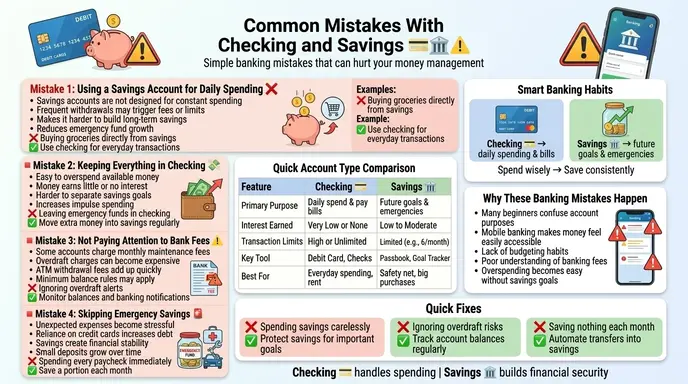
Common Mistakes with Checking and Savings
| Mistake | Correct Understanding |
| Using savings for daily spending | Checking is better for transactions |
| Leaving all money in checking | Savings helps grow money |
| Ignoring interest rates | Savings often earns more |
| Keeping no emergency savings | Separate savings improves security |
| Confusing account purposes | Each account serves different goals |
Quick Memory Tip
- Checking = spending
- Savings = storing and growing money
When to Use Each Account
Use a Checking Account When:
- Paying bills
- Shopping regularly
- Receiving salary deposits
- Using debit cards frequently
Use a Savings Account When:
- Building emergency funds
- Saving for future goals
- Earning interest
- Reducing unnecessary spending
Most financial experts recommend using both together for balanced money management.
Expert Insight
In real financial planning, checking and savings accounts work best when used together instead of choosing one over the other.
Financial advisors often encourage people to keep enough money in checking for monthly expenses while transferring extra funds into savings regularly.
Most beginners accidentally overspend because all their money stays easily accessible in checking accounts.
Separating savings creates a psychological and financial barrier that encourages better money habits.
Modern digital banking has made transfers between accounts much easier, but the core purpose remains the same: checking supports convenience, while savings supports long-term financial stability.
Frequently Asked Questions
What is the main difference between checking and savings?
Checking accounts are for daily spending, while savings accounts are for storing money and earning interest.
Can you use a savings account like checking?
You can withdraw money, but savings accounts are not designed for frequent transactions.
Which account earns more interest?
Savings accounts usually offer higher interest rates.
Do checking accounts come with debit cards?
Yes. Most checking accounts include debit card access.
Is a savings account safer for long-term money?
Yes. Savings accounts help reduce unnecessary spending and grow money gradually.
Should I have both checking and savings accounts?
Most financial experts recommend using both together.
Can salaries go into savings accounts?
Yes, but checking accounts are more commonly used for salary deposits.
Why do banks separate checking and savings?
Because spending money and saving money serve different financial purposes.
Conclusion
Understanding the difference between checking and savings accounts is essential for better money management and smarter financial planning. Although both accounts store money safely, they are designed for very different purposes.
Checking accounts support daily spending, bill payments, debit card use, and fast access to cash, while savings accounts help people build financial security and earn interest over time.
In practical banking, most people benefit from using both accounts together. Checking accounts provide convenience for everyday life, while savings accounts encourage long-term financial growth and emergency preparedness.
Separating spending money from savings also helps reduce overspending and improve budgeting habits.
As digital banking continues evolving through fintech platforms and mobile apps, the basic role of each account remains important.
Once you fully understand the difference between checking and savings, managing personal finances becomes clearer, safer, and more organized.
Discover More Articles!
Difference Between Diamond and Moissanite:With Examples
Difference Between Chromosome and Chromatid:With Examples

James Whitmore. Labdiff.com is my english grammar comparision website. I explore the history and evolution of English words. I write detailed comparisons explaining why spellings change over time and how British and American English diverged. My articles add depth and credibility to grammar comparison topics.