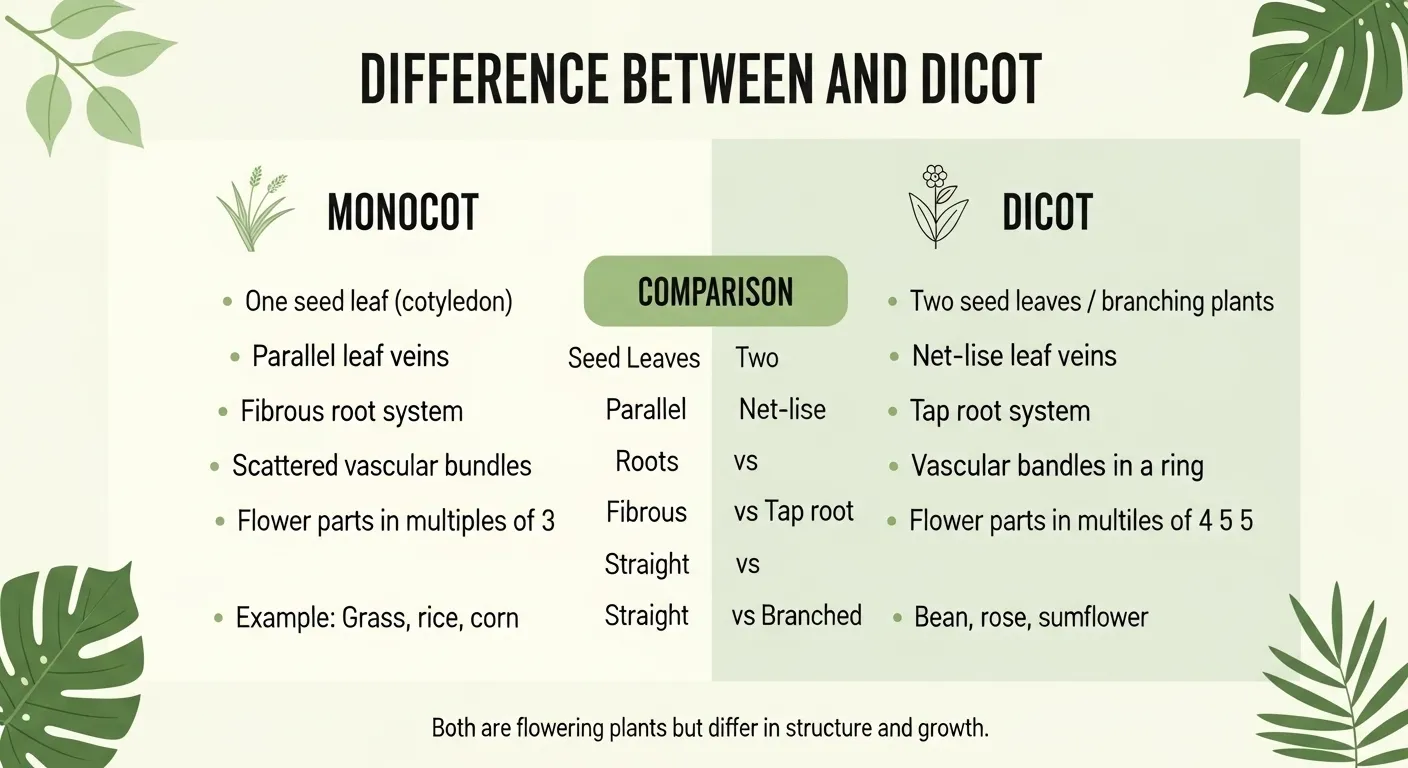
The difference between monocot and dicot is that monocots have one seed leaf, while dicots have two seed leaves.
Both are types of flowering plants. However, they differ in structure, growth, and features.
For example, grass is a monocot. Meanwhile, a bean plant is a dicot.
Many students search this topic in biology. Therefore, this guide explains it in very simple words.
Understanding this difference helps in plant study and identification.
🔑 Key Difference
Monocots have one cotyledon (seed leaf).
In contrast, dicots have two cotyledons.
Monocots show parallel leaf veins.
However, dicots show net-like veins.
🌍 Why It Matters
This difference helps in plant classification.
Monocots grow differently. Therefore, they are easy to identify by leaf pattern.
Dicots have different root and stem systems. As a result, they show varied growth.
In real life, farmers and students use this knowledge to study plants.
🌿 Definition
Monocots are plants with one seed leaf.
Dicots are plants with two seed leaves.
🧠 Nature
Monocots have simple structure. Therefore, they grow in a straight pattern.
Dicots have complex structure. Meanwhile, they branch more.
⚙️ Function
Monocots grow with fibrous roots. These roots spread widely.
Dicots grow with tap roots. These roots grow deep.
🏗️ Structure
Monocot stems have scattered vascular bundles.
In contrast, dicot stems have arranged vascular bundles in a ring.
📌 Usage
Monocots include crops like rice, wheat, and corn.
Dicots include plants like beans, roses, and sunflowers.
🔄 Behavior
Monocots grow upward with less branching.
Dicots grow with branches and wider spread.
🎯 Purpose
Monocots are important for food crops.
Dicots are important for fruits, flowers, and trees.
🍃 Leaf Pattern
Monocot leaves have parallel veins.
Meanwhile, dicot leaves have net-like veins.
🌸 Flower Parts
Monocots have flower parts in multiples of three.
Dicots have flower parts in multiples of four or five.
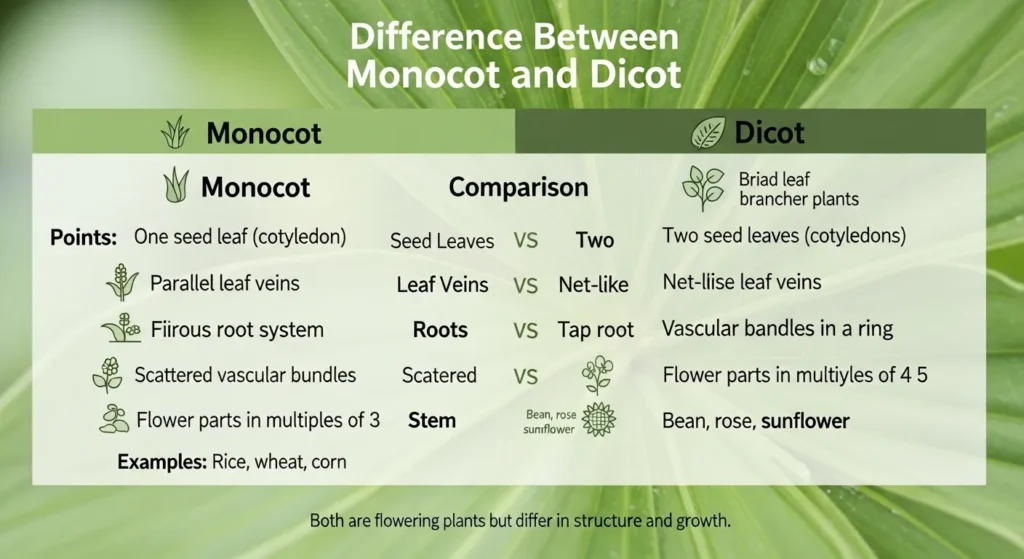
📊 Comparison Table
| Feature | Monocot | Dicot |
| Seed leaves | One | Two |
| Leaf veins | Parallel | Net-like |
| Roots | Fibrous | Tap root |
| Stem structure | Scattered bundles | Ring arrangement |
| Flower parts | Multiples of 3 | Multiples of 4 or 5 |
| Growth | Straight | Branched |
| Examples | Grass, corn | Bean, rose |
🧭 Real-Life Examples
For example, rice and wheat are monocots. Therefore, they show parallel leaf veins.
Meanwhile, bean and sunflower plants are dicots. As a result, they show branched growth.
Another example is roots. Grass has fibrous roots. However, carrot has a tap root.
These examples help in easy identification.
💡 Expert Tip
Look at the leaf veins first. This is the easiest way to identify plant type.
Also check roots and flower parts for confirmation.
Therefore, simple observation helps in quick learning.
Common Google Queries
- monocot vs dicot difference
- what is monocot and dicot
- examples of monocot plants
- examples of dicot plants
- leaf vein difference monocot dicot
- root system monocot vs dicot
- plant classification basics
- monocot features
- dicot features
- biology plant types
❓ FAQs
1. What is a monocot?
A monocot is a plant with one seed leaf and parallel leaf veins.
2. What is a dicot?
A dicot is a plant with two seed leaves and net-like veins.
3. How can I identify them easily?
Check leaf veins and root type. These features are clear.
4. Which has fibrous roots?
Monocots have fibrous roots.
5. Which has tap roots?
Dicots have tap roots.
Difference Between Monocot and Dicot Plants Explained
The difference between monocot and dicot is mainly based on seed leaves, structure, and growth patterns.
Monocots have one cotyledon or seed leaf. Dicots have two cotyledons. This is the main classification feature.
Monocots show parallel leaf veins. Therefore, their leaves look straight and simple. Dicots show net-like veins, which form a branching pattern.
Monocots have fibrous root systems. However, dicots have tap root systems that grow deep into the soil.
Monocot stems have scattered vascular bundles. Meanwhile, dicot stems have vascular bundles arranged in a ring.
Monocots often have flower parts in multiples of three. Dicots have flower parts in multiples of four or five.
Understanding the difference between monocot and dicot helps students and farmers identify plants easily and study plant biology.
Monocot vs Dicot Comparison and Key Differences
Monocot vs dicot is a common biology topic. Monocots are plants with one seed leaf. Dicots are plants with two seed leaves.
Monocots have simple growth patterns. Meanwhile, dicots show branching growth.
People study monocot and dicot differences to understand plant classification. Monocots include crops like wheat and corn. Dicots include plants like beans and flowers.
Monocots have fibrous roots. However, dicots have tap roots.
Both types are important in agriculture and plant science.
Important Biology Terms Related to Monocot and Dicot Plants
Monocot and dicot are plant classification groups in biology. They are part of flowering plants.
Related terms include cotyledon, leaf veins, root system, plant structure, vascular bundles, and plant growth.
Monocots have one cotyledon. Dicots have two cotyledons.
Monocots show parallel venation. Dicots show reticulate venation.
Understanding these terms helps in learning plant biology and classification systems.
Expert Understanding of Monocot and Dicot Plants in Biology
This content is based on standard biology knowledge used in plant science and education.
Monocots and dicots are widely studied in botany. Experts classify plants based on seed leaves, leaf patterns, and root systems.
Biology textbooks and scientific studies use these features to identify plant types.
Students learn monocot and dicot differences as a basic concept in plant classification.
In real-world use, farmers and botanists apply this knowledge for crop study and plant identification.
Therefore, this information reflects widely accepted scientific understanding in biology.
🔎 Quick Summary
Monocots have one seed leaf and parallel veins.
Dicots have two seed leaves and net-like veins.
Both differ in roots, stems, and growth.
🏁 Conclusion
The difference between monocot and dicot is easy to understand when we compare their structure and growth. Monocots have one seed leaf and simple leaf patterns. Therefore, they are easy to identify by parallel veins.
In contrast, dicots have two seed leaves and complex leaf patterns. As a result, they show branching veins and growth.
Monocots have fibrous roots. Meanwhile, dicots have tap roots.
Monocots grow straight. However, dicots grow with branches.
Both plant types are important. Monocots are widely used in crops like rice and wheat. Dicots are common in fruits, flowers, and trees.
Understanding the difference between monocot and dicot helps in plant study, farming, and biology learning.
Discover More Articals!
Difference Between Cotton and Polyester: Complete Fabric Guide
Difference Between Wine and Champagne: With Examples

labdiff.com is my English grammar comparison website where I simplify confusing words, spelling differences, and usage rules through clear explanations and examples. My goal is to help learners, writers, and students understand English easily and use correct grammar with confidence.