Many students, business owners, and beginners search for the difference between microeconomics and macroeconomics because both subjects are closely connected yet focus on completely different parts of the economy.
The terms sound similar, which often creates confusion in classrooms, business discussions, financial news, and competitive exams.
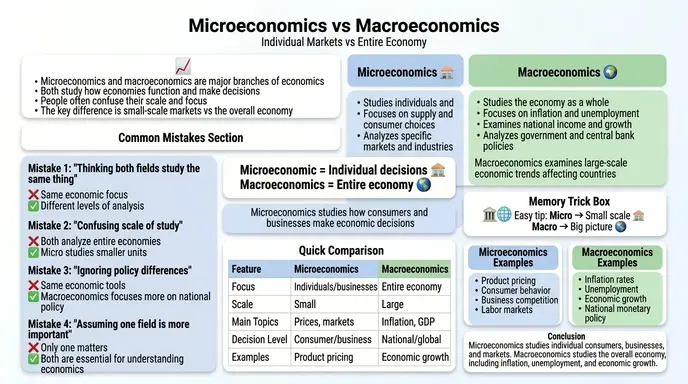
In simple words, microeconomics studies individual economic units like consumers, businesses, and markets, while macroeconomics studies the overall economy of a country or the world.
The difference between microeconomics and macroeconomics becomes especially important when understanding inflation, unemployment, pricing, business decisions, taxation, and government policy.
This guide explains both concepts clearly using practical examples, comparison tables, economic logic, real-world applications, similarities, and expert insights to make the topic easy to understand.
Quick Answer: Difference Between Microeconomics and Macroeconomics
The main difference between microeconomics and macroeconomics is the level of economic analysis.
- Microeconomics focuses on individual consumers, companies, and markets
- Macroeconomics focuses on the economy as a whole, including inflation, GDP, and unemployment
For example:
Studying why coffee prices increase in one city is microeconomics, while studying national inflation rates is macroeconomics.
Definition of Microeconomics and Macroeconomics
- Microeconomics: The branch of economics that studies individual economic behavior, businesses, consumers, and market decisions.
- Macroeconomics: The branch of economics that studies the overall economy, including national income, inflation, unemployment, and economic growth.
Simple Example
- Microeconomics = pricing of one product
- Macroeconomics = economic condition of an entire country
Pronunciation of Both (US & UK)
| Term | US Pronunciation | UK Pronunciation |
| Microeconomics | my-kroh-ek-uh-nom-iks | my-kroh-ee-kuh-nom-iks |
| Macroeconomics | mak-roh-ek-uh-nom-iks | mak-roh-ee-kuh-nom-iks |
Now let’s understand this clearly through markets, government policy, and economic systems.
Difference Between Microeconomics and Macroeconomics Comparison Table
| Feature | Microeconomics | Macroeconomics | Similarity |
| Focus Area | Individuals and businesses | Entire economy | Both study economics |
| Main Concern | Prices and consumer choices | Inflation and growth | Both analyze economic behavior |
| Scope | Small-scale | Large-scale | Both use data and analysis |
| Decision Makers | Consumers and firms | Governments and central banks | Both affect markets |
| Examples | Product pricing | National unemployment | Both influence financial systems |
| Objective | Efficient resource allocation | Economic stability | Both guide policy decisions |
| Market Study | Single markets | National/global markets | Both study supply and demand |
| Usage | Business planning | Economic policymaking | Both affect daily life |
This table clearly shows the difference and similarity between microeconomics and macroeconomics for quick understanding.
Key Differences Explained Between Microeconomics and Macroeconomics
Scope of Study
Microeconomics studies small economic units like:
- Individual buyers
- Households
- Companies
- Specific industries
Macroeconomics studies large-scale economic systems like:
- National economies
- Global trade
- Inflation
- Economic growth
Decision-Making Level
Microeconomics focuses on personal and business decisions.
Example:
A restaurant deciding menu prices uses microeconomic analysis.
Macroeconomics focuses on government and national-level decisions.
Example:
A central bank adjusting interest rates uses macroeconomic analysis.
Price vs Economy
Microeconomics studies individual product pricing and market competition.
Macroeconomics studies overall price levels across the economy, such as inflation.
Employment Focus
Microeconomics analyzes wages and hiring in individual businesses.
Macroeconomics studies national unemployment rates and labor market conditions.
Government Role
Macroeconomics strongly involves government policy, taxation, spending, and monetary systems.
Organizations like International Monetary Fund and World Bank heavily rely on macroeconomic analysis to monitor global economies.
Why Do Microeconomics and Macroeconomics Exist?
Economies are too large and complex to study from only one perspective. Economists separate economic analysis into smaller and larger levels to understand behavior more clearly.
Microeconomics explains how individual choices affect markets, while macroeconomics explains how entire economies function over time.
Together, both branches help governments, businesses, and financial institutions make better decisions.
How Microeconomics Works
Consumer Behavior
Microeconomics studies:
- Why consumers buy products
- How pricing affects demand
- How people make spending decisions
Business Decision-Making
Companies use microeconomics to:
- Set prices
- Analyze competition
- Reduce costs
- Maximize profit
Large companies like Amazon and Apple use microeconomic analysis constantly when adjusting pricing, production, and market strategy.
Supply and Demand
Microeconomics heavily studies supply and demand relationships in individual markets.
Q_d = a – bP
This simplified demand relationship shows how demand changes as price changes.
How Macroeconomics Works
National Income and GDP
Macroeconomics measures economic performance using indicators like Gross Domestic Product (GDP).
genui{“math_block_widget_always_prefetch_v2”:{“content”:”GDP = C + I + G + (X – M)”}}
This formula represents:
- Consumer spending
- Investment
- Government spending
- Exports minus imports
Inflation Analysis
Macroeconomists study why prices rise across the economy.
Central banks monitor inflation carefully because excessive inflation reduces purchasing power.
Unemployment and Economic Growth
Governments use macroeconomic policy to:
- Reduce unemployment
- Stabilize economies
- Encourage investment
- Prevent recessions
Difference Between Microeconomics and Macroeconomics in Real Life
| Situation | Microeconomics | Macroeconomics |
| Coffee shop pricing | Yes | No |
| National inflation | No | Yes |
| Individual consumer spending | Yes | Limited |
| Central bank policy | No | Yes |
| Company hiring decisions | Yes | Indirectly |
| National unemployment | No | Yes |
Many beginners understand economics faster once they connect theory to real-world situations.
Difference Between Microeconomics and Macroeconomics in Business
Microeconomics in Business
Businesses use microeconomics for:
- Pricing products
- Market competition
- Consumer analysis
- Profit strategies
Macroeconomics in Business
Companies monitor macroeconomics for:
- Interest rates
- Economic recessions
- Inflation trends
- Currency exchange rates
Technology companies like Google track both microeconomic and macroeconomic trends because global economic changes directly affect advertising, hiring, and consumer spending.
Real Life Examples with Microeconomics and Macroeconomics
Grocery Store Pricing
A supermarket adjusting milk prices uses microeconomic principles.
National Inflation
Rising fuel prices affecting the entire country relate to macroeconomics.
Smartphone Industry
Companies analyze customer demand, competition, and pricing through microeconomics.
Government Tax Policy
Tax reductions or stimulus packages are macroeconomic tools.
Social Media Advertising
Platforms like Meta use microeconomic data for ad pricing while also monitoring macroeconomic conditions that influence advertiser budgets.
Difference + Similarity Between Microeconomics and Macroeconomics
| Feature | Microeconomics | Macroeconomics | Similarity |
| Study Level | Individual markets | Entire economy | Both analyze economic systems |
| Main Goal | Efficient choices | Economic stability | Both support decision-making |
| Focus | Consumers and firms | National indicators | Both involve supply and demand |
| Analysis Type | Detailed small-scale | Broad large-scale | Both use economic models |
| Users | Businesses and consumers | Governments and institutions | Both affect daily life |
| Economic Concern | Product prices | Inflation and GDP | Both influence markets |
This table clearly shows the difference and similarity between microeconomics and macroeconomics for quick understanding.
Why People Get Confused Between Microeconomics and Macroeconomics
Similar Names
The words differ mainly by “micro” and “macro,” which many students mix up.
Both Study Economics
Since both belong to economics, beginners assume they cover the same concepts.
Overlapping Topics
Some issues like employment and pricing connect both fields indirectly.
Academic Complexity
Textbooks often introduce both subjects together, creating confusion early in learning.
Common Mistakes with Microeconomics and Macroeconomics
| Mistake | Correct Understanding |
| Thinking both are identical | They analyze different scales |
| Assuming macroeconomics ignores individuals | Individual behavior still affects economy |
| Confusing inflation with product pricing | Inflation is economy-wide |
| Ignoring government role in macroeconomics | Policy is central to macroeconomics |
| Treating business pricing as macroeconomics | Pricing is usually microeconomics |
Quick Memory Tip
- Micro = small individual units
- Macro = large overall economy
When to Use Microeconomics or Macroeconomics
Use Microeconomics When:
- Studying businesses or consumers
- Analyzing product pricing
- Understanding market competition
- Examining supply and demand
Use Macroeconomics When:
- Studying inflation or unemployment
- Analyzing national growth
- Discussing government policy
- Understanding recessions and GDP
Expert Insight
In real-world economics, professionals rarely separate microeconomics and macroeconomics completely because both constantly influence each other.
A national recession, for example, affects individual businesses, while millions of consumer choices collectively affect economic growth and inflation.
Business analysts often focus more on microeconomics for pricing and strategy decisions, while policymakers rely heavily on macroeconomics for taxation, interest rates, and employment planning.
Experienced economists understand that studying only one side gives an incomplete picture of how economies truly function.
This interconnected relationship is one reason modern economic analysis has become increasingly data-driven and technology-supported.
Frequently Asked Questions
What is the main difference between microeconomics and macroeconomics?
Microeconomics studies individuals and businesses, while macroeconomics studies the economy as a whole.
Which is easier, microeconomics or macroeconomics?
It depends on the learner. Some people find business-focused microeconomics easier, while others prefer broader macroeconomic concepts.
Does microeconomics affect macroeconomics?
Yes. Individual consumer and business decisions collectively influence the overall economy.
What is an example of microeconomics?
Studying product pricing or consumer demand is microeconomics.
What is an example of macroeconomics?
Studying national inflation or unemployment is macroeconomics.
Why is macroeconomics important?
It helps governments manage economic growth, inflation, and employment.
Do businesses use microeconomics?
Yes. Businesses use it for pricing, competition, and production decisions.
Is GDP part of macroeconomics?
Yes. GDP is a major macroeconomic indicator.
Conclusion
Understanding the difference between microeconomics and macroeconomics becomes much easier once you focus on the scale of analysis.
Microeconomics studies individual consumers, businesses, and markets, while macroeconomics studies broader economic systems such as inflation, unemployment, GDP, and national growth.
Although both branches of economics are connected, they serve different purposes. Microeconomics helps businesses and individuals make pricing and purchasing decisions, while macroeconomics helps governments and financial institutions manage economic stability and growth.
In practical life, both fields influence everyday experiences, from product prices and wages to taxes, interest rates, and job opportunities.
Modern economies depend heavily on understanding both small-scale market behavior and large-scale economic trends.
Once you fully understand the difference between microeconomics and macroeconomics, economic news, business decisions, and government policies become much easier to interpret and analyze.
Discover More Articles!
Difference Between Chromosome and Chromatid:With Examples
Difference Between Diamond and Moissanite:With Examples

labdiff.com is my English grammar comparison website where I simplify confusing words, spelling differences, and usage rules through clear explanations and examples. My goal is to help learners, writers, and students understand English easily and use correct grammar with confidence.