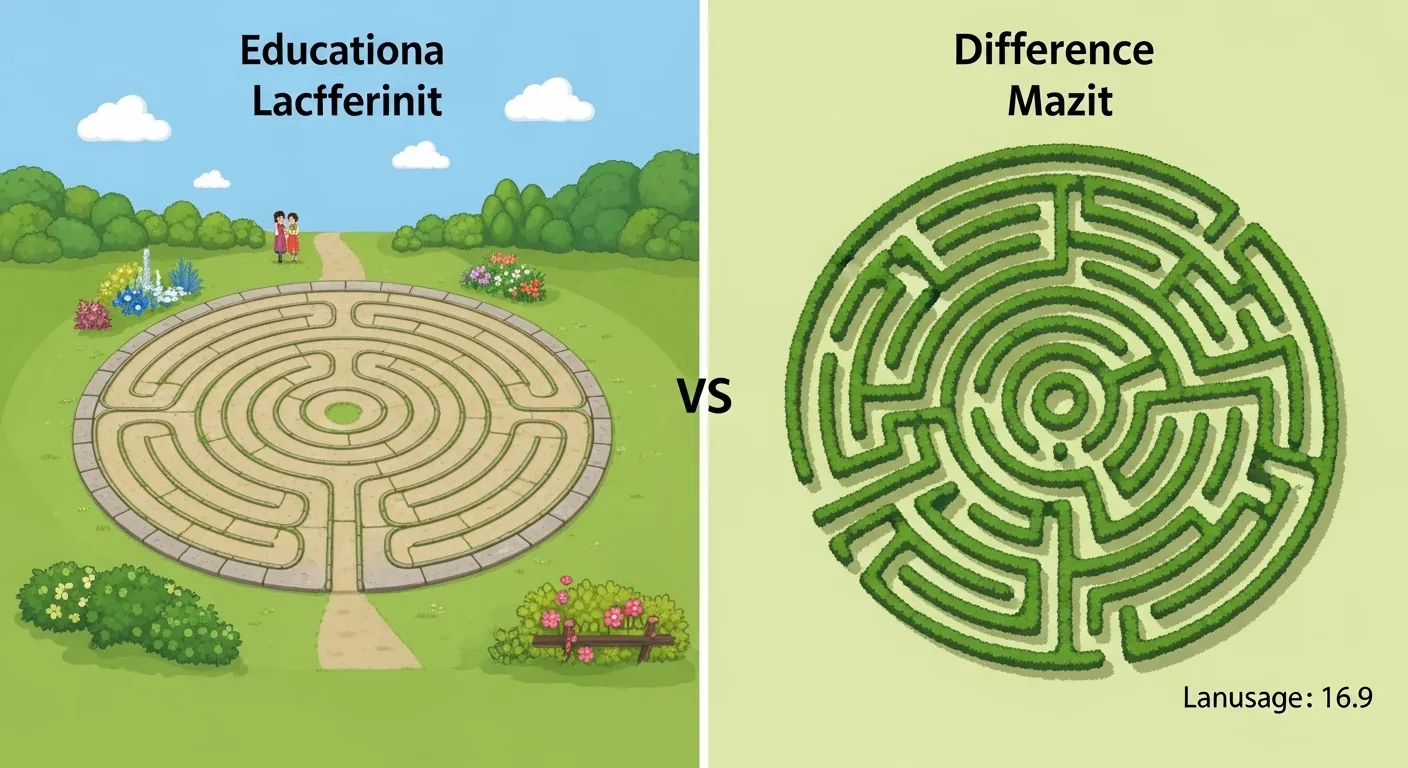
A labyrinth is a single, non branching path leading to the center, while a maze has multiple branching paths and dead ends designed to confuse.
Many people think the words labyrinth and maze mean the same thing. Both describe complex paths or designs that people walk through.
They are often used in gardens, parks, and puzzles. Because they look similar, many people confuse them. However, there is a clear difference between labyrinth vs maze.
A labyrinth is a single path that leads to the center. It does not have branches or dead ends. People usually walk through it for meditation or relaxation.
A maze, on the other hand, is a puzzle. It contains many paths, turns, and dead ends. The goal is to find the correct route to reach the exit.
Understanding the difference between labyrinth or maze helps people appreciate their history and purpose.
Labyrinths are often used for spiritual or symbolic journeys. Mazes are designed mainly for entertainment and problem solving.
Learning the difference between labyrinth and maze makes it easier to understand these fascinating designs.
📖 Definitions
📌 Definition of Labyrinth
A labyrinth is a circular or winding path that leads to a center point. It has only one path. There are no choices or dead ends.
People walk through a labyrinth slowly and follow the path until they reach the center. The purpose is usually reflection, meditation, or relaxation.
Example:
A stone labyrinth in a garden where visitors walk quietly toward the center and then return along the same path.
📌 Definition of Maze
A maze is a puzzle made of many paths and walls. It includes multiple routes and dead ends.
The goal of a maze is to find the correct path from the entrance to the exit.
Example:
A hedge maze in a park where visitors must solve the puzzle to reach the exit.
Labyrinth vs Maze: Understanding the Main Difference 🌀
Many people search for labyrinth vs maze because the two structures appear similar at first glance. Both involve pathways and movement, but their design and purpose are very different.
The main difference between labyrinth and maze is that a labyrinth contains one continuous path, while a maze contains multiple routes and choices.
Examples:
✔ A labyrinth leads people through one winding route to the center.
✔ A maze challenges people to find the correct path among many options.
People frequently ask “what is the difference between labyrinth and maze?” The answer is simple:
👉 Labyrinth = one path, no dead ends
👉 Maze = many paths, dead ends, and decisions
This distinction also changes the experience. A labyrinth creates a peaceful and reflective journey, while a maze creates challenge and problem-solving.
Understanding the labyrinth maze difference helps learners, travelers, and puzzle lovers recognize why both designs exist and how each serves a different purpose.
🔍 Difference Between Maze and Labyrinth
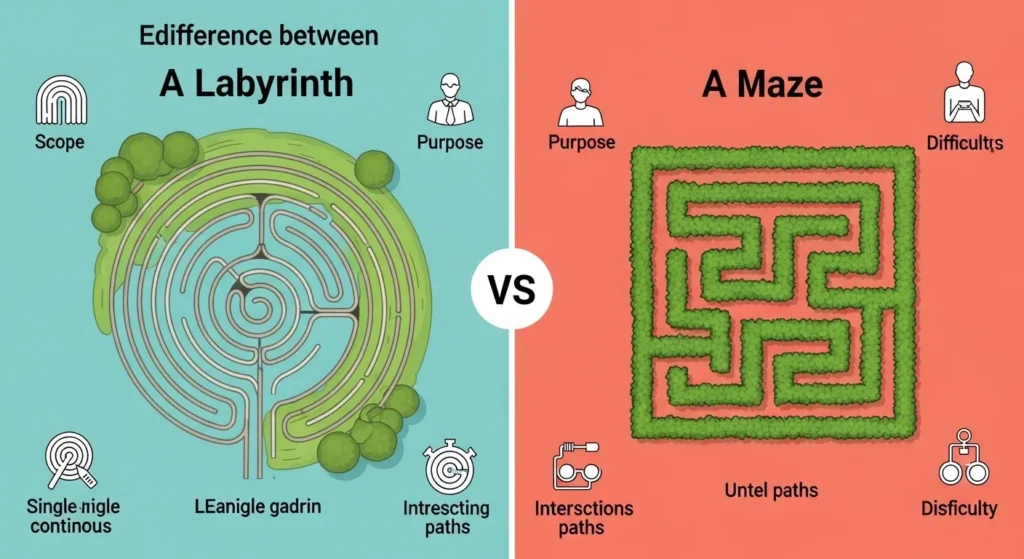
1️⃣ Scope
Labyrinth:
A single continuous path.
No branches or choices.
Maze:
Multiple paths and routes.
Contains choices and turns.
Examples
Labyrinth example:
A circular walking pattern in a garden.
Maze example:
A puzzle made of tall hedges.
2️⃣ Purpose
Labyrinth:
Used for meditation and reflection.
Encourages calm and focus.
Maze:
Used as a puzzle or game.
Encourages problem solving.
Examples
Labyrinth example:
People walking quietly in a spiritual garden.
Maze example:
Children solving a puzzle maze.
3️⃣ Structure
Labyrinth:
One winding path leading to the center.
No dead ends.
Maze:
Complex structure with many branches.
Includes dead ends.
Examples
Labyrinth example:
A spiral path made with stones.
Maze example:
A garden maze with multiple intersections.
4️⃣ Difficulty Level
Labyrinth:
Not difficult to navigate.
You simply follow the path.
Maze:
Challenging and confusing.
You must choose the correct path.
Examples
Labyrinth example:
A visitor slowly walking the path.
Maze example:
A person searching for the exit.
5️⃣ Historical Origin
Labyrinth:
Ancient symbol used in many cultures.
Often associated with spirituality.
Maze:
Developed later as a puzzle.
Popular in gardens and entertainment.
Examples
Labyrinth example:
Ancient stone labyrinths found in Europe.
Maze example:
Renaissance garden hedge mazes.
6️⃣ Navigation
Labyrinth:
Only one route to follow.
No decision making required.
Maze:
Many routes available.
Requires decision making.
Examples
Labyrinth example:
Following the path to the center.
Maze example:
Choosing between several corridors.
7️⃣ Design
Labyrinth:
Usually circular or spiral design.
Symmetrical patterns.
Maze:
Irregular and complex design.
Multiple intersections.
Examples
Labyrinth example:
A circular pattern made of tiles.
Maze example:
A square puzzle maze.
8️⃣ Cultural Role
Labyrinth:
Used in spiritual practices.
Symbolizes a journey inward.
Maze:
Used in games and entertainment.
Represents challenge and adventure.
Examples
Labyrinth example:
Meditation labyrinths in churches.
Maze example:
Amusement park hedge mazes.
Labyrinths and Mazes in Real Life 🏰
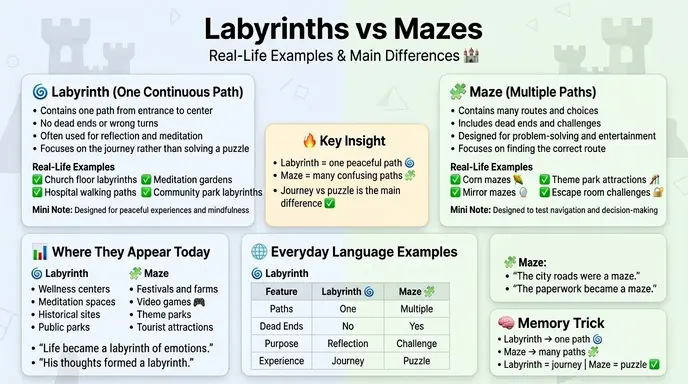
Labyrinths and mazes appear in many places around the world and serve different purposes depending on their design.
abyrinths are commonly found in meditation gardens, churches, hospitals, and peaceful outdoor spaces where visitors walk slowly for reflection and relaxation.
Mazes are usually designed for entertainment and challenge. People often see them in amusement parks, puzzle books, escape attractions, and cornfield events.
Examples:
✔ Garden labyrinths used for mindfulness and quiet walking
✔ Hedge mazes designed for exploration and fun
✔ Simple branching mazes with multiple paths for children and puzzle activities
Although both involve moving through pathways, their goals remain different. One encourages inner focus, while the other encourages navigation and decision-making skills.
This difference explains why labyrinths and mazes continue to remain popular in education, recreation, and cultural settings.
9️⃣ Examples
Labyrinth Examples
Stone labyrinths
Meditation labyrinth gardens
Church labyrinth designs
Maze Examples
Hedge mazes
Puzzle book mazes
Cornfield mazes
🔟 Key Difference Summary
The main difference between labyrinth and maze is their structure and purpose.
A labyrinth has one path leading to the center and is used for meditation or reflection.
A maze has many paths with dead ends and is designed as a puzzle or challenge.
Understanding the difference between labyrinth and maze helps people recognize their unique designs and uses.
🏁 Conclusion
The difference between labyrinth and maze lies mainly in their design, purpose, and complexity. Both involve paths and movement through a structured layout, but their goals are very different.
A labyrinth is a single path design that leads to the center. It is not meant to confuse or challenge the walker.
Instead, it encourages slow movement, reflection, and calm thinking. People often use labyrinths in spiritual settings or peaceful gardens where the focus is on mindfulness and relaxation.
A maze, on the other hand, is a puzzle. It includes multiple paths, intersections, and dead ends. The goal is to find the correct route to reach the exit.
Mazes are commonly used in games, amusement parks, and puzzle books because they provide challenge and entertainment.
Another important difference between labyrinth and maze is the experience they offer. A labyrinth offers a peaceful journey with a guaranteed path to the center. A maze creates uncertainty and requires decision making.
Understanding the difference between labyrinth and maze helps people appreciate both structures. Each has its own purpose and history.
If someone enjoys quiet reflection in a labyrinth or the excitement of solving a maze puzzle, both designs remain fascinating parts of human creativity.
Discover More Articals!
🛠️ Difference Between Steel and Metal: Simple Guide
⚡ Difference Between Ground and Neutral: Complete Guide
🎬 Difference Between Actor and Actress: Simple Guide

James Whitmore. Labdiff.com is my english grammar comparision website. I explore the history and evolution of English words. I write detailed comparisons explaining why spellings change over time and how British and American English diverged. My articles add depth and credibility to grammar comparison topics.