Many biology students and beginners get confused about the difference between chromosome and chromatid because the two terms are closely connected in genetics and cell division.
They often appear together in topics like mitosis, meiosis, DNA replication, and inheritance, which makes understanding them even more important.
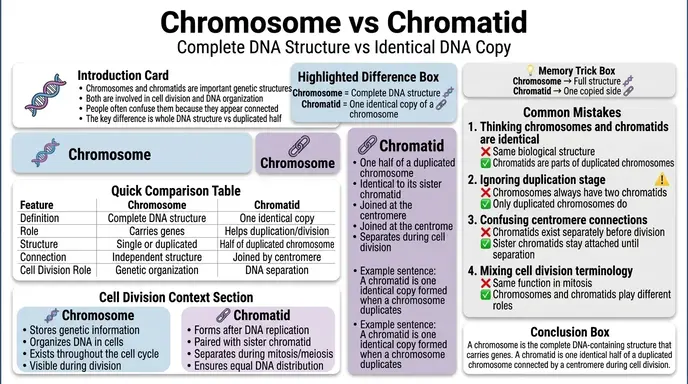
In simple words, a chromosome is a complete DNA structure carrying genetic information, while a chromatid is one identical half of a duplicated chromosome.
The difference between chromosome and chromatid mainly appears during cell division when DNA copies itself before a cell splits.
This guide explains chromosomes and chromatids in simple language, including definitions, functions, structure, similarities, real-life biological importance, and practical examples that make the topic easy to understand.
Quick Answer: Difference Between Chromosome and Chromatid
The main difference between chromosome and chromatid is their structure and stage in cell division.
- A chromosome is a DNA-containing structure carrying genes
- A chromatid is one identical copy of a duplicated chromosome
For example:
Before DNA replication, a chromosome consists of one strand. After replication, it contains two sister chromatids joined together.
Definition of Chromosome and Chromatid
- Chromosome: A thread-like DNA structure containing genetic information inside a cell nucleus.
- Chromatid: One identical half of a duplicated chromosome connected by a centromere.
Simple Example
- One chromosome before copying = single structure
- One chromosome after copying = two chromatids joined together
Pronunciation of Both (US & UK)
| Word | US Pronunciation | UK Pronunciation |
| Chromosome | kroh-muh-sohm | kroh-muh-sohm |
| Chromatid | kroh-muh-tid | kroh-muh-tid |
Now let’s understand this clearly through cell division, DNA structure, and genetics.
Difference Between Chromosome and Chromatid Comparison Table
| Feature | Chromosome | Chromatid | Similarity |
| Definition | Complete DNA structure | Half of duplicated chromosome | Both contain DNA |
| Structure | Single or duplicated form | One identical copy | Both carry genes |
| Formation | Exists throughout cell cycle | Forms after DNA replication | Both appear in nucleus |
| Number | Counted as chromosomes | Two chromatids form one chromosome | Both involved in division |
| Connection | May contain chromatids | Joined by centromere | Both linked genetically |
| Function | Stores hereditary information | Helps equal DNA distribution | Both support inheritance |
| Appearance | Visible during division | Visible after replication | Both studied in genetics |
| Role in Cell Division | Main genetic unit | Separates during mitosis/meiosis | Both essential for reproduction |
This table clearly shows the difference and similarity between chromosome and chromatid for quick understanding.
Key Differences Explained Between Chromosome and Chromatid
Structure Difference
A chromosome may exist as a single structure or as two joined chromatids after DNA replication. A chromatid is specifically one-half of the duplicated chromosome.
DNA Replication Stage
Chromatids only appear after DNA replication occurs during the cell cycle.
Real-life biology example:
During mitosis, DNA duplicates first, creating two sister chromatids that later separate into daughter cells.
Functional Difference
Chromosomes store and organize genetic information. Chromatids mainly help distribute identical genetic material evenly during cell division.
Connection Through Centromere
Two sister chromatids stay attached at a region called the centromere until cell division separates them.
Role in Genetics
Chromosomes determine inherited traits such as eye color, blood type, and many biological characteristics. Chromatids ensure accurate copying of those traits into new cells.
Appearance During Cell Division
Chromosomes become condensed and visible under microscopes during mitosis and meiosis. Chromatids become clearly distinguishable only after duplication.
Why Do Chromosomes and Chromatids Exist?
The human body constantly creates new cells for growth, repair, and reproduction. To keep genetic information accurate, DNA must copy itself carefully before cells divide.
Chromosomes organize DNA efficiently, while chromatids help ensure each new cell receives identical genetic information. Without chromatids, cells could lose or misplace DNA during division.
Modern genetics research supported by organizations like World Health Organization and biotechnology companies increasingly studies chromosome behavior to understand inherited diseases and genetic disorders.
How Chromosomes and Chromatids Work in Cell Division
Chromosomes Before Replication
Before DNA copying:
- Each chromosome contains one DNA molecule
- No sister chromatids exist yet
Chromosomes After Replication
After DNA copying:
- Each chromosome forms two identical sister chromatids
- Both chromatids remain attached by a centromere
Chromatid Separation
During mitosis:
- Sister chromatids separate
- Each chromatid becomes an independent chromosome in the new cell
This process ensures accurate genetic inheritance.
Difference Between Chromosome and Chromatid in Mitosis
| Stage | Chromosome Activity | Chromatid Activity |
| Interphase | DNA replication begins | Sister chromatids form |
| Prophase | Chromosomes condense | Chromatids become visible |
| Metaphase | Chromosomes align | Chromatids remain connected |
| Anaphase | Chromosome count changes | Chromatids separate |
| Telophase | New chromosomes form | Chromatids become chromosomes |
Many students struggle with this topic because chromosome names and numbers change during different stages of mitosis.
Difference Between Chromosome and Chromatid in Meiosis
Chromosomes in Meiosis
Chromosomes pair with homologous chromosomes and exchange genetic material.
Chromatids in Meiosis
Chromatids eventually separate to create reproductive cells with half the normal chromosome number.
This process creates genetic diversity in humans and animals.
Real Life Examples with Chromosome and Chromatid
Human Body Growth
Every time skin cells divide, chromosomes replicate and chromatids help distribute DNA evenly.
Genetic Inheritance
Parents pass chromosomes to children, carrying inherited traits and genetic information.
Medical Research
Scientists study chromosome abnormalities to understand conditions like Down syndrome and certain cancers.
Platforms and research databases supported by Google increasingly assist scientists with genetic data analysis and genome research.
Biotechnology Industry
Modern laboratories examine chromosome behavior during drug development and disease testing.
Education and Microscopy
Students observe chromosomes and chromatids during microscope-based biology experiments.
Difference + Similarity Between Chromosome and Chromatid
| Feature | Chromosome | Chromatid | Similarity |
| DNA Content | Contains DNA | Contains identical DNA | Both carry genes |
| Shape | Single or duplicated | Half structure | Both visible during division |
| Function | Stores information | Assists distribution | Both essential in genetics |
| Cell Cycle Role | Present throughout cycle | Appears after replication | Both active in division |
| Connection | May contain chromatids | Attached by centromere | Both genetically linked |
| Biological Importance | Inheritance | DNA accuracy | Both support reproduction |
This table clearly shows the difference and similarity between chromosome and chromatid for quick understanding.
Why People Get Confused Between Chromosome and Chromatid
Similar Terminology
The words sound almost identical, especially for beginners.
Connected Structures
Chromatids are physically part of chromosomes after DNA replication.
Changing Cell Division Stages
A chromatid later becomes a chromosome after separation, which confuses many students.
Complex Biology Diagrams
Textbooks often show X-shaped chromosomes without explaining that each side is a chromatid.
Common Mistakes with Chromosome and Chromatid
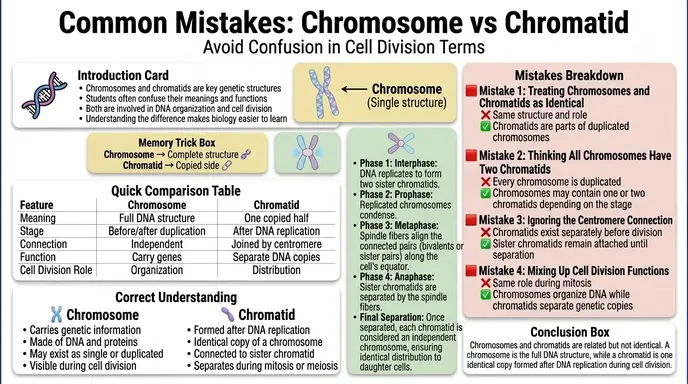
| Mistake | Correct Understanding |
| Thinking chromosome and chromatid are identical | Chromatid is part of duplicated chromosome |
| Confusing chromosome numbers after replication | Replication doubles chromatids, not chromosome count |
| Ignoring centromere role | Centromere connects sister chromatids |
| Assuming chromatids exist permanently | They appear after DNA replication |
| Misreading X-shaped chromosome diagrams | Each half is one chromatid |
Quick Memory Tip
- Chromosome = full DNA package
- Chromatid = one copied half of that package
When to Use Each Term
Use “Chromosome” When:
- Referring to genetic structures generally
- Discussing inheritance or DNA organization
- Talking about chromosome numbers
Use “Chromatid” When:
- Referring to duplicated chromosome halves
- Explaining mitosis or meiosis
- Discussing DNA separation during division
Expert Insight
In real biology education, one of the biggest reasons students struggle with genetics is that chromosome structures constantly change during the cell cycle.
A chromosome can exist as a single strand before replication and as two sister chromatids afterward.
Biologists and medical researchers focus less on memorizing diagrams and more on understanding timing during cell division. O
nce students understand when chromatids appear and why they separate, the entire concept becomes much easier.
This understanding is especially important in modern genetics, cancer research, fertility science, and biotechnology industries where chromosome behavior directly affects diagnosis and treatment research.
Frequently Asked Questions
What is the main difference between chromosome and chromatid?
A chromosome is a complete DNA structure, while a chromatid is one identical half of a duplicated chromosome.
Are sister chromatids identical?
Yes. Sister chromatids contain identical genetic information copied during DNA replication.
When do chromatids form?
Chromatids form after DNA replication during interphase.
Do chromatids become chromosomes?
Yes. After separation during cell division, each chromatid becomes an independent chromosome.
What connects sister chromatids?
A structure called the centromere connects them.
Are chromosomes always duplicated?
No. Chromosomes exist in single or duplicated forms depending on the cell cycle stage.
Why are chromosomes important?
Chromosomes store and transmit hereditary genetic information.
What is an example of chromosome function?
Human chromosomes carry genes responsible for traits like eye color and blood type.
Conclusion
Understanding the difference between chromosome and chromatid becomes much easier once you focus on cell division and DNA replication. A chromosome is the complete genetic structure carrying hereditary information, while a chromatid is one identical half formed after DNA duplication.
Although the two terms are closely related, they are not identical. Chromosomes organize and store genetic material, while chromatids help distribute copied DNA accurately into new cells during mitosis and meiosis. This distinction is essential in biology, genetics, medicine, and biotechnology.
Many students become confused because chromatids later become chromosomes after separation.
However, once you understand the timing and structure changes during the cell cycle, the concept becomes much clearer.
In modern science, understanding chromosomes and chromatids is important for studying inheritance, genetic disorders, cancer research, fertility science, and advanced medical technologies.
Knowing the difference between chromosome and chromatid provides a strong foundation for learning genetics and cell biology more effectively.
Discover More Articles!
Difference Between Intra and Inter Explained Simply (With Real Examples)
Difference Between Cats and Dogs:With In 30 Seconds 2026

James Whitmore. Labdiff.com is my english grammar comparision website. I explore the history and evolution of English words. I write detailed comparisons explaining why spellings change over time and how British and American English diverged. My articles add depth and credibility to grammar comparison topics.