Many beginners feel confused about the difference between piano and keyboard because both instruments look similar at first glance. They both have black and white keys, produce musical notes, and are used in modern music.
But in reality, the difference between piano and keyboard is much bigger than appearance. They differ in sound production, key feel, portability, learning experience, and overall purpose.
A traditional piano creates sound using real strings and hammers, while a keyboard is an electronic instrument that digitally produces sounds. That difference changes how musicians practice, perform, and compose music.
If you are buying your first instrument, learning music, or choosing between brands like Yamaha and Casio, understanding these differences can save time and money.
In this guide, you will learn:
- what a piano and keyboard are
- how they work
- key differences with real examples
- which one is better for beginners
- common buying mistakes
Let’s understand this clearly.
🟢 Quick Answer: Difference Between Piano and Keyboard
A piano is a traditional musical instrument that uses strings and hammers to create sound.
A keyboard is an electronic instrument that creates sound digitally using built-in technology.
👉 Example:
- Grand piano in a concert hall = Piano
- Portable electronic music instrument = Keyboard
🟢 Definition of Piano and Keyboard
- Piano: A stringed musical instrument where pressing keys causes hammers to strike strings and create sound.
- Keyboard: An electronic musical instrument that uses digital sound samples and speakers to produce music.
🟢 Pronunciation Guide
- Piano → “pee-AN-oh” (US & UK)
- Keyboard → “KEE-board” (US & UK)
Now let’s break down the real-world differences musicians care about most.
🟢 Piano vs Keyboard Comparison Table
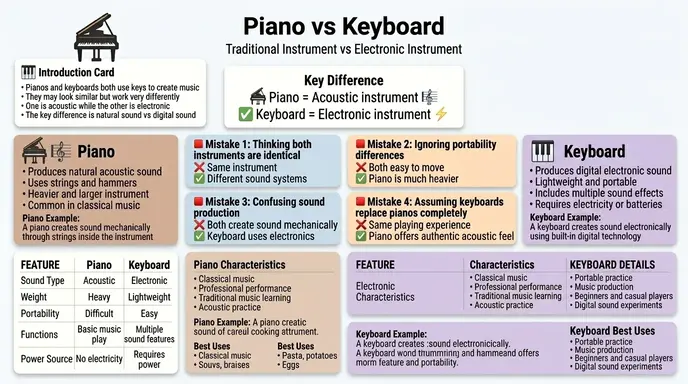
| Feature | Piano | Keyboard |
| Sound Production | Real strings and hammers | Digital/electronic sounds |
| Size | Large and heavy | Compact and portable |
| Key Feel | Weighted keys | Usually lighter keys |
| Power Source | No electricity needed | Requires electricity |
| Sound Variety | Mainly piano sound | Hundreds of instrument sounds |
| Price | Usually expensive | More affordable |
| Maintenance | Needs tuning | Minimal maintenance |
| Best Use | Classical and professional training | Beginners and portable use |
🟢 KEY DIFFERENCES EXPLAINED BETWEEN Piano and Keyboard
1. Sound Creation
A piano creates sound mechanically using strings.
A keyboard creates sound electronically through speakers.
👉 Real example:
Concert halls use acoustic pianos because of their natural sound depth.
2. Key Weight and Feel
Piano keys feel heavier and more responsive.
Keyboard keys are often lighter.
This matters because finger strength develops differently on a real piano.
3. Portability
Pianos are difficult to move.
Keyboards are portable and lightweight.
👉 A student can easily carry a keyboard to music class.
4. Sound Options
Pianos mainly produce one core sound.
Keyboards can imitate:
- drums
- guitars
- violins
- synth sounds
This makes keyboards popular in modern music production.
5. Maintenance Needs
Pianos need regular tuning.
Keyboards require very little maintenance.
That is one reason beginners often start with keyboards.
6. Learning Experience
Pianos teach stronger technique and dynamics.
Keyboards are easier for casual learning.
Music teachers often recommend weighted keyboards for beginners who plan to transition to piano later.
🟢 What is a Piano and How Does It Work?
A piano is a traditional acoustic instrument.
How it works:
- Pressing a key activates a hammer
- The hammer strikes strings
- Vibrations create sound
The sound naturally resonates through the wooden body.
Main piano types:
- grand piano
- upright piano
- digital piano
Brands like Steinway & Sons are famous for high-end concert pianos used worldwide.
🟢 What is a Keyboard and Why is It Popular?
A keyboard is an electronic musical instrument.
How it works:
- Keys send electronic signals
- Internal software produces digital sounds
- Speakers or headphones output audio
Why keyboards are popular:
- affordable
- portable
- beginner-friendly
- multiple sound options
Brands like Casio and Roland dominate this market.
🟢 Why Piano and Keyboard Both Exist
They serve different musical needs.
Piano exists because:
- it provides authentic sound
- supports advanced technique
- works best for classical music
Keyboard exists because:
- it offers flexibility
- supports digital music creation
- is easier for beginners and performers
In practical use, many professional musicians own both.
🟢 Real-Life Examples of Piano and Keyboard
1. Classical Concert
A live orchestra performance uses a grand piano.
2. Home Practice
A student practices on a compact keyboard in a bedroom.
3. Music Production
Electronic producers use keyboards with recording software.
Platforms like YouTube are full of keyboard-based music tutorials and digital production lessons.
4. Stage Performance
Traveling musicians prefer keyboards because they are portable.
🟢 Difference and Similarity Table Between Piano and Keyboard
| Feature | Piano | Keyboard | Similarity |
| Meaning | Acoustic instrument | Electronic instrument | Both create music |
| Keys | Weighted mechanical keys | Electronic keys | Both use black and white keys |
| Sound | Natural string sound | Digital sound | Both play melodies |
| Portability | Heavy | Lightweight | Both usable in performances |
| Technology | Mechanical | Electronic | Both support music learning |
| Learning | Strong technique training | Beginner-friendly | Both teach musical basics |
| Usage | Classical settings | Modern production | Both used by musicians |
This table clearly shows the difference and similarity between piano and keyboard for quick understanding.
🟢 Common Mistakes with Piano and Keyboard
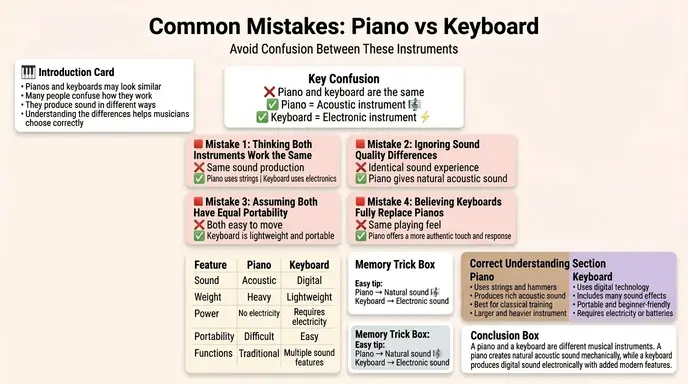
❌ Mistake 1: Thinking They Are Identical
Many beginners assume keyboards and pianos feel the same.
✔ Fix: Try weighted and non-weighted keys in person.
❌ Mistake 2: Buying the Cheapest Keyboard
Very cheap keyboards may hurt learning progress.
✔ Fix: Choose at least touch-sensitive keys.
❌ Mistake 3: Ignoring Long-Term Goals
Casual learners and future pianists need different instruments.
✔ Fix: Match the instrument to your music goals.
❌ Mistake 4: Believing Keyboards Cannot Sound Professional
Modern keyboards can sound excellent in recordings.
✔ Fix: Understand digital music technology improvements.
🟢 Real Life Examples with Piano and Keyboard
- Classical student learning Mozart → Piano
- Beginner child practicing at home → Keyboard
- Music producer creating beats → Keyboard
- Concert pianist performing live → Piano
- Church or school performances → Either instrument
🟢 When to Choose Piano vs Keyboard
Choose Piano When:
- learning classical music
- focusing on professional technique
- wanting authentic sound
Choose Keyboard When:
- starting as a beginner
- needing portability
- exploring modern music production
- working with limited space or budget
🟢 Why People Get Confused Between Piano and Keyboard
Several reasons cause confusion:
- similar appearance
- same note layout
- digital pianos blur the line
- modern keyboards imitate piano sounds very well
Social media and beginner music ads also use the terms loosely.
🟢 How Music Systems and Search Platforms Understand Piano vs Keyboard
Search engines like Google analyze search intent carefully.
Examples:
- “best keyboard for beginners” → buying intent
- “difference between piano and keyboard” → comparison intent
Music education platforms and apps like Simply Piano support both instruments because beginners often transition from keyboard to piano later.
🟢 Expert Insight
In real music education, teachers often recommend starting with a quality keyboard if:
- budget is limited
- space is small
- portability matters
However, serious piano students usually move toward weighted keys or acoustic pianos over time because touch sensitivity and finger control are essential for advanced playing.
Professional musicians often use keyboards for flexibility and pianos for expression.
That balance explains why both instruments remain important in modern music.
🟢 FAQ
Is a keyboard the same as a piano?
No. A piano is acoustic, while a keyboard is electronic.
Which is better for beginners, piano or keyboard?
Keyboard is usually easier and more affordable for beginners.
Can you learn piano on a keyboard?
Yes, especially on a weighted keyboard.
Why are pianos expensive?
Because they use complex mechanical parts and quality materials.
Do keyboards need tuning?
No, electronic keyboards stay digitally tuned.
Which instrument is more portable?
A keyboard is much easier to carry.
Can keyboards sound like real pianos?
Modern keyboards can imitate piano sounds very well.
Do professional musicians use keyboards?
Yes, especially in pop, electronic, and live performance music.
🟢 Conclusion
The difference between piano and keyboard comes down to sound, feel, portability, and purpose.
A piano delivers authentic acoustic sound and professional playing experience. A keyboard offers flexibility, affordability, portability, and modern digital features.
Both instruments are valuable. The right choice depends on your goals, budget, music style, and learning level.
Understanding the difference between piano and keyboard helps beginners make smarter decisions and enjoy music learning with more confidence.
Discover More Articles!
Difference Between Espresso and Cappuccino (Simple & Clear Guide)
Difference Between DoS and DDoS: Guide with Examples

labdiff.com is my English grammar comparison website where I simplify confusing words, spelling differences, and usage rules through clear explanations and examples. My goal is to help learners, writers, and students understand English easily and use correct grammar with confidence.