
Many users get confused about the difference between CNA and RN because both work in healthcare and care for patients. At first glance, their duties may seem similar. However, in real-world hospital settings, their roles are very different.
The difference between CNA and RN mainly comes down to education, responsibilities, and level of authority. A CNA focuses on basic patient care, while an RN handles medical decisions and advanced procedures.
If you are planning a healthcare career, understanding the difference between CNA and RN is very important. In this guide, you will learn what each role means, how they work, why they exist, and which path is best for you.
⚡ Quick Answer: Difference Between CNA and RN
The difference between CNA and RN is simple:
- CNA provides basic care like bathing and feeding patients
- RN provides medical care like giving medicine and making treatment plans
👉 Example: A CNA helps a patient walk, while an RN decides the treatment plan for recovery.
📖 Definition of Difference Between CNA and RN
- CNA (Certified Nursing Assistant): A healthcare worker who provides basic daily care to patients under supervision.
- RN (Registered Nurse): A licensed medical professional who provides advanced care, administers medication, and manages patient treatment.
🔊 Pronunciation of Both Terms
- CNA → See-En-Ay (US & UK same)
- RN → Ar-En (US & UK same)
Now that you understand how to say them, let’s explore the real differences in depth.
📊 CNA vs RN Comparison Table
| Feature | CNA | RN | Explanation |
| Education | Short training (weeks/months) | Degree required (2–4 years) | RN needs formal education |
| Duties | Basic patient care | Advanced medical care | RN handles complex tasks |
| Salary | Lower | Higher | Based on skill level |
| Responsibility | Limited | High responsibility | RN makes decisions |
| Work Scope | Support role | Leadership role | RN supervises CNA |
| Licensing | Certification | Nursing license | RN must pass exams |
| Patient Interaction | Direct care | Care + planning | RN does both |
| Career Growth | Limited | High growth | RN can specialize |
🔑 Key Differences Explained Between CNA and RN
1. Education Level
A CNA completes short training, often in a few months.
An RN completes a nursing degree.
👉 Example: CNA training can be done quickly, but RN requires college-level study.
2. Job Responsibilities
CNA handles daily care like feeding and hygiene.
RN handles medical tasks like injections and diagnosis support.
👉 Real scenario: In hospitals, CNA helps patients move, RN manages treatment.
3. Salary Difference
CNA earns less due to basic duties.
RN earns more due to higher responsibility.
👉 In practical use, RN salaries can be 2–3x higher.
4. Decision-Making Power
CNA follows instructions.
RN makes clinical decisions.
👉 RN decides patient care plans, CNA assists.
5. Work Environment
Both work in hospitals, clinics, and nursing homes.
But RN has more control over workflow.
6. Career Growth
CNA has limited growth options.
RN can become specialist, manager, or practitioner.
🧠 Why Does the Difference Between CNA and RN Exist?
Healthcare systems are complex. Not every task requires a highly trained professional.
- CNA role exists for basic care efficiency
- RN role exists for medical expertise
This structure improves patient care and reduces workload.
In real hospitals, this division ensures smooth operations and better outcomes.
🏥 How Does CNA and RN Work Together?
In practical use, CNA and RN work as a team.
- CNA reports patient condition
- RN analyzes and decides treatment
👉 Example: If a CNA notices a patient is weak, they inform the RN, who then checks and adjusts care.
📍 Where Are CNA and RN Used?
Both roles are used in:
- Hospitals
- Nursing homes
- Rehabilitation centers
- Clinics
Healthcare systems worldwide, supported by organizations like World Health Organization, rely on structured roles like CNA and RN.
📊 Difference and Similarity Between CNA and RN
| Feature | CNA | RN | Similarity |
| Meaning | Assistant role | Professional nurse | Both care for patients |
| Education | Short course | Degree required | Both need training |
| Work Type | Basic care | Medical care | Work in healthcare |
| Authority | Low | High | Work under system |
| Salary | Lower | Higher | Paid healthcare roles |
| Skills | Basic skills | Advanced skills | Patient care skills |
| Interaction | Direct care | Care + planning | Patient-focused |
| Goal | Support patients | Treat patients | Improve health |
This table clearly shows the difference and similarity between CNA and RN for quick understanding.
❌ Common Mistakes with Difference Between CNA and RN
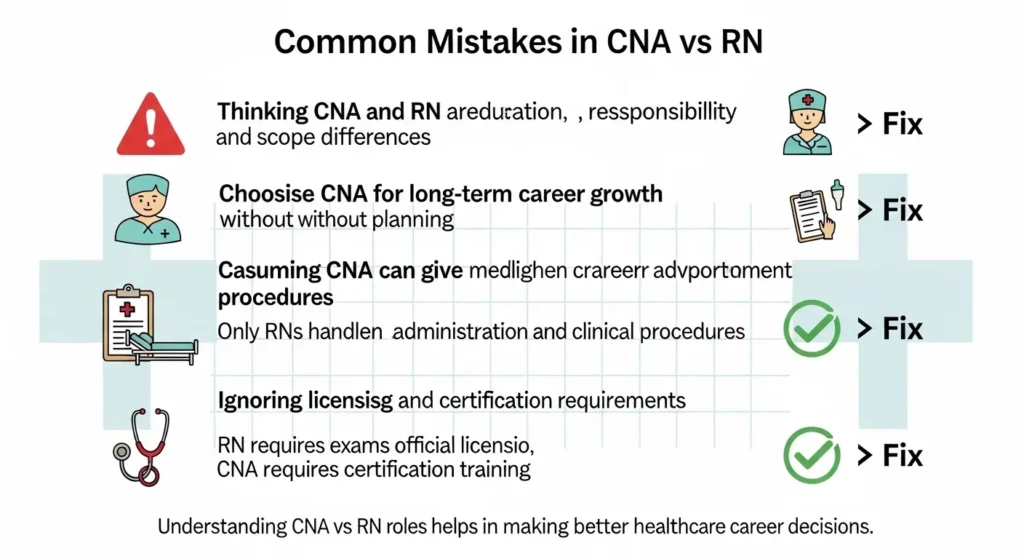
Mistake 1: Thinking CNA and RN are same
👉 Fix: Understand education and role differences
2: Choosing CNA for long-term career growth
👉 Fix: Consider RN for better opportunities
3: Assuming CNA can give medication
👉 Fix: Only RN handles medical procedures
4: Ignoring licensing requirements
👉 Fix: RN must pass exams and licensing
🌍 Real-Life Examples with Difference Between CNA and RN
Example 1: Hospital Setting
CNA helps patient eat and move
RN checks vitals and prescribes care
Example 2: Nursing Home
RN monitors health conditions
Example 3: Emergency Case
CNA prepares patient
RN handles treatment
Example 4: Home Care
CNA supports daily routine
RN manages medical care
🎯 When to Use Each (Career Decision Guide)
Choose CNA if:
- You want quick entry into healthcare
- You prefer basic patient interaction
Choose RN if:
- You want higher salary
- You want career growth and authority
- You want to specialize
🤔 Why People Get Confused in CNA vs RN
- Both work with patients
- Both wear similar uniforms
- Media doesn’t explain roles clearly
- Job titles sound similar
This confusion is common, especially for beginners.
🔍 How Search Engines Understand CNA vs RN
Platforms like Google analyze:
- User intent (comparison queries)
- Keywords like “CNA vs RN salary”
- Engagement signals (time on page, clarity)
Content that clearly explains the difference between CNA and RN with tables, examples, and simple language ranks higher.
👨⚕️ Expert Insight
In real healthcare environments, CNAs are the backbone of daily patient care, while RNs are the decision-makers.
From professional experience, most beginners start as CNA to gain exposure. However, long-term growth almost always requires RN-level education.
Hospitals prefer structured roles because it improves efficiency, reduces errors, and enhances patient outcomes.
❓ FAQs (People Also Ask)
1. What is the main difference between CNA and RN?
CNA provides basic care, RN provides medical care and makes decisions.
2. Can a CNA become an RN?
Yes, many CNAs continue education to become RNs.
3. Who earns more CNA or RN?
RN earns significantly more due to higher skills.
4. Is CNA training difficult?
No, it is shorter and easier compared to RN programs.
5. Can CNA give injections?
No, only RN can perform medical procedures.
6. How long does it take to become RN?
Usually 2–4 years depending on the program.
7. Is RN a good career?
Yes, it offers stability, growth, and high demand.
8. Do CNA and RN work together?
Yes, they work as a team in healthcare settings.
🏁 Conclusion
The difference between CNA and RN is clear when you look at education, responsibility, and career scope. CNA focuses on basic patient support, while RN handles advanced medical care and decision-making.
In simple words, CNA is the starting level in healthcare, and RN is a professional level role with more authority and growth. Both are important, but they serve different purposes in the healthcare system.
If your goal is quick entry, CNA is a good start. But if you want long-term success, higher salary, and specialization, RN is the better choice.
Understanding the difference between CNA and RN helps you make the right career decision and avoid confusion.
Discover More Articals!
Difference Between Monocot and Dicot: Complete Plant Guide
Difference Between Art and Design: Complete Creative Guide

James Whitmore. Labdiff.com is my english grammar comparision website. I explore the history and evolution of English words. I write detailed comparisons explaining why spellings change over time and how British and American English diverged. My articles add depth and credibility to grammar comparison topics.