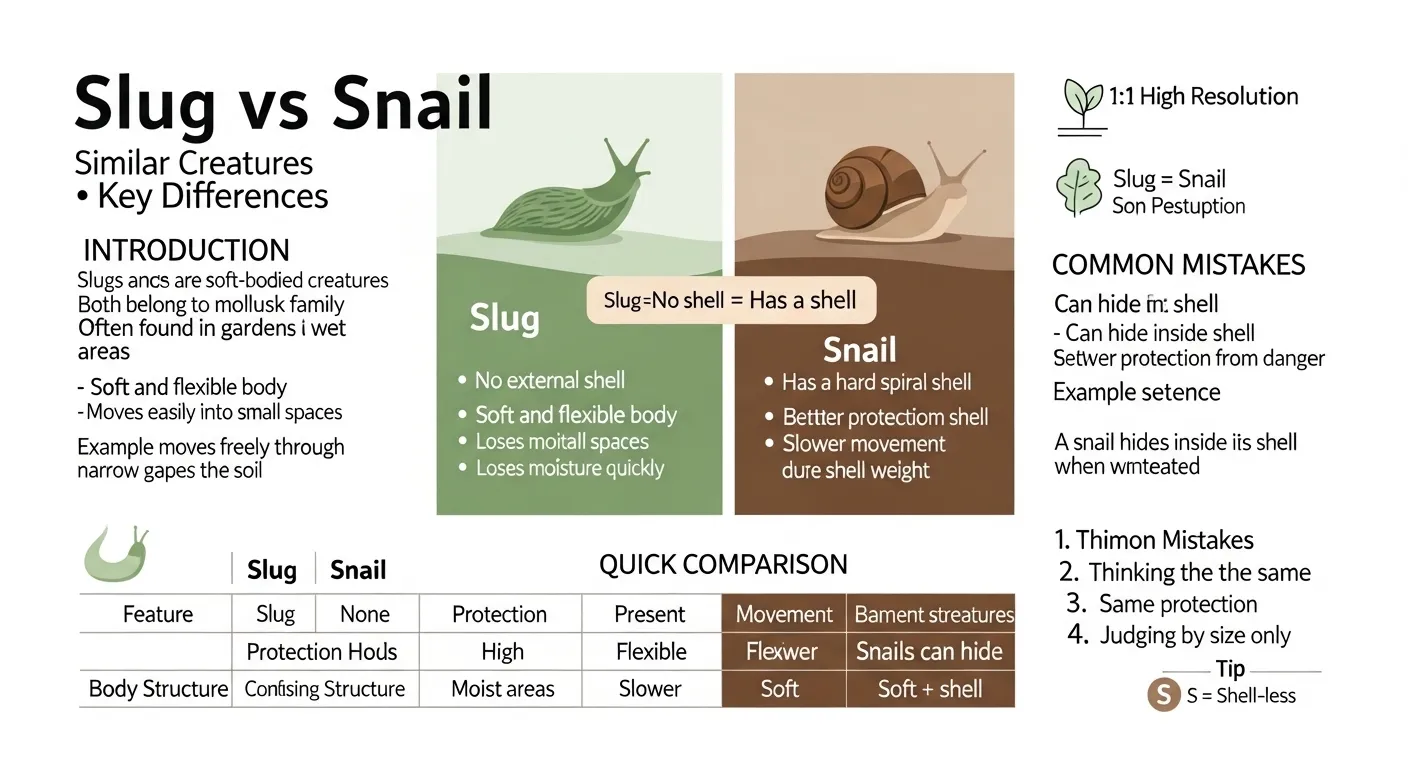
Many people get confused about the difference between slug and snail because both are soft bodied creatures often seen in gardens, especially after rain. At first glance, they look very similar slow moving, slimy, and small.
In simple words, the difference between slug and snail is that snails have a visible shell, while slugs do not (or have a very small hidden one). This single feature changes how they live, move, and protect themselves.
If you’ve ever asked “is a slug just a snail without a shell?” or “which one is harmful to plants?”, this complete guide will explain everything clearly with real life examples.
🟢 Quick Answer: Difference Between Slug and Snail
- Snail → Has a hard external shell for protection
- Slug → No visible shell (soft body exposed)
👉 Example:
If the creature can hide inside a shell → it’s a snail
If it cannot → it’s a slug
🟢 Definition of Slug and Snail
- Snail: A soft bodied mollusk with a spiral shell used for protection and moisture retention.
- Slug: A shell less or nearly shell less mollusk with a soft body, more vulnerable to the environment.
🟢 Pronunciation (US & UK)
- Snail: /sneɪl/
- Slug: /slʌɡ/
👉 Now let’s explore their differences in detail.
🟢 Comparison Table: Slug vs Snail
| Feature | Snail | Slug | Similarity |
| Shell | Present (visible) | Absent or hidden | Soft bodied |
| Protection | Strong due to shell | Weak, exposed | Use mucus |
| Movement | Slow | Slow | Glide using slime |
| Habitat | Moist areas | Moist areas | Prefer damp environments |
| Water Loss | Less | More | Need moisture |
| Appearance | Round shell body | Slim, elongated body | Similar texture |
🟢 Key Differences Explained Between Slug and Snail
1. Shell Presence
- Snails have a hard shell
- Slugs lack a visible shell
👉 This is the biggest and easiest difference
2. Protection Mechanism
- Snails hide inside shells when threatened
- Slugs rely only on mucus and hiding
3. Water Retention
- Snails retain moisture better
- Slugs dry out faster
4. Body Structure
- Snails appear round due to shell
- Slugs look longer and flatter
5. Habitat Adaptation
- Slugs prefer wetter environments
- Snails can survive slightly drier conditions
6. Garden Impact
- Both can damage plants
- Slugs often cause more visible harm
🟢 Why This Difference Exists
The difference between slug and snail exists due to evolution:
- Snails developed shells for protection and survival
- Slugs lost or reduced shells for flexibility and movement
This trade off affects how they live and behave.
🟢 What Is a Snail and How Does It Live?
Snail characteristics:
- Uses shell as protection
- Moves slowly using muscular foot
- Active during moist conditions
👉 Example: Garden snails hiding inside shells during dry weather
🟢 What Is a Slug and How Does It Live?
Slug characteristics:
- No external shell
- Produces more mucus for movement and protection
- Needs very damp environments
👉 Example: Slugs active at night to avoid dryness
🟢 Difference and Similarity Table
| Feature | Snail | Slug | Similarity |
| Protection | Shell defense | No shell defense | Both use slime |
| Shape | Rounded | Elongated | Soft body |
| Survival | Better in dry conditions | Needs wet conditions | Moisture dependent |
| Behavior | Can retreat | Must hide externally | Slow movement |
| Diet | Plants | Plants | Herbivores |
This table clearly shows the difference and similarity between slug and snail for quick understanding.
🟢 Common Mistakes with Slug and Snail
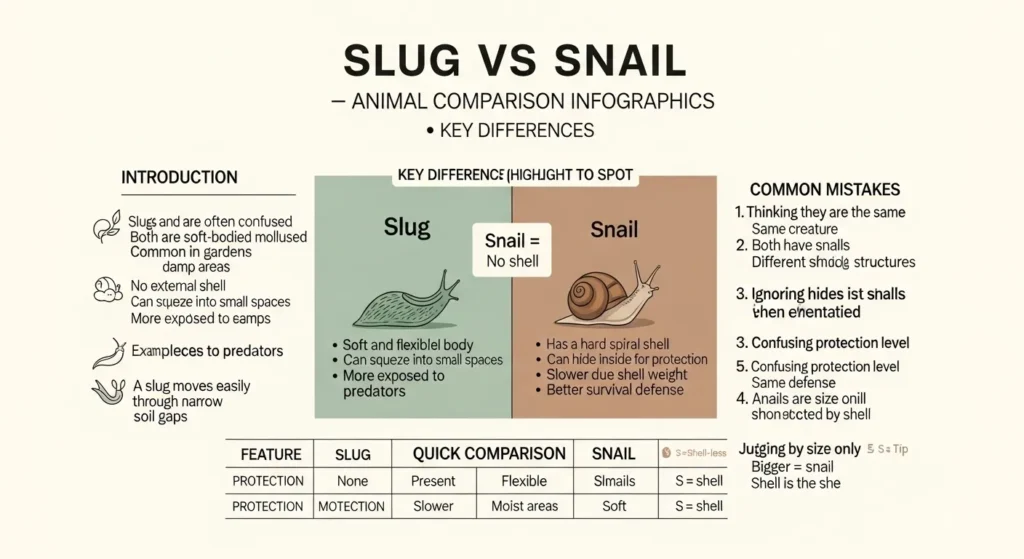
❌ 1. Thinking they are completely different animals
✔ Both are gastropods (same group)
❌ 2. Assuming all snails are harmless
✔ Some damage plants too
❌ 3. Ignoring shell importance
✔ Shell plays a major survival role
❌ 4. Confusing baby snails with slugs
✔ Young snails still have small shells
❌ 5. Believing slugs are just “snails without shells”
✔ Technically related, but evolved differently
🟢 Real Life Examples
📌 Garden Observation
- Creature with shell on leaves → snail
- Slimy, shell less creature → slug
📌 Rainy Weather
- Both appear, but slugs are more active
Plant Damage
- Holes in leaves → often caused by slugs
🟢 When to Identify Each
Identify Snail when:
- Visible spiral shell
- Can retract body
- Found in slightly dry areas
Identify Slug when:
- No shell
- Slimy, elongated body
- Active in very wet environments
🟢 Why People Get Confused
The confusion in the difference between slug and snail happens because:
- Both look similar at first glance
- Same habitat (gardens, wet areas)
- Similar movement and texture
- Lack of awareness about shell role
🟢 How Search Engines Understand This Topic
Search engines like Google treat this as a biology comparison query.
They rank content that includes:
- Simple definitions
- Visual differences
- Practical examples
🟢 Expert Insight
In real world biology, slugs and snails belong to the same class but differ mainly in shell structure.
👉 Key insight:
- Shell = protection + water retention
- No shell = flexibility but higher risk
This explains their behavior and habitat differences.
🟢 FAQ:
1. What is the main difference between slug and snail?
Snails have shells; slugs do not.
2. Is a slug just a snail without a shell?
They are related, but evolved differently.
3. Which is more harmful to plants?
Slugs usually cause more damage.
4. Do both need moisture?
Yes, both depend on moist environments.
5. Can snails survive without shells?
No, shells are essential for snails.
6. Are slugs and snails the same species?
No, but they belong to the same group.
🟢 Conclusion
Understanding the difference between slug and snail is simple once you focus on the key feature the shell.
Snails have a protective shell that helps them survive in various conditions, while slugs lack this protection and rely on moisture and hiding.
Both play roles in nature, but their structure, behavior, and survival strategies are different. By observing their appearance and environment, you can easily tell them apart.
In short, the difference between slug and snail is about protection, structure, and lifestyle and once you know it, identification becomes effortless.
Discover More articals!
Difference Between MS and MBA: Degree and Study Guide
Difference Between Storage and Memory (RAM vs Storage Explained Simply)

labdiff.com is my English grammar comparison website where I simplify confusing words, spelling differences, and usage rules through clear explanations and examples. My goal is to help learners, writers, and students understand English easily and use correct grammar with confidence.