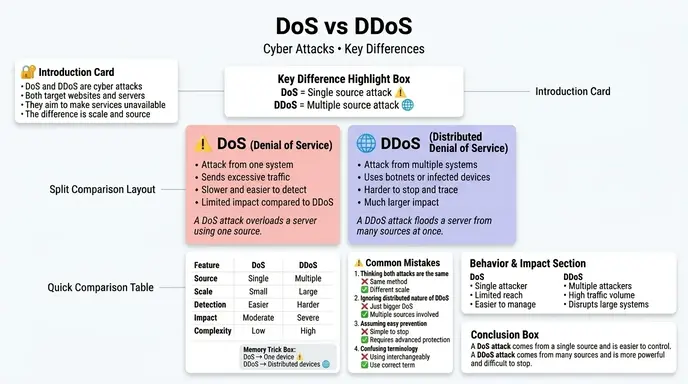
Many users get confused about the difference between DoS and DDoS because both are types of cyberattacks that can crash websites. At first glance, they seem the same. But in real world cybersecurity, they work very differently.
The difference between DoS and DDoS mainly comes down to how the attack is launched and how powerful it is. A DoS attack uses one system, while a DDoS attack uses many systems at once.
If you’ve ever seen platforms like Google, YouTube, or Instagram go down temporarily, there’s a chance a DDoS attack was involved.
In this guide, you’ll learn:
- what DoS and DDoS attacks are
- how they work
- key differences with real examples
- how companies protect against them
Let’s understand this clearly.
🟢 Quick Answer: Difference Between DoS and DDoS
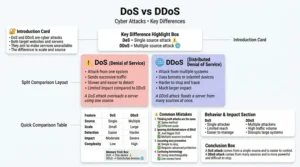
A DoS (Denial of Service) attack comes from one system and floods a server with traffic.
A DDoS (Distributed Denial of Service) attack comes from multiple systems, making it much stronger.
👉 Example:
One hacker attacking a website = DoS
Thousands of infected computers attacking together = DDoS
🟢 Definition of Difference Between DoS and DDoS
- DoS: A cyberattack where a single system overwhelms a server to make it unavailable.
- DDoS: A cyberattack where multiple systems (botnets) attack a server simultaneously to shut it down.
🟢 Pronunciation Guide
- DoS → “dee oh ess” (US & UK)
- DDoS → “dee dee oh ess” (US & UK)
Now that you can say them correctly, let’s break down how they actually work in real systems.
🟢 DoS vs DDoS Comparison Table
| Feature | DoS Attack | DDoS Attack |
| Source | Single computer | Multiple computers (botnet) |
| Power | Limited | Very high |
| Detection | Easier | Harder |
| Traffic Volume | Low to medium | Extremely high |
| Control | One attacker | Distributed attackers |
| Example | One PC flooding server | Thousands of bots attacking together |
| Blocking | Easier to block | Very difficult |
| Real world impact | Small websites | Large platforms like banks or social media |
🟢 KEY DIFFERENCES EXPLAINED BETWEEN DoS and DDoS
1. Single vs Multiple Sources
DoS uses one machine. DDoS uses thousands.
👉 Example: A single hacker vs a global botnet army
2. Attack Strength
DDoS is far more powerful.
👉 Example: A DoS may slow a site, but DDoS can crash it completely
3. Detection Difficulty
DoS is easy to detect. DDoS hides behind many IPs.
👉 Example: Security teams can block one IP, but not thousands easily
4. Setup Complexity
DoS is simple. DDoS requires infected systems.
👉 Example: Malware spreads to create botnets
5. Real World Usage
DDoS is used in major cyber warfare or attacks on big companies.
6. Cost and Effort
DoS is cheap. DDoS needs infrastructure.
🟢 What is a DoS Attack and How Does It Work?
A Denial of Service attack works by sending excessive requests from one system to a server.
👉 Think of it like one person calling a customer service line again and again until no one else can get through.
How it works:
- Attacker sends repeated requests
- Server resources get overloaded
- Website becomes slow or crashes
In real scenarios, smaller websites or poorly secured systems are more vulnerable.
🟢 What is a DDoS Attack and Why is It More Dangerous?
A Distributed Denial of Service attack uses many devices worldwide.
These devices are often infected with malware and controlled remotely.
👉 This network is called a botnet
How it works:
- Thousands of infected devices send requests
- Traffic floods the server
- System crashes instantly
Large platforms like Meta invest heavily to stop such attacks.
🟢 Why DoS and DDoS Attacks Exist?
Understanding why helps you grasp the bigger picture.
Common reasons:
- Financial damage
- Competitive sabotage
- Political motives
- Hacktivism
In real scenarios, attackers may target:
- banks
- gaming servers
- eCommerce sites
🟢 Real World Examples of DoS and DDoS
1. Personal Website Attack
A blogger’s site gets flooded by one attacker → DoS
2. Gaming Server Crash
Multiple users attack a game server → DDoS
3. Business Disruption
An online store goes offline during sales → DDoS
4. Social Media Outage
Temporary downtime on platforms like Instagram may involve large scale traffic overload
🟢 Difference and Similarity Table Between DoS and DDoS
| Feature | DoS | DDoS | Similarity |
| Meaning | Single source attack | Multi source attack | Both overload servers |
| Goal | Disrupt service | Disrupt service | Same purpose |
| Complexity | Simple | Complex | Both require planning |
| Detection | Easy | Hard | Both detectable with tools |
| Impact | Limited | Severe | Both cause downtime |
| Tools Used | Basic scripts | Botnets, malware | Both use network traffic |
| Target | Small systems | Large systems | Both target servers |
This table clearly shows the difference and similarity between DoS and DDoS for quick understanding.
🟢 Common Mistakes with DoS and DDoS
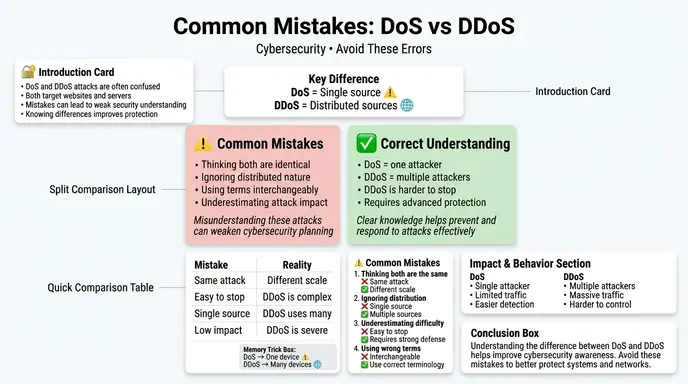
❌ Thinking both are the same
✔ Fix: DDoS is distributed, DoS is not
❌ Ignoring scale difference
✔ Fix: DDoS is much stronger
Assuming small sites are safe
✔ Fix: Even small sites can be attacked
Believing firewalls stop everything
Fix: Advanced protection is needed
🟢 Real Life Examples with DoS and DDoS
- A student testing server limits → DoS
- Hackers targeting banks → DDoS
- Online game lag attack → DDoS
- Website stress testing → controlled DoS
🟢 When to Use Each (Understanding Context)
This is not about “using” attacks but understanding context:
- DoS → testing, learning cybersecurity basics
- DDoS → real world cyber threats, enterprise level risks
🟢 Why People Get Confused in DoS and DDoS
- Similar names
- Same goal (crashing systems)
- Media uses terms interchangeably
- Lack of technical knowledge
🟢 How Search Engines Understand DoS vs DDoS
Search engines like Google analyze user intent carefully.
When users search:
- “what is DoS” → informational intent
- “difference between DoS and DDoS” → comparison intent
Content ranks higher when:
- it explains clearly
- answers multiple questions
- uses real examples
Platforms like YouTube also prioritize educational content explaining cybersecurity threats.
🟢 Expert Insight
In real cybersecurity environments, DDoS attacks are one of the most common threats faced by enterprises.
Security professionals use:
- traffic filtering
- rate limiting
- AI based detection systems
From practical experience, most beginners underestimate how easily botnets can scale attacks globally. That’s why companies invest heavily in cloud security.
🟢 FAQ
What is the main difference between DoS and DDoS?
DoS uses one system; DDoS uses many systems.
Which is more dangerous, DoS or DDoS?
DDoS is more dangerous due to higher traffic volume.
Can a firewall stop DDoS attacks?
Basic firewalls cannot fully stop DDoS.
Why are DDoS attacks hard to detect?
Because traffic comes from many sources.
Are DoS attacks still used today?
Yes, but less common than DDoS.
What is a botnet in DDoS?
A network of infected devices used to launch attacks.
🟢 Conclusion
The difference between DoS and DDoS is simple but very important. Both attacks aim to shut down systems, but their scale and impact are very different.
A DoS attack comes from one source and is easier to control. A DDoS attack uses multiple systems, making it more powerful and harder to stop.
In today’s digital world, where platforms like Google, Instagram, and YouTube handle massive traffic, understanding these attacks is critical.
If you’re a student, business owner, or tech enthusiast, knowing the difference between DoS and DDoS helps you better understand cybersecurity risks and how modern systems stay protected.
Discover More Articles!
Difference Between Sword and Shield ( Guide with Examples)
Difference Between Trading and Investing (With Examples)

labdiff.com is my English grammar comparison website where I simplify confusing words, spelling differences, and usage rules through clear explanations and examples. My goal is to help learners, writers, and students understand English easily and use correct grammar with confidence.