Many investors, students, and beginners search for the difference between Nasdaq and NYSE because both are major stock exchanges where companies buy and sell shares publicly.
Since both markets appear regularly in financial news, people often assume they work the same way.
However, Nasdaq and the New York Stock Exchange (NYSE) operate differently in terms of trading systems, company types, technology, and market structure.
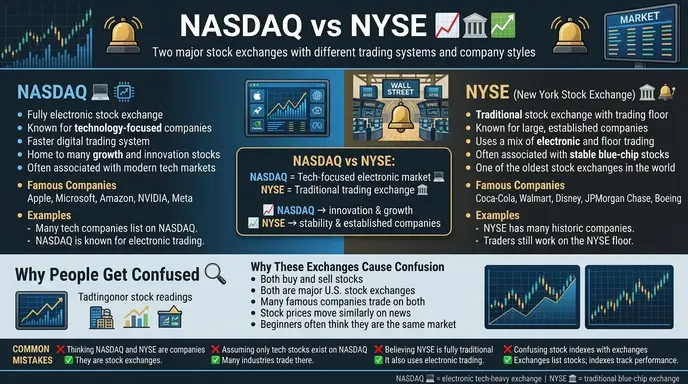
In simple words, Nasdaq is an electronic stock exchange known for technology focused companies, while NYSE uses a hybrid system with both electronic trading and physical trading floors.
The difference between Nasdaq and NYSE becomes especially important when understanding investing, stock market behavior, listed companies, and financial market operations.
This guide explains Nasdaq and NYSE clearly, including definitions, trading methods, company examples, similarities, investor insights, real world examples, and why both exchanges matter globally.
Quick Answer: Difference Between Nasdaq and NYSE
The main difference between Nasdaq and NYSE is how trading is conducted and the types of companies commonly listed.
- Nasdaq is primarily an electronic dealer based stock exchange known for technology companies
- NYSE is a traditional auction based exchange with a physical trading floor and many established corporations
For example:
Apple is listed on Nasdaq, while Coca Cola is listed on NYSE.
Definition of Nasdaq and NYSE
- Nasdaq: An electronic global stock exchange known for technology and growth focused companies.
- NYSE (New York Stock Exchange): A major stock exchange using a hybrid auction and electronic trading system for publicly traded companies.
Simple Example
- Nasdaq = technology focused electronic exchange
- NYSE = traditional stock exchange with trading floor operations
Pronunciation of Both (US & UK)
| Exchange | US Pronunciation | UK Pronunciation |
| Nasdaq | naz dak | naz dak |
| NYSE | en wise | en wise |
Now let’s understand this clearly through trading systems, listed companies, and real world financial examples.
Difference Between Nasdaq and NYSE Comparison Table
| Feature | Nasdaq | NYSE | Similarity |
| Trading Style | Electronic dealer market | Auction + electronic system | Both are stock exchanges |
| Famous For | Technology companies | Large traditional corporations | Both list public companies |
| Trading Floor | No major physical floor focus | Physical trading floor exists | Both support investors |
| Market Structure | Dealer based | Auction based | Both facilitate stock trading |
| Company Image | Growth and innovation | Stability and legacy brands | Both influence global markets |
| Listing Requirements | Slightly flexible | Often stricter reputation standards | Both require compliance |
| Technology Use | Highly digital | Hybrid digital system | Both use electronic trading |
| Investor Access | Global electronic access | Global investor access | Both impact financial markets |
This table clearly shows the difference and similarity between Nasdaq and NYSE for quick understanding.
Key Differences Explained Between Nasdaq and NYSE
Trading System Difference
The biggest difference is how trading occurs.
Nasdaq operates mainly through electronic dealer networks where market makers facilitate trades digitally.
NYSE combines:
- Electronic systems
- Human market specialists
- Physical trading floor activity
This creates different trading environments.
Company Types
Nasdaq is strongly associated with:
- Technology firms
- Growth companies
- Innovation focused businesses
NYSE is commonly linked with:
- Large established corporations
- Industrial companies
- Traditional global brands
Market Maker vs Auction Model
Nasdaq uses market makers who actively buy and sell securities to maintain liquidity.
NYSE traditionally uses an auction style system where buyers and sellers interact directly through brokers and specialists.
Brand Identity
Nasdaq is often viewed as:
- Modern
- Tech driven
- Innovation focused
NYSE is often viewed as:
- Traditional
- Prestigious
- Institutional
Physical Trading Floor
NYSE still maintains a famous trading floor in New York City, while Nasdaq operates primarily electronically.
Why Do Nasdaq and NYSE Exist?
Financial markets need organized systems where investors can buy and sell company shares efficiently.
Multiple exchanges exist because companies have different listing preferences, trading needs, investor expectations, and market identities.
Competition between exchanges also encourages innovation, efficiency, and market growth.
How Nasdaq Works
Electronic Trading System
Nasdaq was designed as an electronic exchange from the beginning.
Trades happen through computer networks rather than relying mainly on physical trading floors.
Technology Focus
Many major technology companies trade on Nasdaq, including:
- Microsoft
- Amazon
- Meta
This helped Nasdaq develop a strong reputation for innovation and growth investing.
Market Makers
Nasdaq uses multiple market makers to help maintain active trading and liquidity.
How NYSE Works
Auction Based Trading
NYSE historically used floor traders and specialists to match buyers and sellers through auctions.
Hybrid Trading Model
Modern NYSE combines:
- Human oversight
- Electronic systems
- Automated order matching
Established Corporate Listings
Many long established companies trade on NYSE, including:
- Walmart
- McDonald’s
- IBM
Difference Between Nasdaq and NYSE in Real Life
| Real Life Area | Nasdaq | NYSE |
| Technology startups | Common | Less dominant |
| Traditional corporations | Moderate presence | Strong presence |
| Electronic trading | Core system | Hybrid system |
| Financial news visibility | High | Very high |
| Investor focus | Growth investing | Stability and blue chip investing |
Many investors monitor both exchanges daily because together they represent major portions of the global stock market.
Difference Between Nasdaq and NYSE in Investing
Nasdaq Investing
Nasdaq attracts investors interested in:
- Technology growth
- Innovation
- Fast expanding companies
This can sometimes involve higher volatility.
NYSE Investing
NYSE often attracts investors seeking:
- Stable corporations
- Dividend paying companies
- Long established brands
Indexes and Market Tracking
Nasdaq is associated with the NASDAQ Composite and NASDAQ 100 indexes.
NYSE companies contribute heavily to indexes like the Dow Jones Industrial Average and S&P 500.
Real Life Examples with Nasdaq and NYSE
Technology Sector Growth
During major technology booms, Nasdaq often receives strong investor attention because of its tech heavy listings.
Traditional Consumer Brands
Many globally recognized consumer brands trade on NYSE due to its historic reputation.
Financial News Coverage
Platforms like Bloomberg and CNBC report daily movements from both exchanges because they strongly influence global markets.
Online Investing Platforms
Brokerage apps supported by Google and fintech systems allow retail investors to trade Nasdaq and NYSE stocks digitally worldwide.
IPO Decisions
Companies often choose between Nasdaq and NYSE based on branding, investor audience, and market positioning.
Difference + Similarity Between Nasdaq and NYSE
| Feature | Nasdaq | NYSE | Similarity |
| Market Type | Electronic dealer market | Auction hybrid market | Both trade stocks |
| Popular Sectors | Technology heavy | Broad traditional industries | Both host global companies |
| Trading Method | Digital networks | Human + electronic systems | Both support liquidity |
| Investor Access | Global online access | Global online access | Both accessible through brokers |
| Company Reputation | Growth oriented | Established prestige | Both influence global investing |
| Financial Importance | Major global exchange | Major global exchange | Both affect economies worldwide |
This table clearly shows the difference and similarity between Nasdaq and NYSE for quick understanding.
Why People Get Confused Between Nasdaq and NYSE
Both Are Stock Exchanges
Beginners often assume all stock exchanges operate the same way.
Shared Financial News Coverage
News outlets discuss both exchanges together constantly.
Similar Investing Purpose
Both allow public companies to issue and trade shares.
Overlapping Companies and Indexes
Large corporations on both exchanges affect broader stock market indexes and investor sentiment.
Common Mistakes with Nasdaq and NYSE
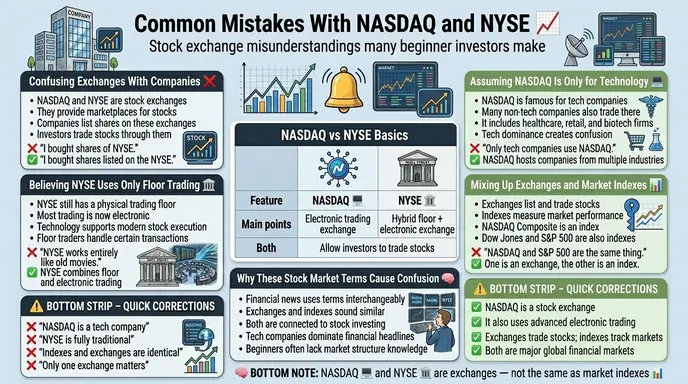
| Mistake | Correct Understanding |
| Thinking Nasdaq is only a stock index | It is also a stock exchange |
| Assuming NYSE is fully manual | It uses advanced electronic systems too |
| Believing tech companies only use Nasdaq | Some tech firms list on NYSE |
| Ignoring exchange branding differences | Listing identity matters |
| Treating both exchanges as identical | Their structures differ significantly |
Quick Memory Tip
- Nasdaq = electronic tech focused exchange
- NYSE = traditional hybrid exchange
When to Focus on Nasdaq or NYSE
Focus on Nasdaq When:
- Studying technology companies
- Following growth stocks
- Analyzing innovation sectors
- Tracking digital economy trends
Focus on NYSE When:
- Studying blue chip corporations
- Following traditional industries
- Monitoring legacy global brands
- Analyzing institutional market behavior
Most investors follow both exchanges because modern portfolios often contain companies from each market.
Expert Insight
In real investing environments, the difference between Nasdaq and NYSE goes beyond technology versus tradition.
Many professional investors view Nasdaq as more growth oriented and innovation driven, while NYSE often represents corporate stability and institutional reputation. However, the distinction has become less extreme over time as both exchanges modernized electronically.
Companies also choose exchanges strategically. A fast growing technology company may prefer Nasdaq’s innovation image, while a mature multinational corporation may value NYSE’s historical prestige and institutional visibility.
For everyday investors, understanding exchange structure is useful, but company fundamentals, financial performance, and long term strategy usually matter more than the exchange itself.
Frequently Asked Questions
What is the main difference between Nasdaq and NYSE?
Nasdaq is primarily electronic and tech focused, while NYSE uses a hybrid auction system with a physical trading floor.
Which exchange is bigger, Nasdaq or NYSE?
NYSE is generally larger by total market capitalization.
Is Nasdaq only for technology companies?
No. Nasdaq lists many industries, though it is strongly associated with technology firms.
Why do companies choose Nasdaq?
Many companies choose Nasdaq for its innovation focused reputation and electronic trading system.
Does NYSE still have a trading floor?
Yes. NYSE still operates a famous physical trading floor.
Can investors trade stocks from both exchanges?
Yes. Modern brokerage platforms allow access to both exchanges.
Is Nasdaq riskier than NYSE?
Nasdaq often contains more growth focused companies, which can sometimes create higher volatility.
Are both exchanges regulated?
Yes. Both exchanges operate under strict financial regulations.
Conclusion
Understanding the difference between Nasdaq and NYSE helps investors, students, and beginners better understand how stock markets operate.
Although both are major global stock exchanges where public companies trade shares, they differ in trading systems, company identity, market structure, and historical reputation.
Nasdaq is known for electronic trading and strong technology sector representation, while NYSE combines traditional auction systems with modern electronic trading and hosts many long established global corporations. Both exchanges play a critical role in global investing, financial markets, and economic activity.
In real world investing, companies choose exchanges based on branding, investor perception, and strategic positioning.
Meanwhile, investors monitor both markets because together they represent some of the world’s most influential businesses and economic indicators.
Once you fully understand the difference between Nasdaq and NYSE, financial news, stock investing, and market discussions become much easier to follow and analyze.
Discover More articles!
Difference Between Magazine and Clip:With Simple Examples
Difference Between Zucchini and Squash:With Examples

labdiff.com is my English grammar comparison website where I simplify confusing words, spelling differences, and usage rules through clear explanations and examples. My goal is to help learners, writers, and students understand English easily and use correct grammar with confidence.