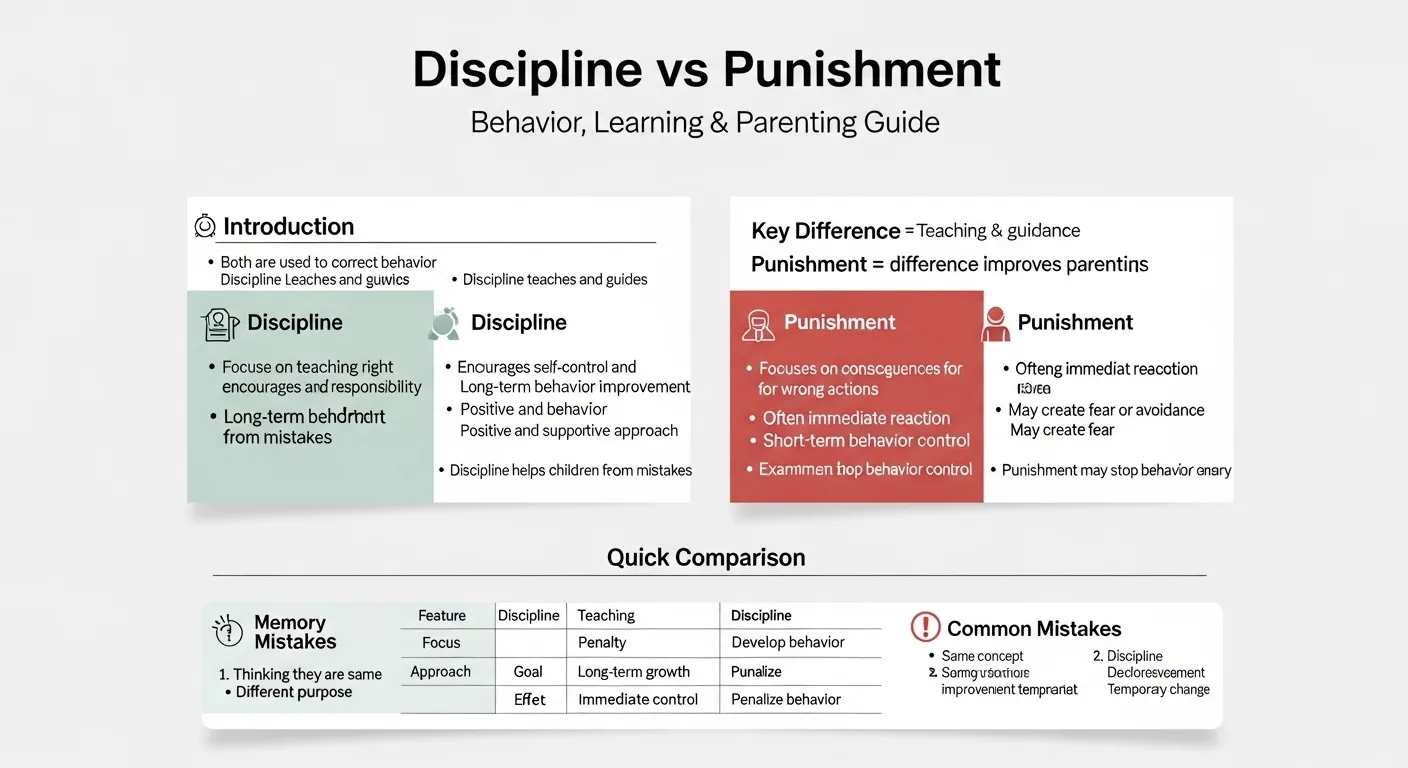
Many people get confused about the difference between discipline and punishment, especially when raising children or managing behavior in schools. At first, both may look the same correcting behavior but they are very different in purpose and impact.
In simple words, the difference between discipline and punishment is that discipline teaches and guides behavior, while punishment focuses on consequences for wrongdoing. One builds long term learning; the other often creates short term control.
If you’ve ever asked “should I discipline or punish?”, “what works better for children?”, or “why punishment sometimes fails?”, this complete guide will explain everything with real life examples and expert insight.
🟢 Quick Answer: Difference Between Discipline and Punishment
- Discipline → Teaching right behavior with guidance and learning
- Punishment → Giving a penalty for wrong behavior
👉 Example:
- Explaining why homework matters → Discipline
- Taking away phone for not doing homework → Punishment
🟢 Definition of Discipline and Punishment
- Discipline: A method of teaching, guiding, and helping someone develop self control and responsible behavior.
- Punishment: A consequence or penalty given after a wrong action to discourage that behavior.
🟢 Pronunciation
- Discipline: /ˈdɪs.ə.plɪn/
- Punishment: /ˈpʌn.ɪʃ.mənt/
👉 Now let’s understand the deeper differences that matter in real life.
🟢 Comparison Table: Discipline vs Punishment
| Feature | Discipline | Punishment | Similarity |
| Purpose | Teach behavior | Control behavior | Behavior correction |
| Focus | Learning & growth | Consequences | Change actions |
| Approach | Positive & guiding | Negative or restrictive | Improve behavior |
| Timing | Proactive & ongoing | Reactive | Response to actions |
| Emotional Impact | Builds trust | Can create fear | Influences mindset |
| Long Term Effect | Self discipline | Temporary compliance | Behavior shaping |
🟢 Key Differences Explained Between Discipline and Punishment
1. Purpose and Intent
- Discipline aims to teach and improve behavior
- Punishment aims to stop unwanted behavior
👉 Example: A parent explains sharing → discipline; shouting or scolding → punishment
2. Long Term vs Short Term Results
- Discipline builds habits over time
- Punishment may stop behavior temporarily
3. Emotional Impact
- Discipline creates understanding and trust
- Punishment may create fear or resentment
4. Approach Style
- Discipline uses guidance, rules, and consistency
- Punishment uses penalties or restrictions
5. Child Development Impact
- Discipline improves decision making skills
- Punishment may not teach the “why” behind behavior
6. Real Life Application
- Teachers explaining rules → discipline
- Giving detention without explanation → punishment
🟢 Why This Difference Exists
The difference between discipline and punishment exists because behavior management has two goals:
- Teaching and development (discipline)
- Immediate control (punishment)
Modern psychology shows that teaching works better for long term behavior change.
🟢 What Is Discipline and How Does It Work?
Discipline is about guidance and learning. It helps children and adults understand:
- Why a behavior is right or wrong
- How to make better choices
- How to develop self control
👉 Example:
A teacher calmly explains why cheating is wrong and encourages honesty.
🟢 What Is Punishment and How Does It Work?
Punishment is about consequences. It focuses on:
- Stopping unwanted behavior
- Applying penalties like time outs, restrictions, or warnings
👉 Example:
A child is grounded for breaking rules.
🟢 Difference and Similarity Table
| Feature | Discipline | Punishment | Similarity |
| Goal | Teach and guide | Penalize behavior | Behavior correction |
| Method | Explanation, support | Penalties, restrictions | Influence actions |
| Result | Long term growth | Short term control | Behavior change |
| Emotion | Positive connection | Fear or pressure | Emotional impact |
| Usage | Parenting, teaching | Rules enforcement | Behavior management |
This table clearly shows the difference and similarity between discipline and punishment for quick understanding.
🟢 Common Mistakes with Discipline and Punishment
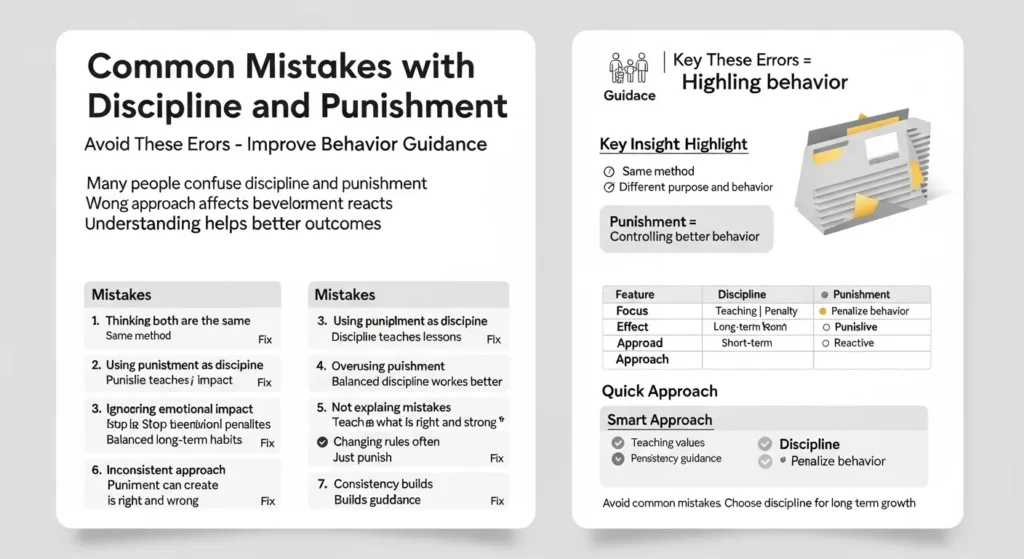
❌ 1. Thinking punishment equals discipline
✔ Discipline is about teaching, not just consequences
❌ 2. Overusing punishment
✔ Too much punishment reduces effectiveness
❌ 3. Ignoring explanation
✔ Children need to understand “why”
❌ 4. Being inconsistent
✔ Discipline requires consistency
❌ 5. Using fear as control
✔ Fear does not build long term habits
🟢 Real Life Examples
Parenting
- Explaining rules → Discipline
- Taking away toys → Punishment
School
- Teaching classroom behavior → Discipline
- Giving detention → Punishment
Workplace
- Coaching employee → Discipline
- Issuing warning letter → Punishment
🟢 When to Use Each
Use Discipline when:
- You want long term behavior change
- Teaching values and responsibility
- Building trust and understanding
Use Punishment when:
- Immediate correction is needed
- Safety rules are broken
- Behavior must stop quickly
👉 Best approach: Use both wisely, but focus more on discipline.
🟢 Why People Get Confused
The confusion in the difference between discipline and punishment happens because:
- Both involve correcting behavior
- Parents and teachers mix the terms
- Cultural practices emphasize punishment
- Media and social platforms like YouTube often show punishment as discipline
🟢 How Search Engines Understand This Topic
Search engines like Google treat this as a behavioral and educational comparison query.
They prioritize:
- Clear definitions
- Real life examples
- Simple explanations
- Parent focused guidance
🟢 Expert Insight
In real world parenting and education, discipline is considered more effective than punishment for long term growth.
Behavior experts often recommend:
- Teaching before correcting
- Explaining consequences
- Encouraging self discipline
Punishment should be limited and used carefully.
🟢 FAQ:
1. What is the main difference between discipline and punishment?
Discipline teaches behavior; punishment gives consequences.
2. Which is better for children?
Discipline is better for long term development.
3. Is punishment necessary?
Sometimes, but it should be limited.
4. Can discipline include consequences?
Yes, but with explanation and learning.
5. Why does punishment fail sometimes?
Because it doesn’t teach the reason behind behavior.
6. Can both be used together?
Yes, but discipline should be the main approach.
🟢 Conclusion
Understanding the difference between discipline and punishment is essential for effective parenting, teaching, and behavior management.
Discipline focuses on teaching, guiding, and building self control, while punishment focuses on stopping unwanted behavior through consequences.
Both have their place, but discipline creates long term positive habits, while punishment often works only temporarily. The best approach is to guide behavior with discipline and use punishment carefully when needed.
In the end, the difference between discipline and punishment is about teaching versus controlling and teaching always leads to better results.
Discover More Articals!
Difference Between Firestick and Roku 2026 Buyer’s Guide
Difference Between Psychologist and Psychotherapist.With Examples(2026)

labdiff.com is my English grammar comparison website where I simplify confusing words, spelling differences, and usage rules through clear explanations and examples. My goal is to help learners, writers, and students understand English easily and use correct grammar with confidence.