Many people search for the difference between liberty and freedom because the two words are often used interchangeably in politics, law, philosophy, history, and everyday conversation.
At first glance, both terms seem to mean the same thing: the ability to live without unnecessary control.
However, liberty and freedom carry slightly different meanings depending on context, legal systems, and social philosophy.
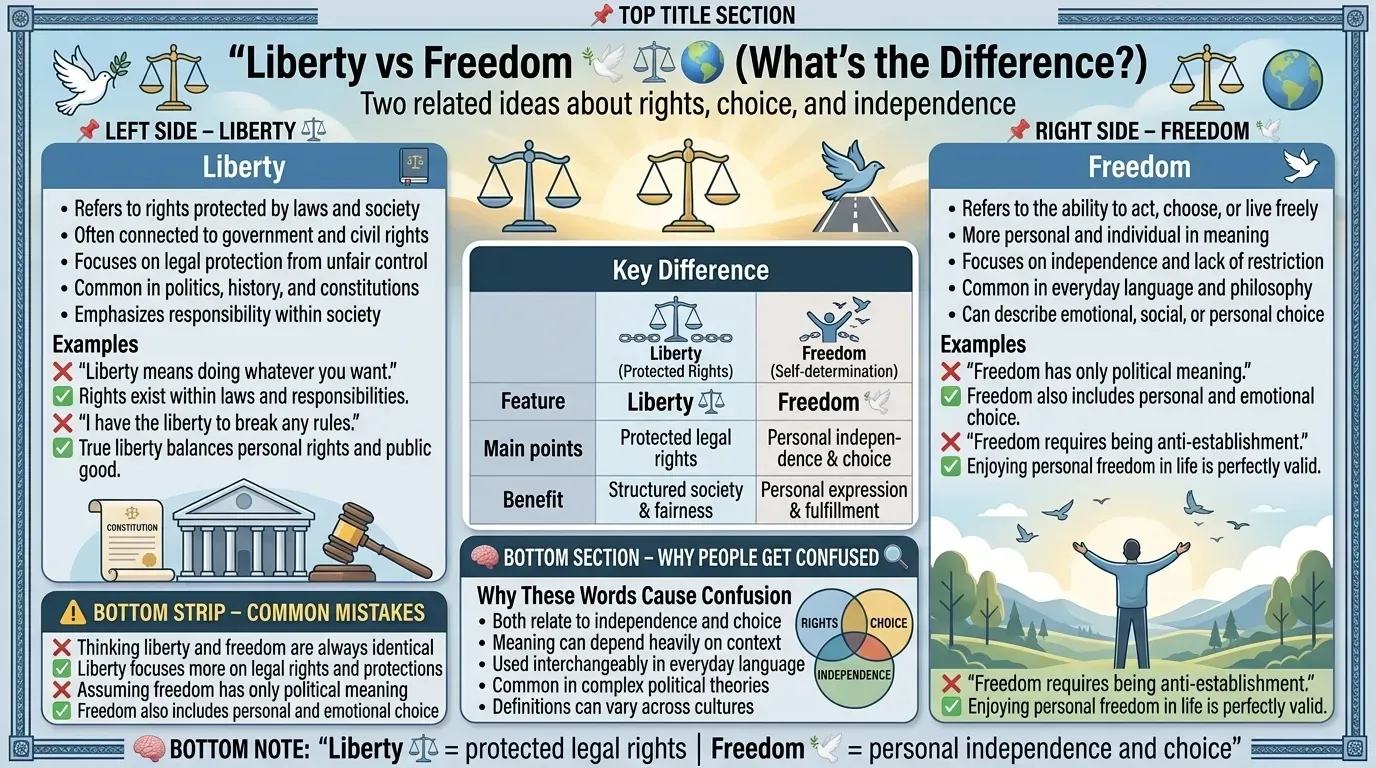
In simple words, freedom usually refers to the ability to act, speak, or live without restriction, while liberty often refers to protected rights granted within a legal or social framework.
The difference between liberty and freedom becomes especially important in discussions about democracy, human rights, constitutions, civil rights, and personal independence.
This guide explains liberty and freedom clearly, including definitions, historical meaning, legal interpretation, similarities, real world examples, philosophical insights, and expert explanations.
Quick Answer: Difference Between Liberty and Freedom
The main difference between liberty and freedom is the context in which the rights are understood and protected.
- Freedom generally means the ability to act without unnecessary restrictions
- Liberty usually refers to rights and protections recognized by laws or society
For example:
Freedom means being able to express your opinion, while liberty means the legal protection that allows you to express it safely.
Definition of Liberty and Freedom
- Liberty: A condition in which people have legally protected rights and independence under a system of laws.
- Freedom: The ability to act, think, speak, or live without undue control or restriction.
Simple Example
- Freedom = ability to act freely
- Liberty = protected rights within society
Pronunciation of Both (US & UK)
| Term | US Pronunciation | UK Pronunciation |
| Liberty | lib er tee | lib er tee |
| Freedom | free dum | free dum |
Now let’s understand this clearly through law, philosophy, society, and real world human rights examples.
Difference Between Liberty and Freedom Comparison Table
| Feature | Liberty | Freedom | Similarity |
| Main Meaning | Protected rights | Ability to act freely | Both relate to independence |
| Legal Connection | Strong legal association | Broader personal concept | Both involve reduced control |
| Social Structure | Exists within laws | Can exist personally or socially | Both valued in democracies |
| Political Usage | Constitutional rights | General human autonomy | Both connected to rights |
| Scope | Often structured | Often broader | Both oppose oppression |
| Common Context | Law and government | Everyday life and philosophy | Both linked to human dignity |
| Limitation | Balanced by law | Sometimes viewed more individually | Both require responsibility |
| Historical Usage | Civil liberties | Personal freedom movements | Both shaped modern societies |
This table clearly shows the difference and similarity between liberty and freedom for quick understanding.
Key Differences Explained Between Liberty and Freedom
Legal Protection vs Personal Ability
The biggest difference is that liberty usually involves legal protection.
Freedom can exist as a personal or philosophical idea even without formal laws.
Example:
- Freedom of speech = ability to speak
- Liberty = legal protection preventing unfair punishment for speaking
Structured vs Broad Meaning
Liberty often operates within a legal structure or constitutional system.
Freedom is broader and can describe:
- Emotional freedom
- Creative freedom
- Financial freedom
- Personal independence
Political and Historical Use
Liberty is commonly used in:
- Constitutions
- Legal systems
- Political philosophy
Freedom is more common in:
- Everyday language
- Social discussions
- Personal life situations
Responsibility and Limits
True liberty usually includes rules that protect everyone equally.
Liberty = Rights + Responsibility
This simplified relationship reflects how liberty works within organized societies.
Freedom is sometimes discussed more individually without emphasizing legal structure.
Collective Society vs Individual Experience
Liberty often focuses on balancing rights inside society.
Freedom often focuses on the individual experience of independence.
Why Do Liberty and Freedom Exist as Separate Concepts?
Human societies need both personal independence and organized legal systems. Over time, philosophers, lawmakers, and political movements developed separate terms to describe these related but slightly different ideas.
Freedom expresses the natural desire for independence, while liberty emphasizes protected rights that allow societies to function fairly and safely.
How Liberty Works
Legal Rights
Liberty usually refers to rights protected by laws and constitutions.
Examples include:
- Civil liberties
- Religious liberty
- Political liberty
Government Protection
Democratic governments often protect liberties through courts and constitutional systems.
Documents connected with liberty include:
- The United States Constitution
- The French Revolution ideals of liberty and equality
Social Order
Liberty usually exists alongside laws that prevent harm to others.
How Freedom Works
Personal Independence
Freedom often refers to:
- Personal choices
- Expression
- Movement
- Lifestyle decisions
Emotional and Social Freedom
People commonly discuss:
- Freedom from fear
- Freedom from poverty
- Creative freedom
Cultural Importance
Freedom is a major value in many democratic societies and human rights movements worldwide.
Organizations like United Nations frequently discuss freedom in the context of human rights and global equality.
Difference Between Liberty and Freedom in Real Life
| Real Life Situation | Liberty | Freedom |
| Free speech laws | Legal protection | Ability to express ideas |
| Religious practice | Constitutional right | Personal belief choice |
| Travel rights | Legal permission | Ability to move freely |
| Business ownership | Protected economic rights | Financial independence |
| Voting rights | Civil liberty | Political freedom |
Both ideas often work together in modern democratic systems.
Difference Between Liberty and Freedom in Philosophy
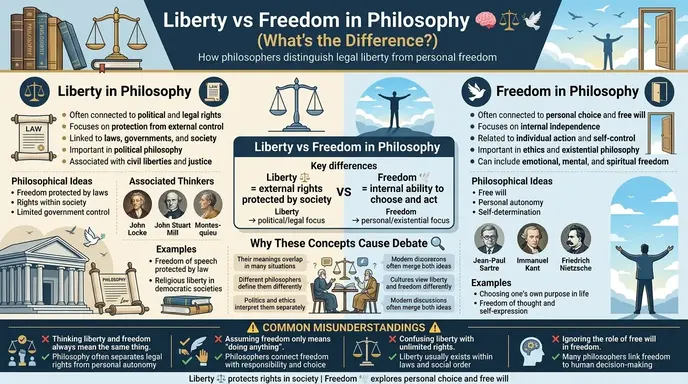
Liberty in Philosophy
Political philosophers often connect liberty with:
- Justice
- Rights
- Social contracts
- Government limits
Thinkers like John Locke strongly influenced liberty based political systems.
Freedom in Philosophy
Freedom is often discussed in:
- Existential philosophy
- Human psychology
- Moral choice
- Individual autonomy
Modern Interpretation
Today, liberty and freedom are frequently connected in democratic values and human rights discussions.
Real Life Examples with Liberty and Freedom
Freedom of Speech
A person speaking openly reflects freedom.
Legal protections preventing censorship reflect liberty.
Religious Liberty
Many countries legally protect the right to practice religion freely.
Creative Freedom
Artists, writers, and filmmakers often discuss freedom of expression.
Platforms like YouTube and Instagram are often involved in debates about digital freedom, speech, and content moderation.
Civil Rights Movements
Historical movements for equality focused heavily on liberty and freedom together.
Internet and Privacy
Modern debates involving Meta and digital platforms often involve questions about freedom of expression versus legal and social responsibility.
Difference + Similarity Between Liberty and Freedom
| Feature | Liberty | Freedom | Similarity |
| Core Idea | Protected rights | Independent action | Both oppose oppression |
| Legal Role | Strong | Sometimes indirect | Both support human dignity |
| Social Context | Organized society | Individual experience | Both valued globally |
| Political Meaning | Constitutional rights | Human autonomy | Both linked to democracy |
| Personal Use | Structured rights | Lifestyle independence | Both involve choice |
| Modern Relevance | Civil liberties | Personal rights | Both shape modern societies |
This table clearly shows the difference and similarity between liberty and freedom for quick understanding.
Why People Get Confused Between Liberty and Freedom
Similar Everyday Meaning
Both words commonly refer to independence and lack of control.
Historical Overlap
Political speeches and historical documents often use them together.
Translation Differences
In some languages, liberty and freedom translate into similar or identical terms.
Media and Popular Usage
Movies, books, and social media frequently use the words interchangeably.
Common Mistakes with Liberty and Freedom
| Mistake | Correct Understanding |
| Thinking they are completely identical | They have slightly different emphasis |
| Assuming liberty means unlimited action | Liberty exists within legal systems |
| Believing freedom ignores responsibility | Responsible freedom is important |
| Confusing political liberty with personal freedom | Context changes meaning |
| Treating liberty as only historical | It remains highly relevant today |
Quick Memory Tip
- Freedom = ability to act
- Liberty = protected right to act
When to Use Liberty or Freedom
Use “Liberty” When:
- Discussing laws or constitutions
- Talking about civil rights
- Referring to legal protections
- Analyzing political systems
Use “Freedom” When:
- Discussing personal independence
- Talking about expression or lifestyle
- Referring to emotional or social autonomy
- Describing general human choice
In many situations, both words can still overlap naturally.
Expert Insight
In practical political and legal discussions, liberty and freedom are deeply connected but not perfectly identical.
Freedom is often viewed as the broader human condition of independence, while liberty usually emphasizes rights protected within organized society.
Modern democracies depend on both concepts working together. Unlimited freedom without laws can create disorder, while liberty without meaningful personal freedom can feel restrictive or authoritarian.
This balance remains central to constitutional law, civil rights debates, digital privacy, and global human rights discussions today.
Understanding this distinction helps people interpret political systems, legal protections, and social debates more accurately.
Frequently Asked Questions
What is the main difference between liberty and freedom?
Freedom is the ability to act without restriction, while liberty usually refers to legally protected rights.
Are liberty and freedom the same thing?
They are closely related but have slightly different meanings depending on context.
Is liberty more legal than freedom?
Yes. Liberty is more strongly connected to laws and constitutional rights.
What is an example of freedom?
Freedom of expression or personal lifestyle choice.
What is an example of liberty?
Freedom of speech protected by constitutional law.
Why are liberty and freedom important?
They support human rights, democracy, and individual dignity.
Can freedom exist without liberty?
Some personal freedom may exist, but liberty provides stronger legal protection.
Why do governments discuss liberty?
Because liberty helps define citizens’ protected rights within society.
Conclusion
Understanding the difference between liberty and freedom becomes easier once you recognize the role of legal protection and personal independence.
Freedom generally refers to the ability to think, act, or live without unnecessary restriction, while liberty usually refers to rights protected by laws and social systems.
Although the two ideas overlap heavily, liberty often emphasizes structured rights within society, while freedom focuses more broadly on individual independence and autonomy.
Both concepts remain essential in democracy, constitutional law, civil rights, and modern human rights discussions.
In real world society, liberty and freedom work best together. Freedom allows personal expression and choice, while liberty ensures those rights are protected fairly and responsibly.
Once you fully understand the difference between liberty and freedom, political debates, legal systems, and social discussions become much easier to interpret clearly.
Discover More Articles!
Difference Between Zucchini and Squash:With Examples
Difference Between Magazine and Clip:With Simple Examples

James Whitmore. Labdiff.com is my english grammar comparision website. I explore the history and evolution of English words. I write detailed comparisons explaining why spellings change over time and how British and American English diverged. My articles add depth and credibility to grammar comparison topics.