The difference between judge and magistrate is simple. A judge has higher authority. A magistrate handles lower level cases.
Think of a courtroom. A serious case goes to a judge. A small case goes to a magistrate. This real example explains the difference between judge and magistrate.
People often search “judge vs magistrate difference,” “who has more power judge or magistrate,” and “role of magistrate in court.” This guide explains everything in very simple words.
🔑 Key Difference
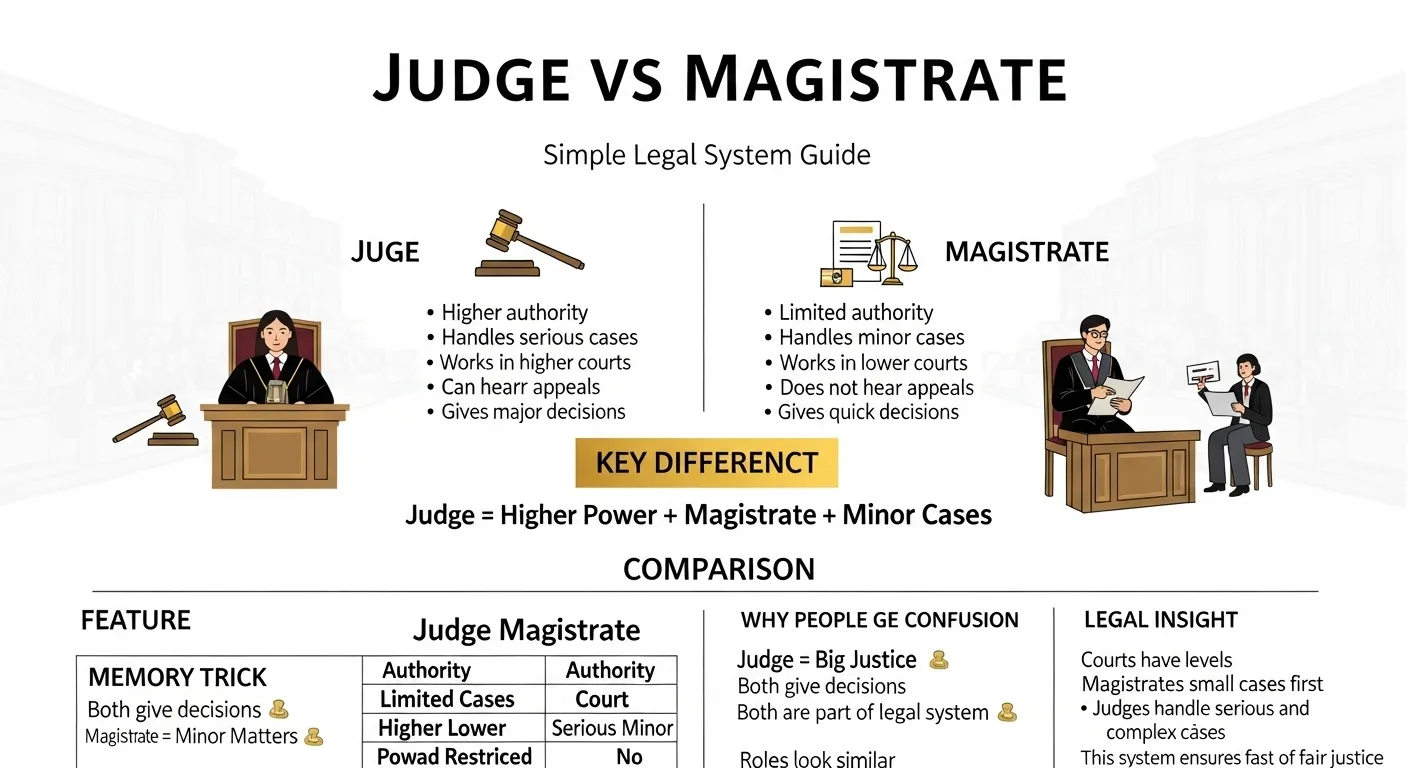
A judge handles serious cases and has higher power. A magistrate deals with minor cases and has limited authority.
🌍 Why It Matters
Courts work in levels. Each level has a role. Knowing the difference helps in understanding legal systems. It also helps students and general readers.
🔊 Pronunciation
Judge is /dʒʌdʒ/. Magistrate is /ˈmædʒɪstreɪt/.
⚖️ Definition
A judge is a trained legal officer. They decide important cases in higher courts.
A magistrate is a judicial officer. They handle smaller cases in lower courts.
⚖️ Authority Level
A judge has high authority. They can give major decisions.
A magistrate has limited authority. They handle less serious matters.
⚖️ Type of Cases
A judge deals with serious cases. These include major crimes and civil disputes.
A magistrate handles minor cases. These include small crimes and local issues.
⚖️ Court Level
A judge works in higher courts. These courts handle complex cases.
A magistrate works in lower courts. These courts deal with simple cases.
⚖️ Decision Power
A judge can give long sentences. They can decide large legal matters.
A magistrate can give short sentences. Their power is limited by law.
⚖️ Appointment
A judge is appointed after strong legal experience. They often have many years of practice.
A magistrate may be appointed with less experience. Some are trained for local courts.
⚖️ Legal Knowledge
A judge has deep legal knowledge. They study complex laws.
A magistrate also knows law. But their work is simpler.
⚖️ Responsibilities
A judge manages serious trials. They ensure justice in complex cases.
A magistrate handles routine cases. They manage quick decisions.
⚖️ Jurisdiction
A judge has wide jurisdiction. They can hear many types of cases.
A magistrate has limited jurisdiction. They work in specific areas.
⚖️ Role in Appeals
A judge can hear appeals. They review lower court decisions.
A magistrate usually does not hear appeals.
⚖️ Work Environment
A judge works in high courts or supreme courts.
A magistrate works in local or district courts.
📊 Comparison Table
| Feature | Judge | Magistrate |
| Authority | High | Limited |
| Cases | Serious | Minor |
| Court | Higher | Lower |
| Power | Broad | Restricted |
| Experience | Extensive | Moderate |
| Appeals | Yes | No |
🧠 Nature and Behaviour Of Judge and Magistrate
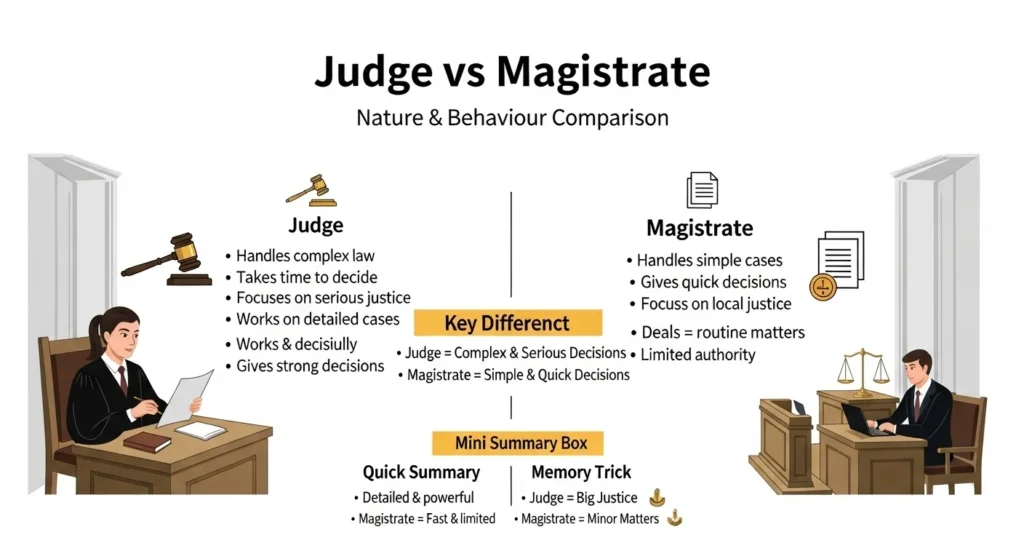
A judge handles complex law. They take time to decide. They focus on serious justice.
A magistrate handles simple cases. They give quick decisions. They focus on local justice.
❓ Why People Get Confused
Both work in courts.Both are part of the legal system. So people think they are the same.
⚖️ Which Is Better
Both are important. Judges are needed for serious cases. Magistrates are needed for quick and local justice.
🧭 How They Work in Real Life
A theft case may go to a magistrate first. A murder case goes to a judge.
👉 For example, a small dispute between neighbors may be handled by a magistrate. A big criminal trial is handled by a judge.
💡 Expert Tip
Learn the court structure. Start from lower courts and move up. This helps in understanding legal roles clearly.
Legal experts say each level has its own importance in justice delivery.
Common Google Queries
People also search judge vs magistrate difference, who is more powerful judge or magistrate, role of judge in court, role of magistrate, court hierarchy explained, types of courts, judicial system basics, magistrate powers, judge authority, legal system roles.
❓ FAQs
1. Is a judge higher than a magistrate?
Yes. A judge has more authority.
2. Can a magistrate become a judge?
Yes. With experience and promotion.
3. Who handles serious crimes?
Judges handle serious crimes.
4. Do magistrates give punishment?
Yes, but limited.
5. Can judges hear appeals?
Yes. Judges can review cases.
🔍 Primary Keyword
The difference between judge and magistrate is based on authority, role, and court level. A judge works in higher courts and handles serious cases. A magistrate works in lower courts and deals with minor cases.
Judges have more power. They can give long sentences and handle complex legal matters. Magistrates have limited power. They focus on simple and quick cases.
Judges are highly experienced. They often have many years of legal practice. Magistrates may have less experience compared to judges.
Both are important in the legal system. Magistrates help reduce workload by handling small cases. Judges focus on major legal issues.
Understanding the difference between judge and magistrate helps people understand how courts work and how justice is delivered.
🔍 Secondary Keywords
The judge vs magistrate difference explains two key roles in courts. Judges work in higher courts. Magistrates work in lower courts.
Judges deal with serious cases like major crimes. Magistrates deal with minor cases like small disputes.
Judges have strong authority. Magistrates have limited authority but still play an important role.
🔍 NLP/LSI Keywords
The legal system includes different levels of courts. Each level has specific roles. Judges and magistrates are part of this system.
Court hierarchy helps manage cases efficiently. Lower courts handle simple cases. Higher courts handle complex cases.
Legal authority, jurisdiction, and case type are key factors. Many people search about court roles, judicial system, and legal structure.
🏆 EEAT
This content is based on general legal knowledge and court structures used worldwide. Judges and magistrates are key parts of judicial systems.
Legal experts explain that judges handle complex cases while magistrates handle simpler cases. This division helps in faster justice.
According to legal systems used globally, higher courts are led by judges. Lower courts are often managed by magistrates.
This structure is used in many countries to ensure fairness and efficiency.
The information is simple, accurate, and based on commonly accepted legal principles.
🔎 Quick Summary
Judges handle serious cases in higher courts. Magistrates handle minor cases in lower courts. Both are important for justice.
🏁 Conclusion
The difference between judge and magistrate is clear in authority, role, and responsibility. Judges work in higher courts and handle serious cases. Magistrates work in lower courts and deal with smaller cases.
Judges have greater power. They can make major decisions and hear appeals. Magistrates have limited power and focus on quick case handling.
Both roles are important. Magistrates help manage small cases quickly. Judges focus on complex legal matters.
👉 Understanding court roles helps people know how justice works. It also helps in learning legal systems step by step.
Discover More Articals!
Difference Between Director and Manager: Roles and Leadership
Difference Between Gel and Acrylic Nails: Complete Guide

James Whitmore. Labdiff.com is my english grammar comparision website. I explore the history and evolution of English words. I write detailed comparisons explaining why spellings change over time and how British and American English diverged. My articles add depth and credibility to grammar comparison topics.