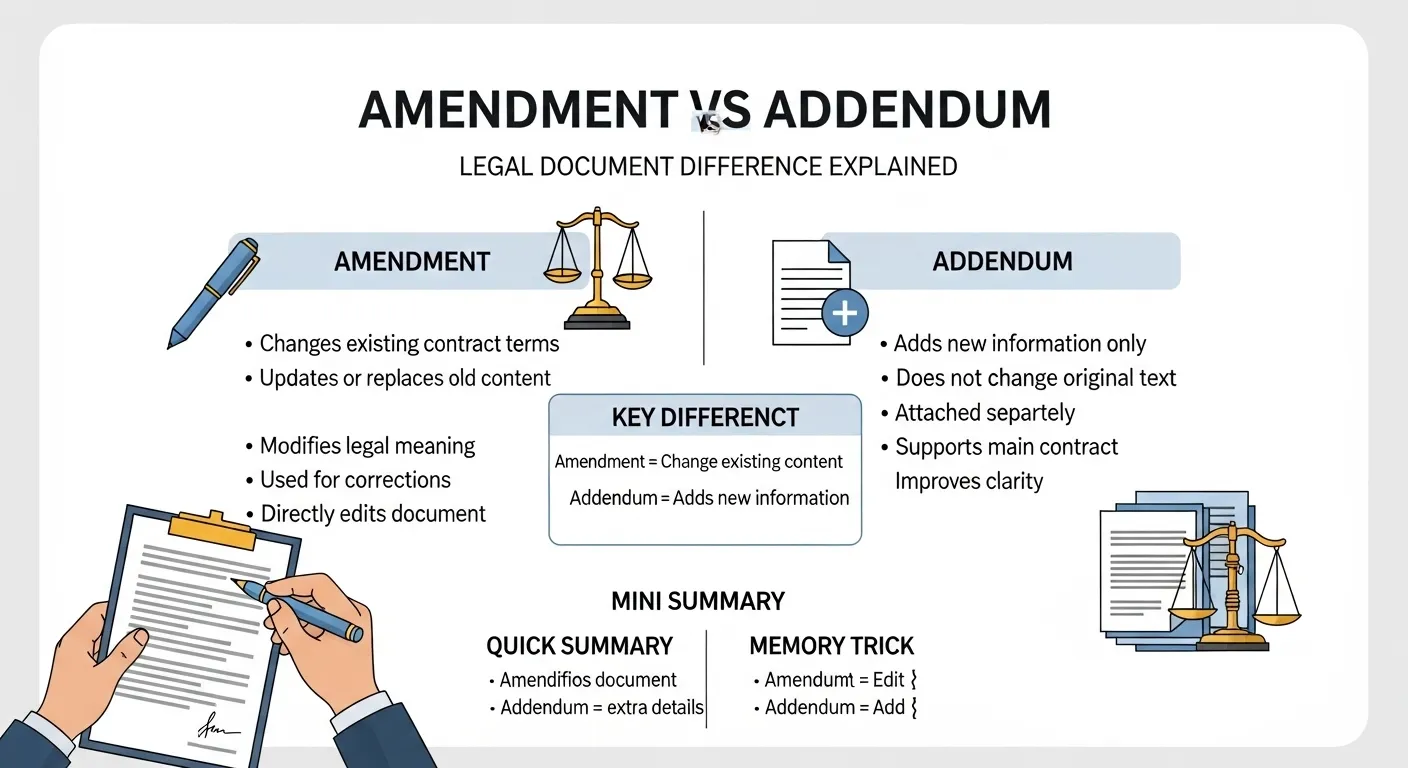
The difference between amendment and addendum is that an amendment changes the original document, while an addendum adds new information without changing the original content.
This concept plays an important role in legal writing. It appears in contracts, agreements, and business documents.
For example, a rental contract may change rent later. That change becomes an amendment. However, if new rules are added without changing old terms, that becomes an addendum.
People often search for this topic online because it seems confusing. Therefore, this guide explains it in simple and clear language.
Understanding this difference prevents legal mistakes. It also improves communication between parties.
🔑 Key Difference
An amendment changes existing content in a document.
Meanwhile, an addendum adds new information without altering the original text.
🌍 Why It Matters
This difference matters in real legal and business work.
Contracts appear in jobs, rentals, and companies. Therefore, accuracy becomes very important.
If someone writes a change incorrectly, confusion may happen. As a result, old terms may still apply.
An amendment solves this issue by updating existing terms.
In contrast, an addendum only adds extra details. It does not replace anything.
Businesses use both tools regularly. Similarly, individuals also use them in agreements.
📄 Definition
An amendment refers to a formal change in a document. It updates or replaces specific parts.
On the other hand, an addendum refers to extra information added separately. It does not change the original text.
🧠 Nature
An amendment stays corrective in nature. It fixes or updates content.
Meanwhile, an addendum remains additive in nature. It expands the document.
⚙️ Function
An amendment improves accuracy by changing existing terms. Therefore, it keeps documents updated.
An addendum improves clarity by adding extra information. However, it does not alter original content.
🏗️ Structure
An amendment directly edits the document. It clearly shows what has changed.
In contrast, an addendum appears as a separate attachment. It stays at the end of the document.
📌 Usage
An amendment applies when changes occur in existing terms.
Meanwhile, an addendum applies when new details appear later.
🔄 Behavior
An amendment modifies original content. It replaces outdated information.
However, an addendum only adds content. It does not modify anything.
🎯 Purpose
An amendment focuses on correction and updates.
On the other hand, an addendum focuses on addition and explanation.
⭐ Features
Amendments stay precise and direct. Therefore, they clearly show changes.
Addendums remain flexible and supportive. As a result, they provide extra clarity.
📊 Comparison Table
| Feature | Amendment | Addendum |
| Purpose | Change content | Add content |
| Effect | Modifies document | Keeps document unchanged |
| Placement | Inside document | Separate attachment |
| Structure | Direct edits | Added section |
| Usage | Corrections | Additional details |
| Flexibility | Limited | High |
| Legal impact | Changes terms | Supports terms |
| Timing | When change is needed | When new info is added |
🧭 Real-Life Examples
For instance, a rent agreement may increase rent. That becomes an amendment because it changes terms.
Meanwhile, a job contract may add bonus rules. That becomes an addendum because it only adds information.
In business deals, payment terms may also change through amendments. However, extra instructions often appear as addendums.
These examples clearly show the difference in real situations.
💡 Expert Tip
Legal experts recommend writing amendments clearly. They should always show exact changes.
Meanwhile, addendums should stay separate. They should not modify original clauses.
Law firms and companies use both tools regularly. Therefore, clarity remains very important in legal documents.
Common Google Queries
- amendment vs addendum difference
- what is amendment in contract
- addendum meaning in law
- legal difference between amendment and addendum
- contract amendment example
- addendum vs appendix difference
- when to use amendment
- when to use addendum
- legal document update rules
- contract modification meaning
❓ FAQs
1. Is amendment same as addendum?
No, they are different. An amendment changes content, while an addendum adds information.
2. Does amendment change original document?
Yes, it updates or replaces existing terms.
3. Does addendum change original content?
No, it only adds new information.
4. When should I use amendment?
Use it when you need to change existing terms.
5. When should I use addendum?
Use it when you need to add extra details.
🔍 Primary Keyword
The difference between amendment and addendum plays an important role in legal documents.
An amendment changes existing content. It updates or replaces old terms. Therefore, it ensures that agreements stay accurate and up to date.
In contrast, an addendum adds new information without changing the original document. It works as an additional section that supports the main agreement.
In legal practice, professionals use amendments when contracts require changes. For example, price updates or condition changes need amendments. However, when new clauses or extra details appear, addendums are used instead.
Moreover, law firms and companies rely on both tools to maintain clarity. As a result, documents remain structured and easy to understand.
Understanding the difference between amendment and addendum helps avoid legal confusion. It also improves communication and reduces contract errors in real-world situations.
🔍 Secondary Keywords
Amendment vs addendum is an important legal concept. An amendment changes existing contract terms. It modifies outdated or incorrect information.
Meanwhile, an addendum adds new details. It does not change the original content. Instead, it supports the agreement with extra information.
Both tools are widely used in legal and business environments. For example, amendments apply in contract revisions and policy updates. However, addendums apply when additional clauses are required.
Furthermore, these tools help maintain clarity in agreements. They reduce misunderstandings between parties. As a result, contracts remain more reliable and professional.
🔍 NLP/LSI Keywords
Legal documents often change over time. Therefore, amendments and addendums play a key role in contract management.
An amendment modifies existing terms. It ensures accuracy in agreements. Meanwhile, an addendum adds new details without changing original content.
Related terms include contract update, legal drafting, agreement revision, and document modification.
These terms are widely used in business and law. They help maintain clear communication. Moreover, they improve document structure and reduce confusion.
Using correct legal terms improves contract quality. As a result, legal documents become more effective and professional.
🏆 EEAT Of amendment and addendum

This content follows standard legal drafting practices used in global systems. In professional environments, amendments are widely used to modify contracts.
Law firms, corporations, and legal professionals regularly apply amendments to ensure accuracy. Therefore, contracts stay updated and legally valid.
Meanwhile, addendums are used when additional information is required. They do not change original agreements. Instead, they support the document with extra details.
In real-world legal systems, both tools are essential. They help maintain clarity and reduce disputes between parties.
Moreover, legal experts recommend using clear wording in amendments. They also suggest keeping addendums separate for better structure.
As a result, documents become more organized, readable, and legally reliable.
🔎 Quick Summary
An amendment changes a document.
However, an addendum adds new information.
🏁 Conclusion
The difference between amendment and addendum is clear when we study their purpose. An amendment changes existing content in a document. It updates or replaces old terms. Therefore, it ensures accuracy and keeps agreements legally correct.
In contrast, an addendum adds new information without changing the original content. It works as an additional section that supports the main document.
Both tools are important in legal and business writing. Amendments help when changes are required. Meanwhile, addendums help when new information is added later.
Moreover, using the correct term improves legal clarity. It also reduces confusion and prevents disputes.
In real-world practice, professionals use both tools regularly. Therefore, understanding them is essential for students, workers, and businesses.
Finally, proper use of amendments and addendums ensures clear communication and strong legal documentation.
Discover More Articals!
Difference Between Judge and Magistrate: Simple Legal Guide
Difference Between Suit and Blazer: Simple Style Guide

James Whitmore. Labdiff.com is my english grammar comparision website. I explore the history and evolution of English words. I write detailed comparisons explaining why spellings change over time and how British and American English diverged. My articles add depth and credibility to grammar comparison topics.