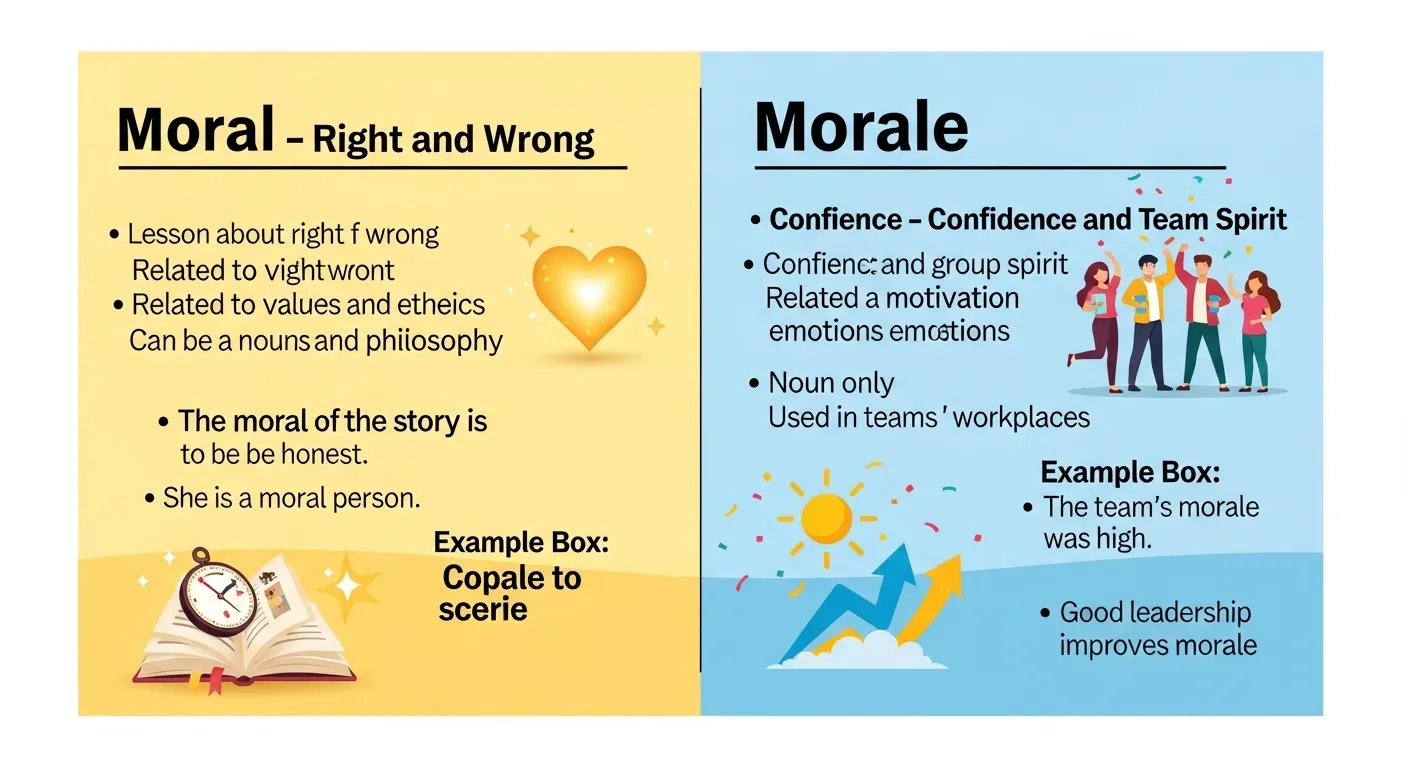
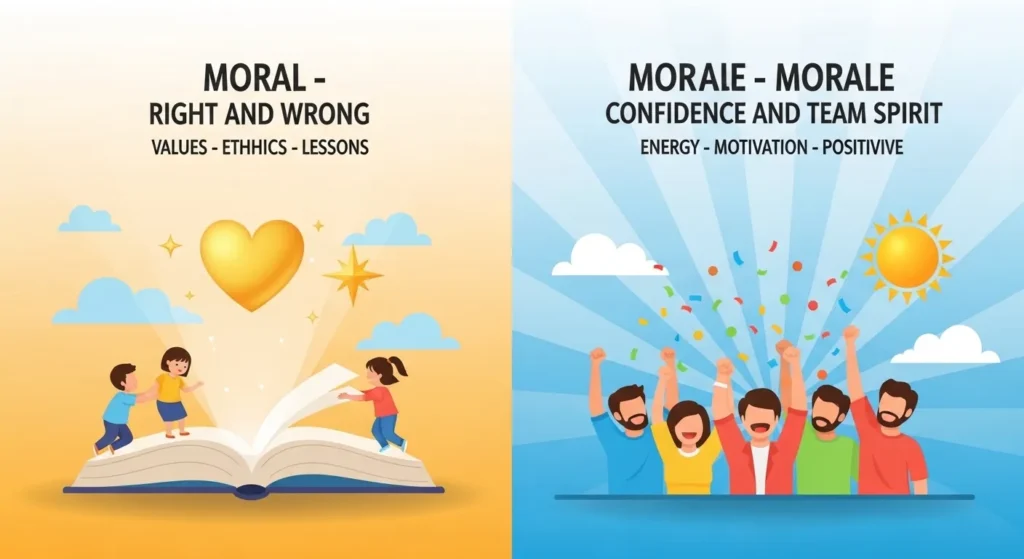
The difference between moral or morale is simple. Moral relates to right and wrong, while morale refers to confidence and team spirit.
Many people mix these words because they sound alike. But their meanings are very different. The difference between moral and morale matters in school, work, and daily life.
A moral teaches values. Morale shows feelings. Understanding the difference between moral and morale helps students write correctly and speak clearly.
These words are small. Their meanings are big. Let us understand them step by step in easy language.
📖 Definition of Moral vs Morale
Moral means a lesson about right and wrong. It can also describe good behavior.
Example:
- The moral of the story is to be honest.
- She is a moral person.
Morale means confidence, spirit, or happiness in a group.
Example:
- The team’s morale was high.
- Good leadership improves morale.
Moral is about values.
Morale is about feelings.
🔊 Pronunciation (US & UK)
- Moral: /ˈmɔːrəl/ (US & UK)
- Morale: /məˈræl/ (US & UK)
Moral sounds like “more-uhl.”
Morale sounds like “muh-ral.”
🔗 Linking Hook
Now that we know the basic meanings, let us explore the full difference between moral and morale in detail.
🆚 Difference Between Morale and Moral
1️⃣ Meaning
- Moral: About right and wrong.
- Morale: About confidence and spirit.
Example 1: The moral of the tale is kindness.
Example 2: The soldiers’ morale was strong.
2️⃣ Part of Speech
- Moral: Noun or adjective.
- Morale: Noun only.
Example 1: That is a moral lesson.
Example 2: Team morale improved.
3️⃣ Usage in Stories
- Moral: Used at the end of a story.
- Morale: Not used in story lessons.
Example 1: The moral teaches honesty.
Example 2: The class morale increased after winning.
4️⃣ Usage in Workplace
- Moral: Refers to ethics at work.
- Morale: Refers to team happiness.
Example 1: A moral decision avoids cheating.
Example 2: Good managers boost morale.
5️⃣ Focus
- Moral: Focus on values.
- Morale: Focus on emotions.
Example 1: Sharing is a moral act.
Example 2: Praise raises morale.
6️⃣ Context
- Moral: Used in religion, philosophy, stories.
- Morale: Used in army, sports, offices.
Example 1: Moral values guide life.
Example 2: The coach improved morale.
7️⃣ Tone
- Moral: Serious tone.
- Morale: Emotional tone.
Example 1: Moral rules are strict.
Example 2: High morale feels exciting.
8️⃣ Individual vs Group
- Moral: Can describe a person.
- Morale: Describes a group.
Example 1: He has strong moral beliefs.
Example 2: The team has high morale.
9️⃣ Opposites
- Moral: Immoral.
- Morale: Low morale.
Example 1: Stealing is immoral.
Example 2: Loss lowered morale.
🔟 Field of Study
- Moral: Ethics and philosophy.
- Morale: Psychology and leadership.
Example 1: Moral philosophy studies right and wrong.
Example 2: Leaders study morale in teams.
📊 Comparison Table
| Feature | Moral | Morale | Similarity |
| Meaning | Right and wrong | Confidence and spirit | Both relate to behavior |
| Part of Speech | Noun/Adjective | Noun | Both common words |
| Focus | Values | Emotions | Used in daily life |
| Used For | Stories, ethics | Teams, groups | Important in society |
| Opposite | Immoral | Low morale | Affect actions |
🌿 Nature and Behavior
Moral guides actions. It teaches honesty and kindness. It shapes character.
Morale affects energy and motivation. It boosts teamwork.It improves performance.
Moral shapes the heart.
Morale shapes the mood.
🤔 Why People Are Confused
- Words sound similar.
- Both relate to behavior.
- Spelling difference is small.
- Pronunciation is close.
But meaning is very different.
🏆 Which Is Better in What Situation?
Moral
Moral is better when discussing values. It is important in stories and lessons. Teachers use morals to guide students.
Parents teach moral behavior at home. Moral values build character.Moral thinking prevents harm. Use moral when speaking about right and wrong.
Morale
Morale is better when talking about groups. It is important in teams and offices. High morale improves productivity. Leaders focus on morale to keep workers happy.
Soldiers need high morale. Students need morale before exams. Use morale when talking about spirit and motivation.
🎭 Metaphors and Similes
- Moral is a compass for life.
- Morale is fuel for teamwork.
- Moral shines like a guiding star.
- Morale rises like the sun.
💭 Connotative Meaning
Moral
- Positive: Honest, good, ethical.
Example: She has strong moral values. - Negative (when strict): Moral judgment can feel harsh.
Morale
- Positive: Energetic, confident, hopeful.
Example: The team’s morale is high. - Negative: Low morale means sadness.
📚 Works in Literature
- Aesop’s Fables – Fable, Aesop, Ancient Greece – Known for strong morals.
- Animal Farm – Political satire, Animal Farm, 1945 – Shows moral lessons and group morale.
🎬 Movies Related to Moral or Morale
- Remember the Titans – 2000, USA – Focus on team morale.
- The Dark Knight – 2008, USA – Shows moral dilemmas.
❓ Frequently Asked Questions
1. Are moral and morale the same?
No. Moral is about right and wrong. Morale is about spirit.
2. Can morale describe one person?
Usually it describes a group.
3. Can moral be an adjective?
Yes. Example: moral values.
4. Which word relates to teamwork?
Morale.
5. Which word is used in stories?
Moral.
🌍 How Both Are Useful for Society
Moral builds strong character. It reduces crime. It teaches honesty.
Morale builds strong teams. It improves performance. It increases happiness.
Society needs both.
Values guide actions.
Spirit drives success.
📝 Final Words
The difference between moral and morale is clear. Moral teaches right and wrong. Morale shows confidence and team spirit.
Moral builds character. Morale builds energy. Both words are important. Both affect life deeply. Use them correctly. Speak clearly. Write confidently.
📌 Conclusion
Understanding the difference between moral and morale helps in writing and speaking. Moral relates to values and ethics.
Morale relates to confidence and group spirit. Moral guides decisions. Morale improves teamwork.
These words may sound alike, but their meanings differ greatly. Moral builds strong character. Morale builds strong teams. Both are important for schools, workplaces, and society.
When you remember that moral equals values and morale equals motivation, you will never confuse them again.
Discover More Articals!
🛠️ Difference Between Steel and Metal: Simple Guide
⚡ Difference Between Ground and Neutral: Complete Guide
🎬 Difference Between Actor and Actress: Simple Guide

James Whitmore. Labdiff.com is my english grammar comparision website. I explore the history and evolution of English words. I write detailed comparisons explaining why spellings change over time and how British and American English diverged. My articles add depth and credibility to grammar comparison topics.