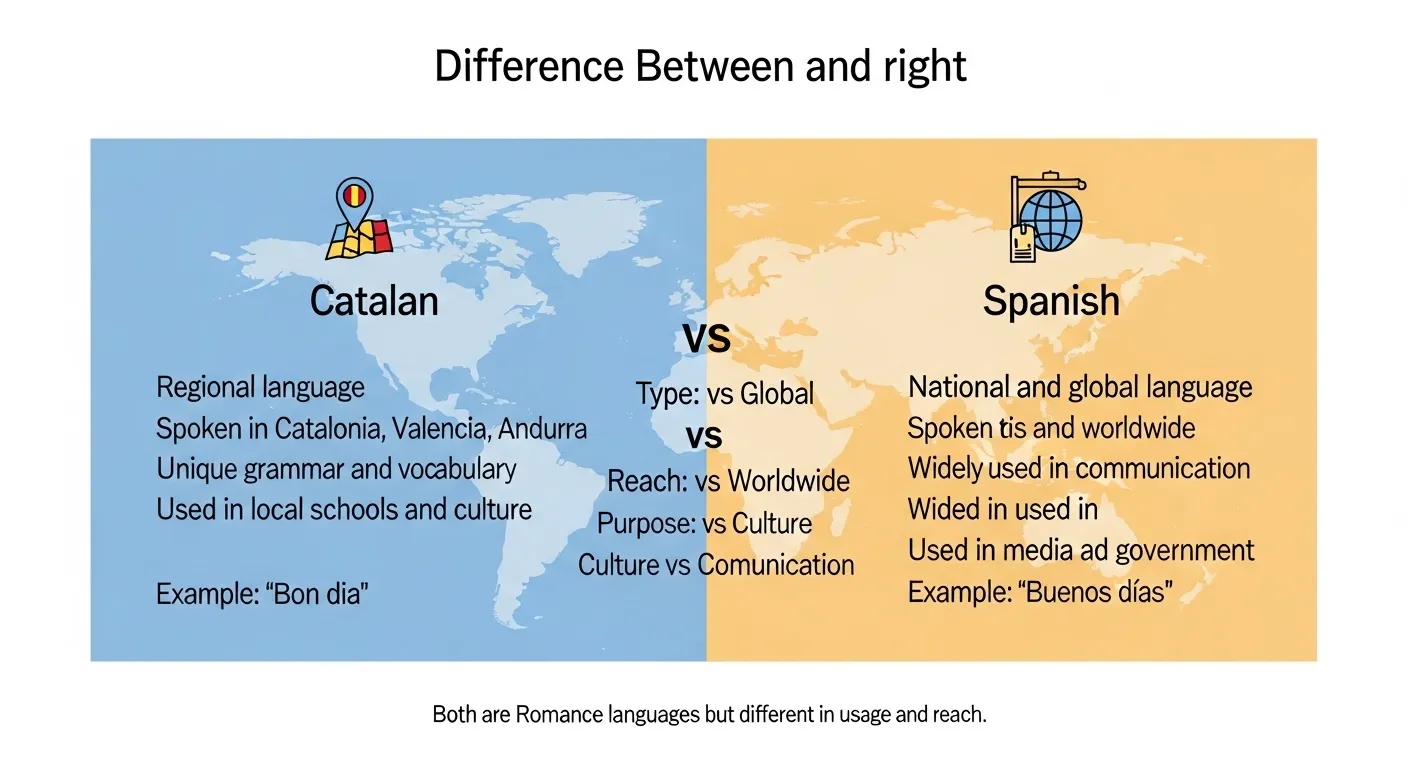
The difference between Catalan and Spanish is that Catalan is a separate Romance language mainly spoken in Catalonia, while Spanish is a global language spoken across Spain and many countries worldwide.
Both are used in Spain. However, they are not the same language.
For example, people in Barcelona may speak Catalan at home. Meanwhile, they also speak Spanish in daily communication.
Many people search this topic to understand language use in Spain. Therefore, this guide explains everything in very simple words.
Understanding this difference helps in travel, study, and communication.
🔑 Key Difference
Catalan is a regional language.
In contrast, Spanish is a national and global language.
Catalan has its own grammar and vocabulary.
However, Spanish is more widely spoken worldwide.
🌍 Why It Matters
This difference affects communication and culture.
Catalan is important for local identity. Therefore, it is used in schools and regional offices.
Spanish is used across Spain and internationally. As a result, it helps in global communication.
In real life, people often use both languages depending on situation.
🗣️ Definition
Catalan is a Romance language spoken in Catalonia and nearby regions.
Spanish, also called Castilian, is a Romance language spoken in Spain and many countries.
🧠 Nature
Catalan has a unique linguistic identity. Therefore, it stands as an independent language.
Spanish has a broader reach. Meanwhile, it connects people across countries.
⚙️ Function
Catalan is used for regional communication and education.
Spanish is used for national and international communication.
🏗️ Structure
Catalan grammar is closer to French and Italian in some ways.
In contrast, Spanish has its own structure and rules.
📌 Usage
Catalan is used in Catalonia, Valencia, and parts of Andorra.
Spanish is used in Spain, Latin America, and many global regions.
🔄 Behavior
Catalan is often used in local settings and cultural events.
Spanish is used in media, government, and international communication.
🎯 Purpose
Catalan preserves regional culture and identity.
Spanish supports wider communication and global connection.
🔤 Vocabulary Difference
Catalan words differ from Spanish words.
For example:
Catalan: “Bon dia” (Good morning)
Spanish: “Buenos días” (Good morning)
📊 Comparison Table
| Feature | Catalan | Spanish |
| Type | Regional language | National/global language |
| Origin | Romance language | Romance language |
| Usage area | Catalonia & nearby regions | Spain & worldwide |
| Speakers | Millions | Hundreds of millions |
| Grammar | Unique structure | Different structure |
| Purpose | Cultural identity | Global communication |
🧭 Real Life Examples
For example, a student in Barcelona may learn Catalan in school. Therefore, they use it in local settings.
Meanwhile, the same student uses Spanish to talk with people from other parts of Spain.
Another example is travel. Visitors often use Spanish because it is widely understood. However, locals may prefer Catalan in daily life.
💡 Expert Tip
Learn basic Spanish for travel across Spain.
Meanwhile, learning Catalan helps in local communication in Catalonia.
Therefore, knowing both languages can be useful.
Common Google Queries
- catalan vs spanish difference
- is catalan same as spanish
- where is catalan spoken
- spanish vs catalan language
- catalan language basics
- differences in vocabulary catalan spanish
- is catalan difficult
- spanish global language facts
- catalonia language use
- catalan pronunciation
❓ FAQs
1. Is Catalan the same as Spanish?
No. Catalan is a separate language with its own grammar and vocabulary.
2. Where is Catalan spoken?
It is mainly spoken in Catalonia and nearby regions.
3. Is Spanish more widely used?
Yes. Spanish is spoken worldwide.
4. Can Spanish speakers understand Catalan?
They may understand some words, but not everything.
5. Which language should I learn?
Spanish is more useful globally. Catalan is useful locally.
Difference Between Catalan and Spanish Language Explained
The difference between Catalan and Spanish is mainly based on usage, origin, and reach. Catalan is a regional Romance language spoken in Catalonia and nearby areas.
It has its own grammar, pronunciation, and vocabulary. Therefore, it is considered a separate language.
Spanish, also known as Castilian, is a global language spoken in Spain and many countries around the world. It connects millions of people and is used in international communication.
Catalan is used in schools, local government, and daily life in its region. However, Spanish is used in national communication and global media.
Both languages share some similarities because they belong to the Romance language family. Meanwhile, they also have clear differences in structure and words.
Understanding the difference between Catalan and Spanish helps in communication, travel, and cultural awareness.
Catalan vs Spanish Comparison and Key Differences
Catalan vs Spanish is a common language comparison. Catalan is a regional language used in parts of Spain. Spanish is a global language used worldwide.
Catalan has its own identity and is used in local communication. Meanwhile, Spanish is used for national and international communication.
People often compare them for travel and study purposes. Catalan is important in Catalonia. Spanish is important everywhere in Spain.
Both languages are part of the Romance language group. However, they differ in vocabulary and pronunciation.
Important Linguistic Terms Related to Catalan and Spanish Languages
Catalan and Spanish are Romance languages. They developed from Latin roots.
Catalan is spoken in Catalonia, Valencia, and Andorra. Spanish is spoken in many countries across the world.
Related terms include language family, dialect, vocabulary, grammar, pronunciation, and communication.
Both languages are important for culture and identity.
Understanding these terms helps in learning languages and improving communication skills.
Expert Overview of Catalan and Spanish Languages in Linguistics
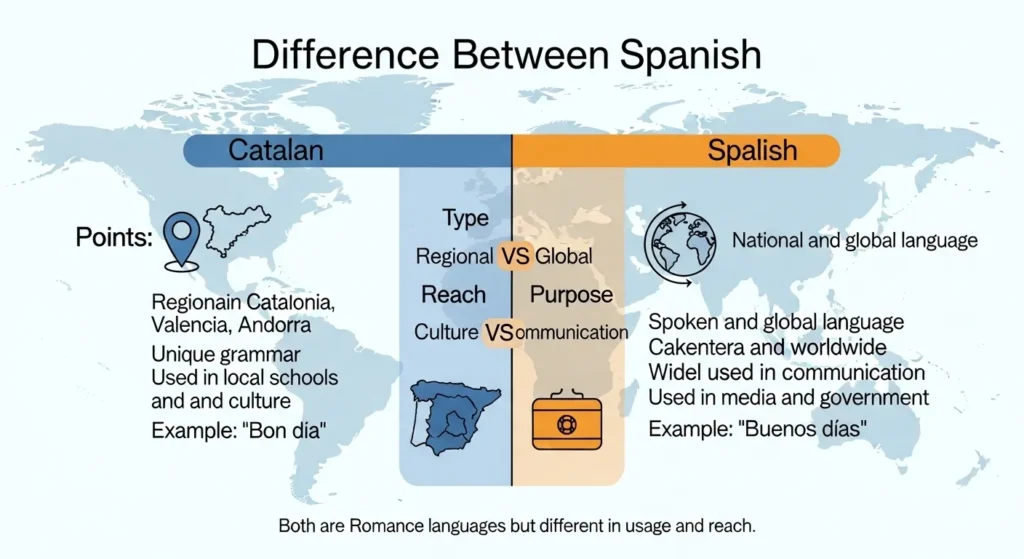
This content is based on general linguistic knowledge and language studies.
Catalan and Spanish are widely studied in the field of linguistics. Experts classify both as Romance languages with Latin origins.
Catalan is recognized as a regional language with official status in certain areas. Spanish is recognized as a national and international language.
Language experts study their grammar, vocabulary, and usage patterns to understand differences.
In real world use, both languages are important for communication and cultural identity.
Therefore, this information reflects widely accepted linguistic understanding.
🔎 Quick Summary
Catalan is a regional language with local use.
Spanish is a global language with wide reach.
Both are different but related languages.
🏁 Conclusion
The difference between Catalan and Spanish becomes clear when we compare their use and reach. Catalan is a regional language used mainly in Catalonia and nearby areas. Therefore, it plays a strong role in local culture and identity.
In contrast, Spanish is a global language used in many countries. As a result, it connects people across the world.
Catalan has its own grammar and vocabulary. Meanwhile, Spanish has a wider influence and usage.
In daily life, people in Catalonia often use both languages. However, Spanish is more useful for international communication.
Both languages are important. Therefore, learning them depends on your needs and goals.
Understanding the difference between Catalan and Spanish helps improve communication and cultural awareness.
Discover More Articals!
Difference Between Cotton and Polyester: Complete Fabric Guide
Difference Between Wine and Champagne: With Examples

James Whitmore. Labdiff.com is my english grammar comparision website. I explore the history and evolution of English words. I write detailed comparisons explaining why spellings change over time and how British and American English diverged. My articles add depth and credibility to grammar comparison topics.