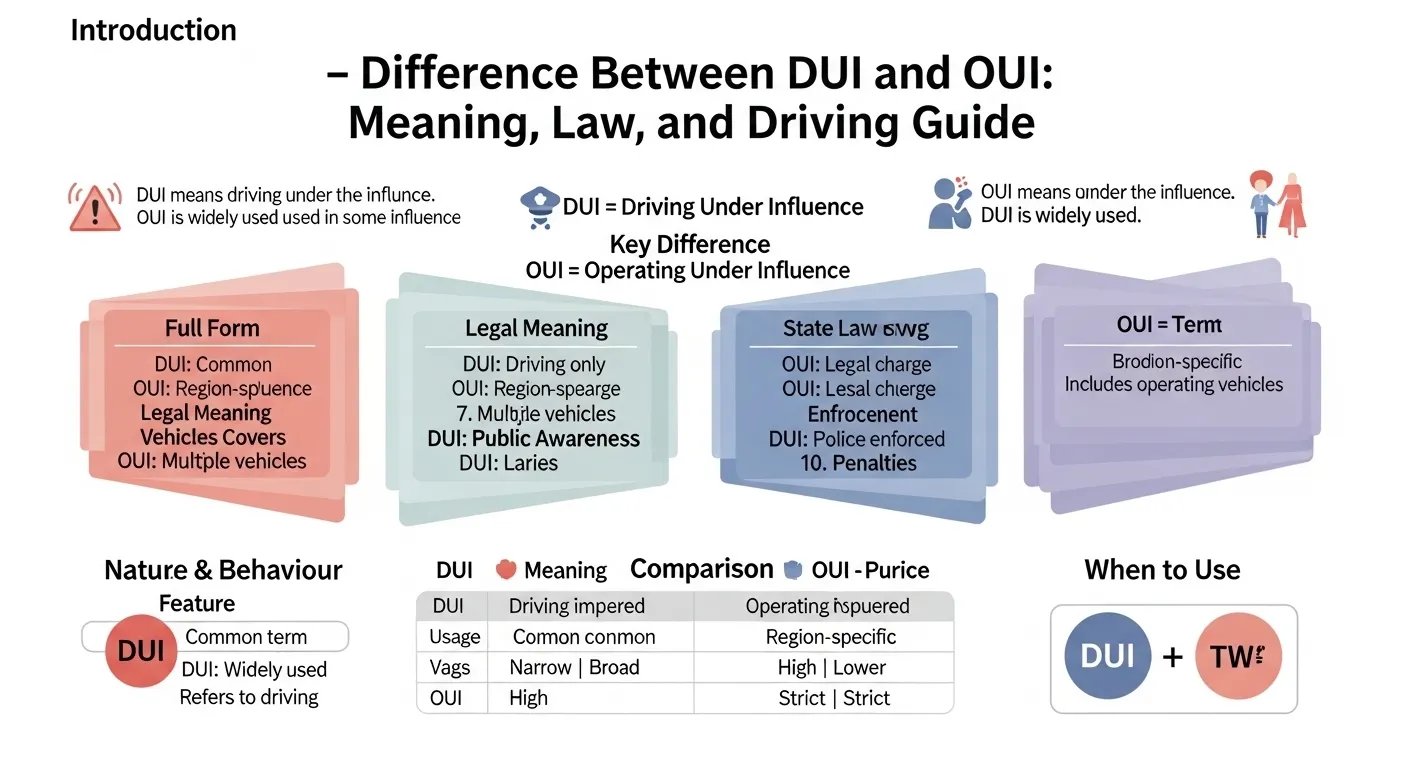
The difference between DUI vs OUI is simple. Both mean driving under the influence, but the wording and legal use can differ by place. Imagine a driver stopped by police after drinking.
In some areas, the charge is called DUI. In others, it is called OUI. This real life example explains the difference between DUI and OUI clearly.
Many users search queries like “DUI vs OUI meaning,” “is OUI same as DUI,” “difference between DUI and OUI laws,” and “which is worse DUI or OUI.”
These show that the difference between DUI or OUI is important for drivers. Both relate to impaired driving. But their legal terms vary. Understanding the difference between DUI and OUI helps avoid confusion.
🔑 Key Difference Between the Both
The main difference is terminology. DUI means driving under the influence. OUI means operating under the influence.
🎯 Why Their Difference Is Necessary for Learners and Experts
This difference helps in legal understanding. It supports safe driving. It helps professionals use correct terms.
🔊 Pronunciation (US & UK)
| Term | US Pronunciation | UK Pronunciation |
| DUI | /ˌdiː juː ˈaɪ/ | /ˌdiː juː ˈaɪ/ |
| OUI | /ˌoʊ juː ˈaɪ/ | /ˌəʊ juː ˈaɪ/ |
Now let’s explore the difference between DUI and OUI in detail.
📖 Definition with Examples
📌 DUI Definition
DUI means driving under the influence. It refers to driving while impaired.
Example 1:
Driver arrested after alcohol test.
Example 2:
DUI charged for drug use.
📌 OUI Definition
OUI means operating under the influence. It includes operating any vehicle while impaired.
Example 1:
Person charged while driving car.
Example 2:
OUI may apply to boats.
⚖️ Difference Between the Keywords
1. Full Form
DUI means driving under influence. OUI means operating under influence.
Example 1:
DUI for driving.
Example 2:
OUI for operating.
2. Usage by Region
DUI used widely. OUI used in some places.
Example 1:
DUI common in many states.
Example 2:
OUI used in specific states.
3. Scope
DUI focuses on driving. OUI includes broader operation.
Example 1:
DUI for cars.
Example 2:
OUI for boats or vehicles.
4. Legal Meaning
Both similar. Slight wording difference.
Example 1:
DUI legal charge.
Example 2:
OUI legal charge.
5. Vehicles Covered
DUI mainly cars. OUI can include more.
Example 1:
DUI for driving car.
Example 2:
OUI for operating machine.
6. State Laws
DUI laws vary. OUI laws vary.
Example 1:
Different DUI rules.
Example 2:
Different OUI rules.
7. Terminology
DUI more common. OUI less common.
Example 1:
DUI used in media.
Example 2:
OUI used in legal texts.
8. Public Understanding
DUI widely known. OUI less known.
Example 1:
People know DUI.
Example 2:
OUI less familiar.
9. Enforcement
Both enforced by police.
Example 1:
DUI arrest.
Example 2:
OUI arrest.
10. Penalties
Penalties similar. Depend on law.
Example 1:
DUI fines.
Example 2:
OUI penalties.
🧠 Nature and Behaviour Of dui and oui
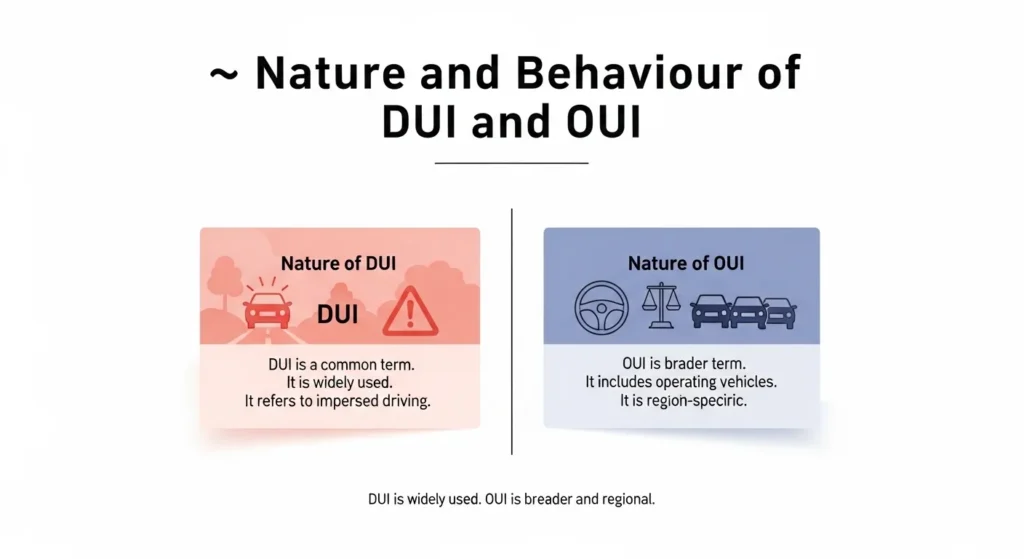
🔹 Nature of DUI
DUI is common term. It is widely used. It refers to impaired driving.
🔹 Nature of OUI
OUI is broader term. It includes operating vehicles. It is region specific.
❓ Why People Are Confused About Their Use
Both mean similar. Names differ. Laws vary by region. This creates confusion.
📊 Table Showing Difference and Similarity
| Feature | DUI | OUI | Similarity |
| Meaning | Driving impaired | Operating impaired | Both illegal |
| Usage | Common | Less common | Both legal terms |
| Scope | Narrow | Broad | Both involve alcohol |
| Awareness | High | Lower | Both punishable |
| Penalty | Strict | Strict | Both serious |
🏆 Which Is Better in What Situation
✅ When DUI Term Is Used
DUI is used in many regions. It is common. It fits general discussion.
✅ When OUI Term Is Used
OUI is used in specific areas. It fits legal context. It includes more activities.
🎭 How the Keywords Are Used in Metaphors and Similes
DUI metaphor:
Example: “His actions were like a DUI, risky and careless.”
OUI metaphor:
Example: “He operated under pressure like an OUI case.”
💭 Connotative Meaning
DUI negative
Example: “DUI shows danger.”
OUI negative
Example: “OUI shows risk.”
📚 Idioms or Proverbs Related to the Words
Better safe than sorry
Example: Avoid DUI or OUI.
📖 Works in Literature
- Drunk Driving Laws Legal, 2018
- Traffic Safety Studies Research, 2020
- Alcohol and Driving Study, 2019
🎬 Movies Related to the Keywords
- Flight 2012, United States
- The Hangover 2009, United States
- Crash 2004, United States
❓ Frequently Asked Questions
1. What is the difference between DUI and OUI?
DUI means driving. OUI means operating.
2. Are they the same?
Almost similar.
3. Which is worse?
Both serious.
4. Where is OUI used?
In some regions.
5. Why confusion happens?
Names differ.
🌍 How Both Are Useful for Surroundings
Both laws improve safety. They reduce accidents. They protect people.
📝 Final Words for the Both
DUI and OUI are important legal terms. Both promote safe driving.
📌 Conclusion
The difference between DUI and OUI mainly lies in terminology and scope. DUI stands for driving under the influence and is the more commonly used term in many regions.
OUI stands for operating under the influence and may cover a broader range of activities, including operating different types of vehicles or machinery.
Both terms refer to serious legal offenses involving impaired operation due to alcohol or drugs. The confusion arises because both terms are often used interchangeably, even though their legal definitions may vary slightly depending on location.
Understanding the difference between DUI and OUI helps individuals stay informed about laws and avoid risky behavior. In simple terms, DUI is widely used for driving offenses, while OUI is a broader legal term used in specific areas.
Discover More Articals!
Difference Between Love and Attachment: Meaning and Emotional Guide
Difference Between Iqra and Qaseera: With In 30 Seconds

labdiff.com is my English grammar comparison website where I simplify confusing words, spelling differences, and usage rules through clear explanations and examples. My goal is to help learners, writers, and students understand English easily and use correct grammar with confidence.