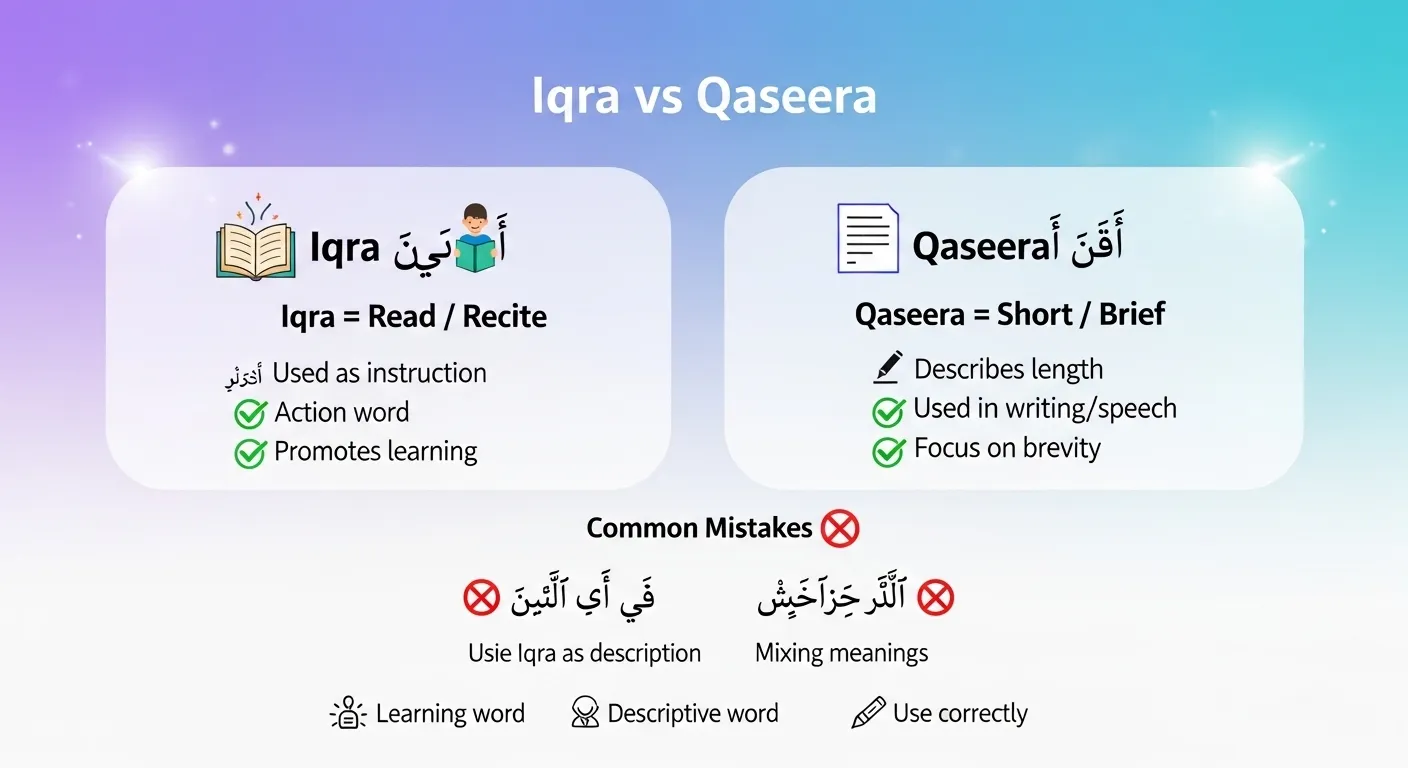
The difference between Iqra vsQaseera is simple. Iqra means “read,” while Qaseera means “short.” Imagine a teacher in class saying “Iqra.” Students start reading.
Then the teacher says “Qaseera jawab do.” Students give short answers. This real life example explains the difference between Iqra or Qaseera clearly.
Many learners search queries like “Iqra meaning in English,” “Qaseera meaning,” and “difference between Iqra and Qaseera words.”
These show that the difference between Qaseera and Iqra is important in understanding Arabic and Urdu vocabulary. Both words are used in daily learning.
But they have different meanings and uses. Understanding the difference between Iqra and Qaseera improves language skills.
Key Difference Between the Both
The main difference is meaning and usage. Iqra is a command to read. Qaseera describes something short.
Why Their Difference Is Necessary for Learners and Experts
This difference helps in language learning. Students understand instructions better. Teachers use correct words in class. It improves reading and writing skills. It also builds strong vocabulary.
Pronunciation (US & UK)
| Term | US Pronunciation | UK Pronunciation |
| Iqra | /ɪkˈrɑː/ | /ɪkˈrɑː/ |
| Qaseera | /kəˈsɪərə/ | /kəˈsɪərə/ |
Now let’s explore the difference between Iqra and Qaseera in detail.
Definition with Examples
Iqra Definition
Iqra is an Arabic word. It means “read” or “recite.”
Example 1:
Teacher says, “Iqra this lesson.”
Example 2:
Students start reading loudly.
Qaseera Definition
Qaseera means “short” or “brief.”
Example 1:
Write a Qaseera answer.
Example 2:
Give a short speech.
Difference Between the Keywords
1. Meaning
Iqra means read. Qaseera means short.
Example 1:
Iqra the text.
Example 2:
Write Qaseera notes.
2. Type of Word
Iqra is a verb. Qaseera is an adjective.
Example 1:
Iqra is an action.
Example 2:
Qaseera describes length.
3. Usage
Iqra is used as instruction. Qaseera is used as description.
Example 1:
Iqra the book.
Example 2:
Give a Qaseera answer.
4. Language Origin
Both come from Arabic. But used differently.
Example 1:
Iqra in religious texts.
Example 2:
Qaseera in daily language.
5. Function
Iqra tells what to do. Qaseera tells how something is.
Example 1:
Iqra now.
Example 2:
Keep it Qaseera.
6. Context
Iqra in learning. Qaseera in writing or speaking.
Example 1:
Iqra the lesson.
Example 2:
Qaseera reply.
7. Form
Iqra is command form. Qaseera is descriptive form.
Example 1:
Iqra loudly.
Example 2:
Short answer is Qaseera.
8. Emotional Tone
Iqra is directive. Qaseera is neutral.
Example 1:
Iqra shows action.
Example 2:
Qaseera shows quality.
9. Application
Iqra in reading tasks. Qaseera in length control.
Example 1:
Iqra Quran.
Example 2:
Qaseera paragraph.
10. Importance
Iqra builds knowledge. Qaseera improves clarity.
Example 1:
Iqra helps learning.
Example 2:
Qaseera helps precision.
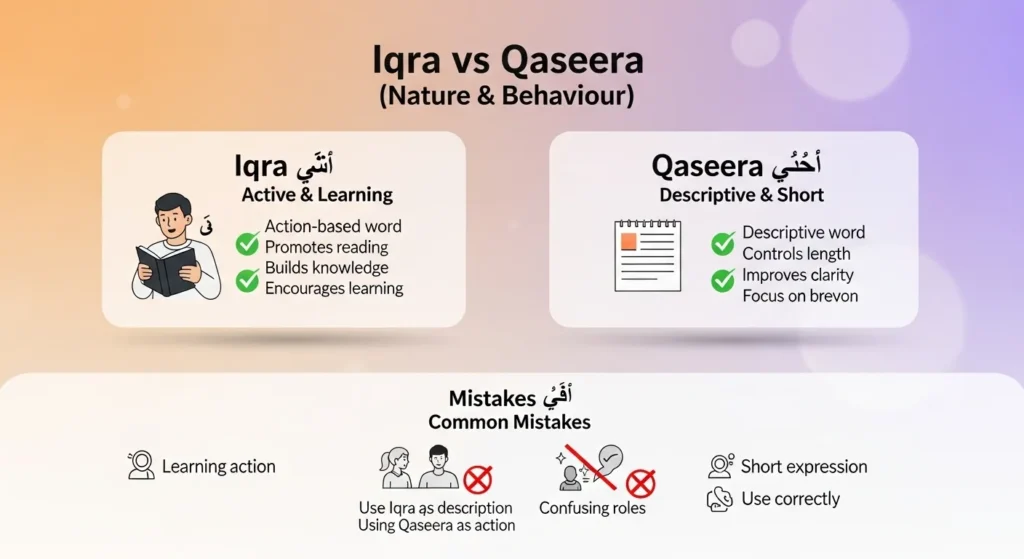
Nature and Behaviour Of ichra and qsehra
Nature of Iqra
Iqra is active. It promotes reading. It builds knowledge.
Nature of Qaseera
Qaseera is descriptive. It controls length. It improves clarity.
Why People Are Confused About Their Use
Both are Arabic words. Both used in education. Learners mix meanings. This causes confusion.
Table Showing Difference and Similarity
| Feature | Iqra | Qaseera | Similarity |
| Meaning | Read | Short | Both Arabic words |
| Type | Verb | Adjective | Both used in learning |
| Usage | Command | Description | Both in language |
| Function | Action | Quality | Both useful |
| Context | Reading | Writing | Both educational |
Which Is Better in What Situation
When Iqra Is Better
Use Iqra in reading tasks. It helps in learning.It builds understanding. It is useful in education and religious study.
When Qaseera Is Better
Use Qaseera when you need short answers. It improves clarity. It is useful in exams and writing.
How the Keywords Are Used in Metaphors and Similes
Iqra metaphor:
Example: “Iqra is the key to knowledge.”
Qaseera metaphor:
Example: “Her words were Qaseera but powerful.”
Connotative Meaning
Iqra positive
Example: “Iqra represents learning.”
Qaseera neutral
Example: “Qaseera represents brevity.”
Idioms or Proverbs Related to the Words
Knowledge is power
Example: Iqra leads to knowledge.
Less is more
Example: Qaseera answers are effective.
Works in Literature
- Quran Religious Text, 7th century
- Arabic Grammar Guide Academic, 2010
- Language Learning Basics Education, 2015
Movies Related to the Keywords
- The Message 1976, Libya
- Bilal: A New Breed of Hero 2015, UAE
- Kingdom of Heaven 2005, United States
Frequently Asked Questions
1. What is the difference between Iqra and Qaseera?
Iqra means read. Qaseera means short.
2. Is Iqra a verb?
Yes.
3. Is Qaseera an adjective?
Yes.
4. Can both be used in school?
Yes.
5. Why are they confused?
Because both are Arabic words.
How Both Are Useful for Surroundings
Both improve communication. Iqra builds knowledge. Qaseera improves clarity.
Final Words for the Both
Iqra and Qaseera are simple but important words. They support learning and communication.
Conclusion
The difference between Iqra and Qaseera is based on meaning and function. Iqra is a verb that means to read or recite, while Qaseera is an adjective that describes something short or brief. Both words come from Arabic and are widely used in educational and daily contexts.
Iqra plays an important role in learning because it encourages reading and gaining knowledge. It is often used in instructions and religious texts.
Qaseera, on the other hand, helps in keeping communication clear and concise. It is useful in writing short answers and giving brief responses.
Understanding the difference between Iqra and Qaseera helps learners use these words correctly.
It also improves language skills and communication. In simple terms, Iqra focuses on action, while Qaseera focuses on description. Both are valuable in their own way.
Discover More Articals!
Difference Between ln and log: What Is Different?(2026)
Difference Between Supplier and Vendor: Meaning and Examples

labdiff.com is my English grammar comparison website where I simplify confusing words, spelling differences, and usage rules through clear explanations and examples. My goal is to help learners, writers, and students understand English easily and use correct grammar with confidence.