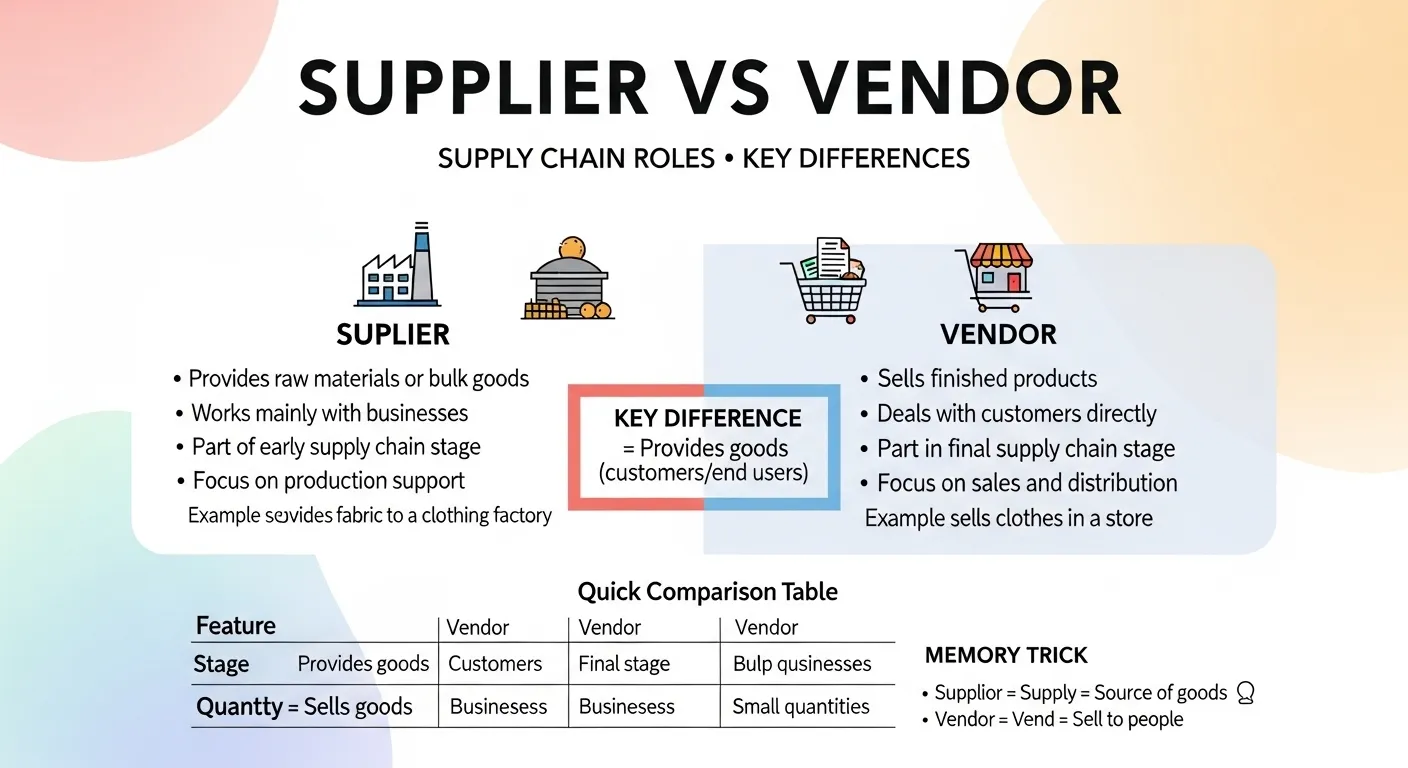
The difference between supplier or vendor is simple. A supplier provides raw materials or goods in bulk, while a vendor sells finished products directly to customers or businesses. Imagine a clothing business.
A company that provides fabric to the factory is a supplier. The shop that sells ready made clothes to customers is a vendor. This real life situation clearly explains the difference between supplier vs vendor.
Many people search questions like “supplier vs vendor meaning,” “vendor vs supplier examples,” and “difference between supplier and vendor in business.”
These queries show that the difference between vendor and supplier is important in commerce and daily business language.
Both roles are part of the supply chain, but their functions are different. Understanding the difference between supplier and vendor helps students, business owners, and professionals communicate clearly and make better decisions.
Key Difference Between the Both
The main difference is role in the supply chain. A supplier provides materials or products to businesses, while a vendor sells goods directly to customers or end users.
Why Their Difference Is Necessary for Learners and Experts
Understanding this difference is important in business, trade, and management. Students studying commerce learn these roles to understand how products move from production to customers.
Business professionals use these terms in contracts, purchasing, and sales. Companies depend on suppliers for materials and vendors for distribution.
Using the correct term helps avoid confusion in business communication and improves decision making in supply chain management.
Pronunciation (US & UK)
| Term | US Pronunciation | UK Pronunciation |
| Supplier | /səˈplaɪər/ | /səˈplaɪə/ |
| Vendor | /ˈvɛndər/ | /ˈvendə/ |
Now that the basics are clear, let’s explore the detailed difference between supplier and vendor.
Difference Between the Keywords
1. Basic Meaning
A supplier provides goods or materials. A vendor sells products.
Example 1:
A company supplies raw materials to a factory.
Example 2:
A vendor sells products in a shop.
2. Role in Supply Chain
Suppliers are at the beginning. Vendors are closer to the end.
Example 1:
A steel supplier provides metal to manufacturers.
Example 2:
A shop vendor sells finished goods to customers.
3. Type of Goods
Suppliers often deal with raw or bulk materials. Vendors deal with finished goods.
Example 1:
A supplier provides fabric to a clothing factory.
Example 2:
A vendor sells clothes in a store.
4. Target Customers
Suppliers mainly serve businesses. Vendors serve customers or businesses.
Example 1:
A supplier sells materials to a company.
Example 2:
A vendor sells products to individuals.
5. Quantity
Suppliers deal in large quantities. Vendors sell in smaller quantities.
Example 1:
A supplier delivers bulk goods.
Example 2:
A vendor sells single items.
6. Relationship with Buyer
Suppliers build long term business relationships. Vendors may have short term sales relationships.
Example 1:
A company signs contracts with suppliers.
Example 2:
Customers buy from vendors occasionally.
7. Pricing
Suppliers offer lower prices due to bulk supply. Vendors sell at retail prices.
Example 1:
Suppliers provide discounted bulk rates.
Example 2:
Vendors sell at market prices.
8. Business Type
Suppliers are part of production. Vendors are part of distribution.
Example 1:
A supplier supports manufacturing.
Example 2:
A vendor supports sales.
9. Interaction Level
Suppliers interact mostly with companies. Vendors interact with customers.
Example 1:
A supplier communicates with factory managers.
Example 2:
A vendor deals directly with buyers.
10. Examples in Daily Life
Suppliers operate behind the scenes. Vendors are visible in markets.
Example 1:
A farmer supplying crops to a company.
Example 2:
A shopkeeper selling vegetables.
Nature and Behaviour
Nature of Supplier
Suppliers focus on production and bulk distribution. They maintain steady supply and long term contracts.
Nature of Vendor
Vendors focus on selling and customer interaction. They handle final sales and customer service.
Why People Are Confused About Their Use
Both terms relate to business and selling. Many people think they mean the same thing. The confusion increases because both provide goods. However, their roles in the supply chain are different.
Table Showing Difference and Similarity
| Feature | Supplier | Vendor | Similarity |
| Role | Provides goods | Sells goods | Both part of supply chain |
| Stage | Early stage | Final stage | Both deal with products |
| Customers | Businesses | Customers or businesses | Both involve transactions |
| Quantity | Bulk | Small quantities | Both sell goods |
| Function | Production support | Sales and distribution | Both important in business |
Which Is Better in What Situation
When Supplier Is Better
A supplier is better when a business needs raw materials or goods in large quantities. Manufacturers depend on suppliers for production. For example, factories require suppliers to provide materials regularly to maintain operations.
When Vendor Is Better
A vendor is better when selling products directly to customers. Retail shops, online sellers, and service providers act as vendors. They help deliver finished goods to end users.
How the Keywords Are Used in Metaphors and Similes
Supplier metaphor:
Example: “Education is a supplier of knowledge.”
Vendor metaphor:
Example: “A teacher is a vendor of ideas in the classroom.”
Connotative Meaning
Supplier – neutral meaning
Example: “The company selected a reliable supplier.”
Vendor – neutral or slightly positive
Example: “The vendor offered helpful customer service.”
Idioms or Proverbs Related to the Words
Direct idioms are rare.
Business proverb: Supply creates demand
Example: A supplier increases availability of goods.
Customer proverb: The customer is always right
Example: Vendors focus on customer satisfaction.
Works in Literature
- Supply Chain Management Business Studies, Sunil Chopra, 2001
- The Vendor Management Office Business Guide, Marko Novakovic, 2011
- Operations Management Academic Text, William Stevenson, 2005
Movies Related to the Keywords
- The Founder 2016, United States
- Joy 2015, United States
- The Big Short 2015, United States
Frequently Asked Questions
1. What is the difference between supplier and vendor?
A supplier provides goods, while a vendor sells them to customers.
2. Can a supplier also be a vendor?
Yes. Some businesses perform both roles.
3. Who works with manufacturers?
Suppliers usually work with manufacturers.
4. Who sells directly to customers?
Vendors sell directly to customers.
5. Why is this difference important?
It helps in understanding business roles clearly.
How Both Are Useful for Surroundings
Both roles support the economy. Suppliers ensure the availability of materials. Vendors make products accessible to customers. Together they keep the supply chain active and efficient.
Final Words for the Both
Supplier and vendor are key parts of business operations. Each has a specific role in moving products from production to customers.
Conclusion
The difference between supplier and vendor mainly lies in their role and position in the supply chain.
Suppliers provide materials or goods to businesses, while vendors sell finished products to customers. Both are essential for smooth business operations.
Understanding the difference between supplier and vendor helps learners and professionals use these terms correctly and improve communication in business contexts.
Discover More Articals!
Difference Between Ago and Before: Meaning and Correct Usage Guide(2026)
Difference Between 220V and 240V

James Whitmore. Labdiff.com is my english grammar comparision website. I explore the history and evolution of English words. I write detailed comparisons explaining why spellings change over time and how British and American English diverged. My articles add depth and credibility to grammar comparison topics.