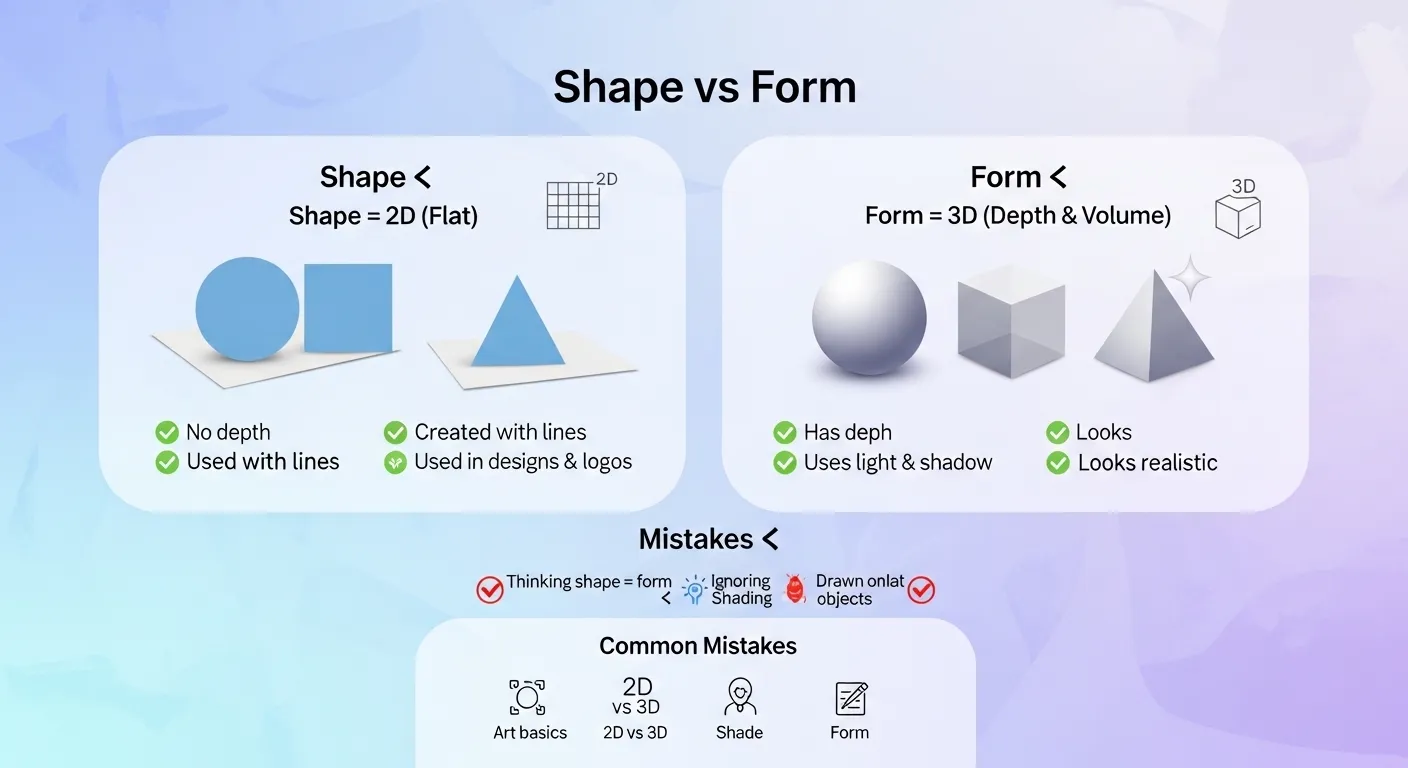
The difference between form and shape is simple. Shape is flat and two dimensional, while form is three dimensional and has depth. Imagine a student drawing on paper. He draws a circle. It is a shape because it is flat.
Then he shades it to look like a ball. Now it becomes a form because it appears to have depth. This real life example clearly explains the difference between shape vs form.
Many learners search questions like “shape vs form in art,” “difference between form and shape examples,” and “what is shape and form in design.”
These queries show that the difference between shape or form is important in art and design. Both terms describe visual elements, but their meanings are different.
Understanding the difference between shape and form helps learners improve drawing, design, and visual understanding.
Key Difference Between the Both
The main difference is dimension. Shape is two dimensional, while form is three dimensional and has volume.
Shape and Form: Are They the Same Thing? 🎨
Many learners search terms such as shape and form, shape and form difference, and difference between shape and form because these visual concepts often appear similar in art and design.
The simple answer is no — shape and form are not the same thing.
A shape is a flat visual element that has height and width. A form includes height, width, and depth, making it appear more realistic and three-dimensional.
Examples:
✔ A circle on paper is a shape.
✔ A ball is a form.
Many beginners also wonder If shape and form can replace each other. In drawing and design, a shape often becomes a form when artists add light, shadow, and perspective.
Some international learners search phrases such as diferencia entre shape y form because the confusion exists across many languages. The idea remains simple:
👉 Shape = flat appearance
👉 Form = depth and volume
Designers often use shapes to build structure first and then develop those ideas into complete forms.
Why Their Difference Is Necessary for Learners and Experts
Understanding this difference is important in art, design, and education. Students use these concepts to improve drawing skills.
Designers use them to create realistic visuals. Artists rely on form to show depth and shape to build structure.
In daily life, people see shapes in flat designs and forms in real objects. Knowing the difference helps create better visual communication and artistic work.
Pronunciation (US & UK)
| Term | US Pronunciation | UK Pronunciation |
| Shape | /ʃeɪp/ | /ʃeɪp/ |
| Form | /fɔːrm/ | /fɔːm/ |
Now that the basics are clear, let’s explore the detailed difference between shape and form.
Difference Between the Keywords
1. Basic Definition
Shape is flat. Form has depth.
Example 1:
A square drawn on paper is a shape.
Example 2:
A cube is a form.
2. Dimension
Shape is 2D. Form is 3D.
Example 1:
A triangle is a shape.
Example 2:
A pyramid is a form.
3. Depth
Shape has no depth. Form has depth.
Example 1:
A circle is flat.
Example 2:
A sphere has depth.
4. Visual Appearance
Shape looks simple. Form looks realistic.
Example 1:
A rectangle is a simple shape.
Example 2:
A box appears as a form.
5. Use in Art
Shape is used for outlines. Form is used for realism.
Example 1:
Artists sketch shapes first.
Example 2:
Artists add shading to create form.
6. Creation Method
Shapes are created with lines. Forms are created with shading and light.
Example 1:
A line creates a square shape.
Example 2:
Shading turns it into a cube form.
7. Examples in Daily Life
Shapes appear in drawings. Forms appear in real objects.
Example 1:
A logo uses shapes.
Example 2:
A chair is a form.
8. Complexity
Shapes are simple. Forms are complex.
Example 1:
A star is a shape.
Example 2:
A sculpture is a form.
9. Space
Shape exists on a flat surface. Form occupies space.
Example 1:
A design on paper is a shape.
Example 2:
A building is a form.
10. Perception
Shape is seen directly. Form is perceived through light and shadow.
Example 1:
A flat image shows shape.
Example 2:
A shaded drawing shows form.
Nature and Behaviour Of shape and form
Nature of Shape
Shape is simple and basic. It forms the foundation of design and drawing.
Nature of Form
Form is detailed and realistic. It adds depth and volume to objects.
Shape, Structure, and Visual Design Concepts 🏗️
Learners often compare shape with other design concepts such as structure, size, and form because these ideas frequently appear together in art and design education.
Shape and structure are not the same thing. Shape describes the external appearance of an object, while structure refers to the arrangement or framework that supports it.
Example:
✔ A building’s outline is its shape.
✔ Its internal support system is its structure.
People also confuse size and shape. Size explains how big or small something is, while shape explains how something looks.
Examples:
✔ Two circles may have different sizes.
✔ Both still keep the same shape.
Another common topic is the condition of change of shape or form. In art and design, adding shading, perspective, lighting, or changing an object’s angle can transform a simple shape into a realistic form.
Designers and artists use these principles to create logos, illustrations, products, architecture, and visual layouts that appear balanced and visually appealing.
Why People Are Confused About Their Use
Both terms describe visual elements. Many learners think they mean the same thing. The confusion increases because shapes can become forms when depth is added.
Table Showing Difference and Similarity
| Feature | Shape | Form | Similarity |
| Dimension | 2D | 3D | Both used in art |
| Depth | No | Yes | Both describe objects |
| Use | Basic design | Realistic design | Both important visually |
| Complexity | Simple | Complex | Both part of drawing |
| Space | Flat | Occupies space | Both relate to visuals |
Which Is Better in What Situation
When Shape Is Better
Shape is better when working on simple designs, patterns, and layouts. It is useful in logos, icons, and basic sketches where flat visuals are enough.
When Form Is Better
Form is better when creating realistic drawings and 3D designs. It is useful in sculpture, architecture, and detailed artwork where depth and volume are needed.
How the Keywords Are Used in Metaphors and Similes
Shape metaphor:
Example: “His ideas began to take shape.”
Form metaphor:
Example: “Her plan took form over time.”
Connotative Meaning
Shape neutral or positive
Example: “The project is taking shape.”
Form positive
Example: “The idea is in its final form.”
Idioms or Proverbs Related to the Words
Take shape
Example: The plan started to take shape.
In any shape or form
Example: He refused the offer in any shape or form.
Works in Literature
- The Shape of Things Play, Neil LaBute, 2001
- Form and Content Essays, various writers, 20th century
- Ways of Seeing Art Criticism, John Berger, 1972
Movies Related to the Keywords
- The Shape of Water 2017, United States
- In Good Form 2018, Germany
- Shaping Reality 2020, United Kingdom
Frequently Asked Questions
1. What is the difference between shape and form?
Shape is flat, while form has depth and volume.
2. Can a shape become a form?
Yes. Adding shading can turn a shape into a form.
3. Which is used in 3D design?
Form is used in 3D design.
4. Are shapes important in art?
Yes. They are the foundation of design.
5. Why do learners confuse them?
Because both describe visual elements.
How Both Are Useful for Surroundings
Shapes are used in design, logos, and patterns. Forms are used in buildings, objects, and real world structures. Both help people understand and create visual content.
Final Words for the Both
Shape and form are basic but powerful concepts in art and design. Each plays an important role in visual creation.
Conclusion
The difference between shape and form lies in dimension and depth. Shape is two dimensional and flat, while form is three dimensional and realistic.
Both are essential in art, design, and daily life. Understanding the difference between shape and form helps learners improve creativity and visual skills.
Discover More Articals!
Difference Between Objectives and Goals
Difference Between Femboy and Transn

James Whitmore. Labdiff.com is my english grammar comparision website. I explore the history and evolution of English words. I write detailed comparisons explaining why spellings change over time and how British and American English diverged. My articles add depth and credibility to grammar comparison topics.