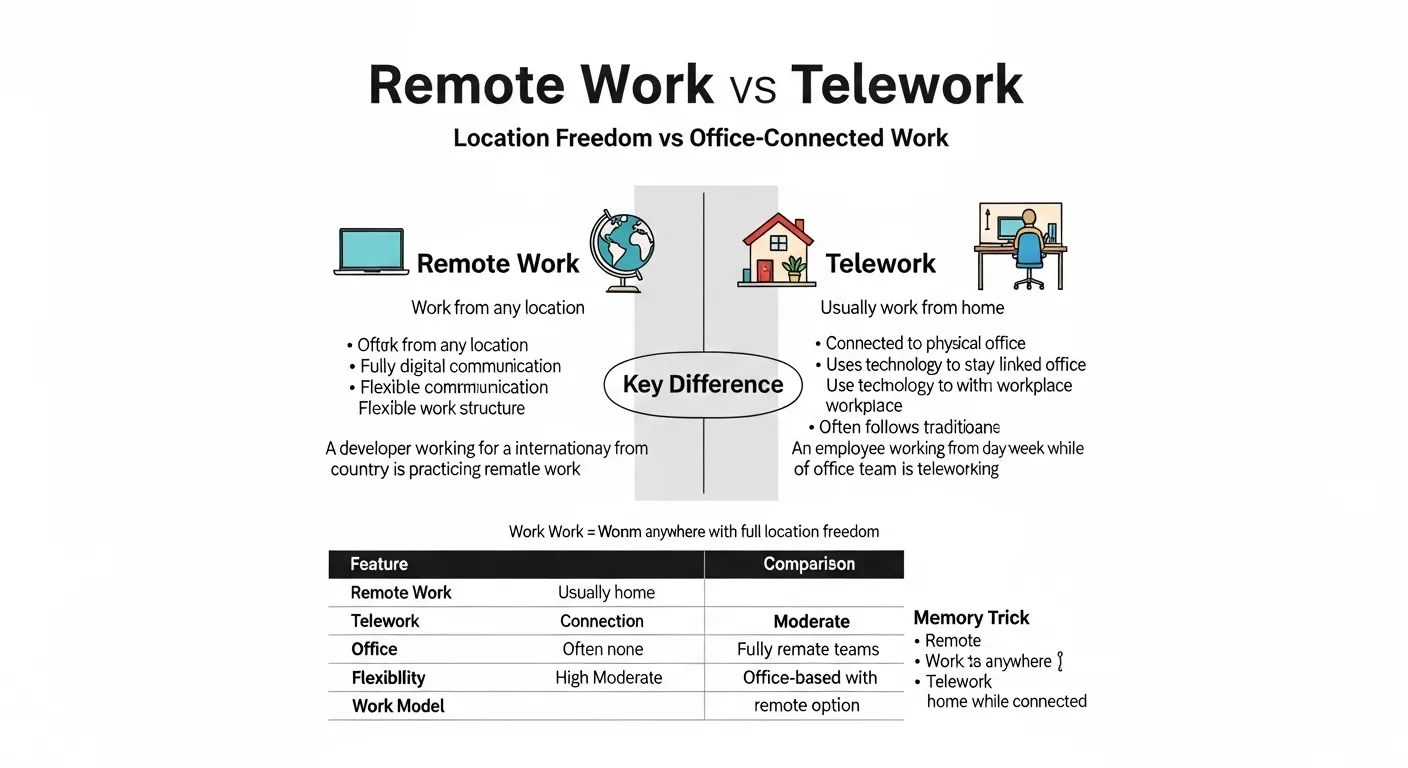
Remote work means working from any location outside the office, while telework usually refers to working from home using telecommunications technology.
Modern work is changing quickly. Many people no longer work only in traditional offices. Technology now allows employees to work from many locations. Because of this change, terms like remote work and telework are often used.
Many people think these two terms mean the same thing. Both describe working away from a central office.
Both use technology to communicate with teams and managers. However, there is a small but important difference between them.
Remote work usually means working from any location outside the company office. The employee may work from home, a café, or even another city. The focus is on location freedom.
Telework, on the other hand, often refers to working from home or another nearby place while still connected to the office through technology. It is usually linked to a traditional job structure.
Understanding the difference between remote and telework is useful. It helps employers create better work policies. It also helps employees understand their working arrangements.
In simple terms, remote work focuses on location independence, while telework focuses on working away from the office using communication technology.
📖 Definitions
🌍 Definition of Remote Work
Remote work refers to a working style where employees perform their job duties outside a traditional office environment.
Workers can complete tasks from almost any location as long as they have internet access and the necessary tools.
Remote work focuses on flexibility and location independence. Employees may work from home, coworking spaces, or even different countries. Many remote companies operate without a central office.
Communication usually happens through digital tools. These tools include video calls, messaging apps, project management platforms, and email. Because of technology, remote teams can collaborate even when they are far apart.
Remote work is very common in industries like software development, digital marketing, writing, and online services. Many modern companies build entire teams that work remotely.
Example:
A software developer working from another country for an international company is practicing remote work.
🏠 Definition of Telework
Telework refers to working outside the traditional office by using communication technologies such as computers, internet connections, and phone systems.
It usually means employees work from home or another nearby location while remaining connected to their employer’s office.
Telework is often part of a traditional job structure. The company still has an office, and employees may sometimes be required to visit it. Teleworking simply allows them to perform tasks remotely for certain days or hours.
Many organizations introduced telework policies to improve work–life balance and reduce commuting time. Telework is also common during situations when employees cannot easily travel to the office.
Telework relies heavily on digital communication tools to stay connected with coworkers and supervisors.
Example:
An employee who works from home two days a week while still being part of an office team is practicing telework.
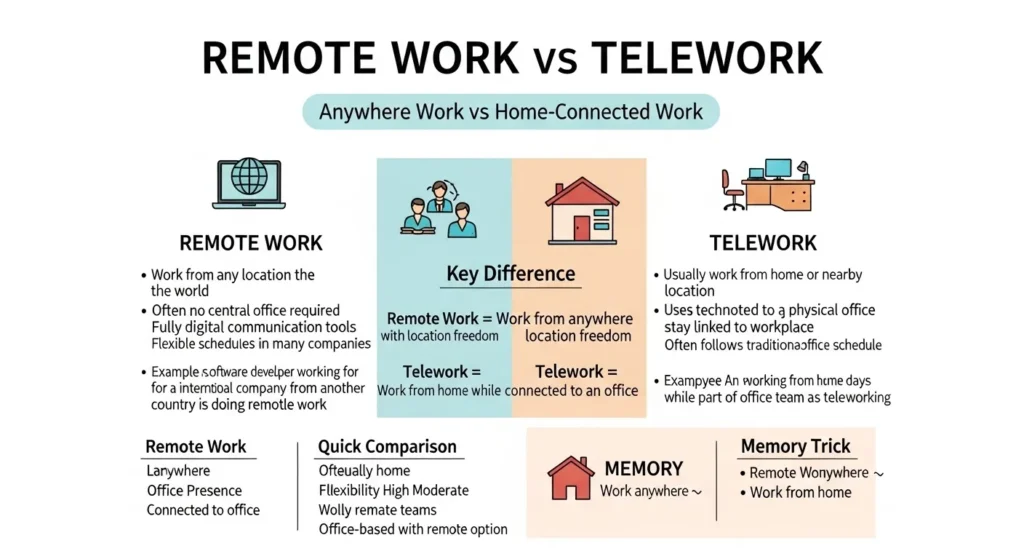
🔍 Key Differences Between Telework and Remote
1️⃣ Scope
Remote Work:
Remote work has a broader scope. Employees can work from almost any location in the world.
Telework:
Telework usually refers to working from home or another nearby location while still connected to an office.
2️⃣ Purpose
Remote Work:
Remote work focuses on flexibility and location freedom.
Telework:
Telework focuses on using technology to work away from the office.
3️⃣ Work Structure
Remote Work:
Remote jobs may not require a physical office at all.
Telework:
Telework usually exists within a traditional office structure.
4️⃣ Location
Remote Work:
Employees may work from different cities or countries.
Telework:
Employees usually work from home or a nearby location.
5️⃣ Schedule Flexibility
Remote Work:
Remote workers may have flexible schedules depending on company policy.
Telework:
Teleworkers often follow the same schedule as office employees.
6️⃣ Organizational Model
Remote Work:
Many remote companies operate fully online with distributed teams.
Telework:
Telework usually supports an existing office based organization.
7️⃣ Communication
Remote Work:
Remote teams rely completely on digital communication tools.
Telework:
Teleworkers also use digital tools but may still attend office meetings occasionally.
8️⃣ Cultural Role
Remote Work:
Remote work represents a modern work model with global teams.
Telework:
Telework is often seen as a flexible arrangement within traditional workplaces.
9️⃣ Examples
Remote Work Examples:
Freelance designers working from home
Software developers working for international companies
Digital marketers working from different countries
Telework Examples:
Office employees working from home one or two days per week
Government employees using telework policies
Staff working from home during temporary situations
🔟 Key Difference Summary
Remote Work:
Location independent
Fully digital work environment
Often no central office
Flexible working arrangements
Telework:
Usually home based work
Connected to a physical office
Often part time remote schedule
Traditional organizational structure
🏁 Conclusion
Remote work and telework both describe working away from a traditional office environment. They allow employees to complete tasks outside the workplace using digital communication tools. However, the two terms are not exactly the same.
Remote work is a broader concept. It refers to employees working from any location outside a company office.
Workers may live in different cities or countries. Many remote companies operate entirely online without a central office.
Communication happens through digital platforms such as messaging apps, video calls, and project management tools.
Telework is slightly more specific. It usually refers to employees working from home or another nearby location while still being connected to a traditional office.
Teleworkers may follow the same schedule as office employees and may occasionally visit the workplace.
Another difference is organizational structure. Remote companies often build distributed teams from the start.
Telework, however, is usually introduced as a flexible option within existing office based organizations.
Both work styles offer benefits. They reduce commuting time and improve work–life balance. They also allow companies to access talent from different locations.
In simple terms, remote work focuses on complete location flexibility, while telework focuses on using technology to work away from the office within a traditional job structure.
Discover More Articals!
🌱 Difference Between Edamame and Soybeans: Simple Guide
🎨 Difference Between Paint and Stain: Simple Guide
📘 Difference Between Moral and Morale : Clear and Simple Guide

labdiff.com is my English grammar comparison website where I simplify confusing words, spelling differences, and usage rules through clear explanations and examples. My goal is to help learners, writers, and students understand English easily and use correct grammar with confidence.