Many people get confused about the difference between tire and wheel, especially when talking about cars, bikes, or repairs. In daily conversation, these terms are often used as if they mean the same thing but they don’t.
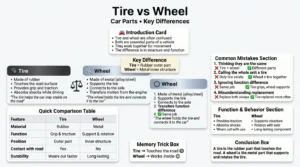
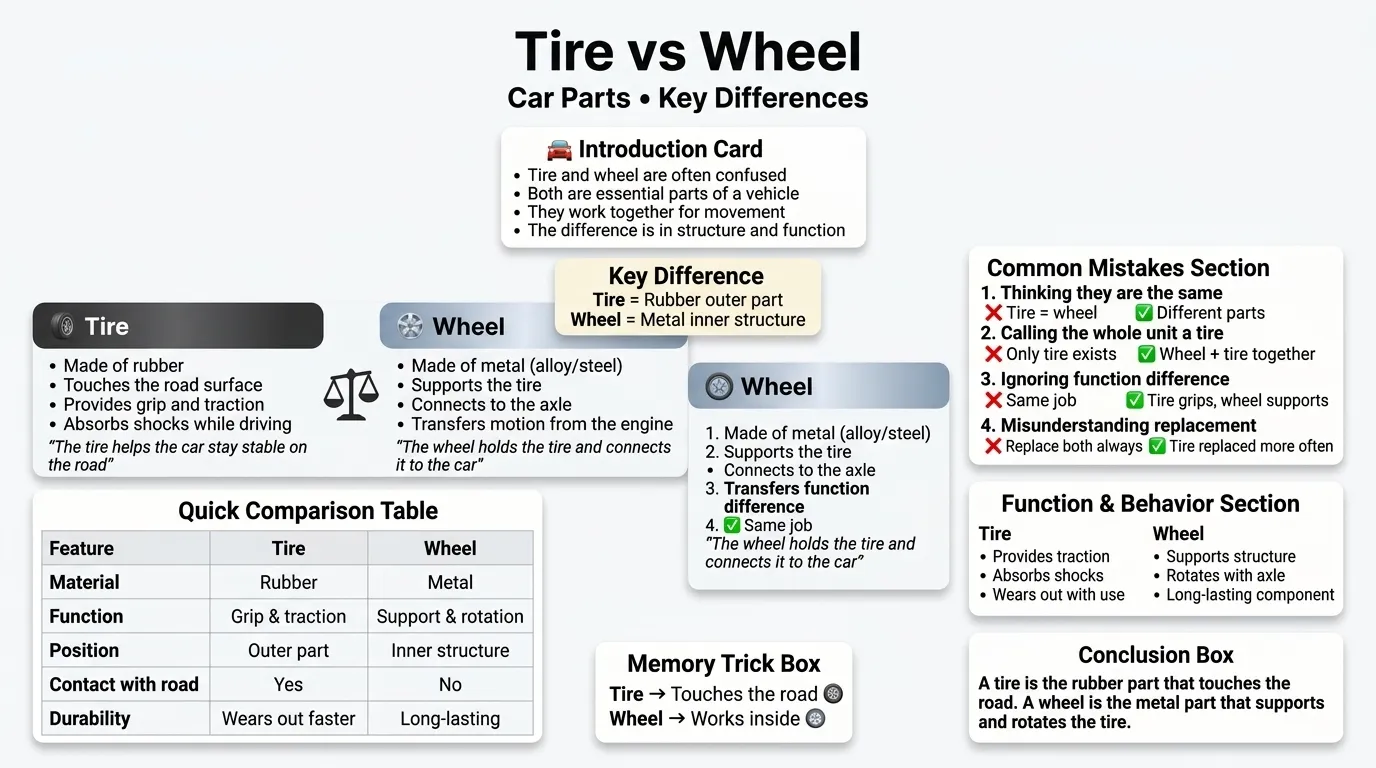
In simple words, the difference between tire and wheel is that the tire is the rubber outer part that touches the road, while the wheel is the metal structure that holds the tire and connects to the vehicle. They work together, but they are completely different components.
If you’ve ever asked “is a tire the same as a wheel?”, “what part actually spins?”, or “what do I replace when damaged?”, this complete guide will clear everything with real-life examples.
🟢 Quick Answer: Difference Between Tire and Wheel
- Tire → Rubber outer layer that grips the road
- Wheel → Metal rim that holds the tire
👉 Example:
A puncture happens in the tire, not the wheel
🟢 Definition of Tire and Wheel
- Tire: A rubber covering filled with air that provides grip, cushioning, and traction on the road.
- Wheel: A circular metal component (rim + hub) that supports the tire and attaches to the vehicle axle.
🟢 Pronunciation (US & UK)
- Tire: /ˈtaɪər/ (US), /ˈtaɪə/ (UK)
- Wheel: /wiːl/
👉 Now let’s understand how they differ in function and design.
🟢 Comparison Table: Tire vs Wheel
| Feature | Tire | Wheel | Similarity |
| Material | Rubber | Metal (steel/aluminum) | Part of vehicle |
| Function | Grip & cushioning | Support & structure | Work together |
| Contact with Road | Yes | No (indirect) | Enable movement |
| Damage Type | Puncture, wear | Bending, cracks | Need maintenance |
| Replacement | More frequent | Less frequent | Replaceable parts |
| Role | Safety & traction | Mounting system | Essential components |
🟢 Key Differences Explained Between Tire and Wheel
1. Basic Function
- Tire provides traction and grip
- Wheel provides structure and support
👉 Without tire → no grip
👉 Without wheel → no mounting
2. Material Difference
- Tire is made of rubber
- Wheel is made of metal
3. Contact with Road
- Tire directly touches the road
- Wheel stays inside the tire
4. Wear and Tear
- Tires wear out faster
- Wheels last much longer
5. Damage Type
- Tire → punctures, cracks
- Wheel → bending or structural damage
6. Replacement Cost
- Tires are cheaper and replaced often
- Wheels are more expensive but durable
🟢 Why This Difference Exists
The difference between tire and wheel exists because vehicles need two separate systems:
- Grip and cushioning (tire)
- Support and connection (wheel)
This combination ensures safety, comfort, and performance.
🟢 What Is a Tire and How Does It Work?
A tire works by:
- Holding air pressure
- Providing grip through tread patterns
- Absorbing shocks from the road
👉 Example:
Driving on wet roads requires good tire grip to avoid slipping.
🟢 What Is a Wheel and How Does It Work?
A wheel works by:
- Supporting the tire
- Connecting to the axle
- Transferring engine power to movement
👉 Example:
The wheel rotates, allowing the vehicle to move forward.
🟢 Difference and Similarity Table
| Feature | Tire | Wheel | Similarity |
| Role | Road contact | Structural support | Vehicle movement |
| Material | Rubber | Metal | Durable components |
| Maintenance | Frequent | Occasional | Require care |
| Lifespan | Shorter | Longer | Replaceable |
| Purpose | Traction | Mounting | Essential for driving |
This table clearly shows the difference and similarity between tire and wheel for quick understanding.
🟢 Common Mistakes with Tire and Wheel
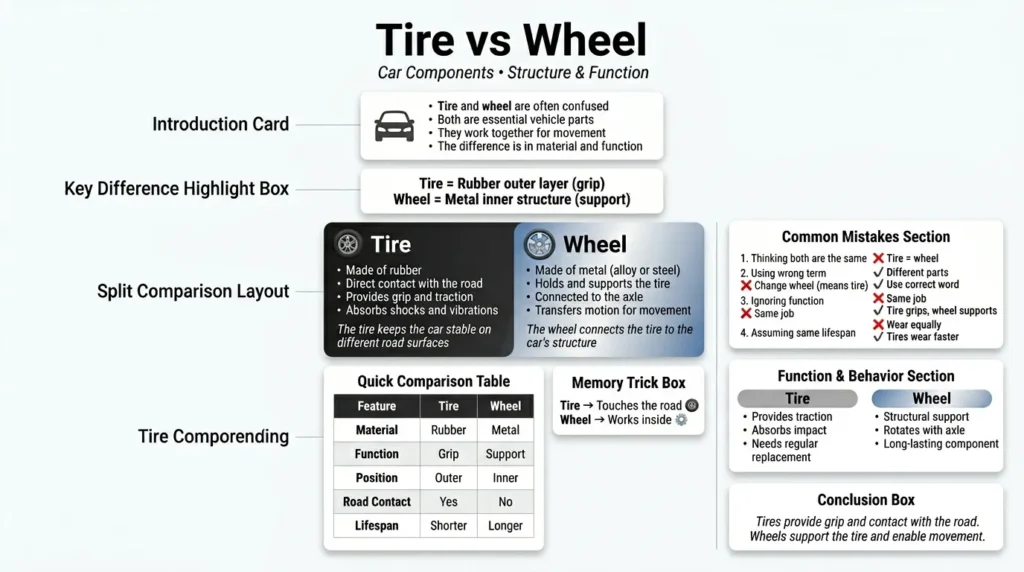
❌ 1. Using terms interchangeably
✔ They are different parts
❌ 2. Saying “wheel puncture”
✔ Correct term is tire puncture
❌ 3. Ignoring wheel damage
✔ Bent wheels affect driving
❌ 4. Replacing wrong component
✔ Diagnose before replacing
❌ 5. Assuming both wear equally
✔ Tires wear faster
🟢 Real-Life Examples
📌 Flat Tire
- Only tire is damaged
📌 Alloy Wheel Damage
- Wheel gets bent after hitting pothole
Car Maintenance
- Tire change → routine
- Wheel replacement → rare
🟢 When to Use Each Term
Use “Tire” when:
- Talking about grip or road contact
- Discussing punctures or wear
Use “Wheel” when:
- Talking about structure or rim
- Discussing alignment or mounting
🟢 Why People Get Confused
The confusion in the difference between tire and wheel happens because:
- Terms are used interchangeably
- Both rotate together
- Visually appear as one unit
- Lack of basic mechanical knowledge
🟢 How Search Engines Understand This Topic
Search engines like Google treat this as a basic automotive knowledge query.
They rank content that includes:
- Clear definitions
- Visual comparisons
- Practical examples
🟢 Expert Insight
In real-world automotive use:
- Tires directly impact safety and braking
- Wheels impact balance and alignment
👉 Always check both for optimal performance.
🟢 FAQ:
1. What is the main difference between tire and wheel?
The tire is rubber and touches the road; the wheel is metal and holds the tire.
2. Can a car run without a tire?
No, it would damage the wheel and be unsafe.
3. Which part wears out faster?
Tires wear out much faster.
4. Is the rim the same as the wheel?
The rim is part of the wheel.
5. What gets punctured?
Only the tire gets punctured.
6. Do both need maintenance?
Yes, but tires need more frequent care.
🟢 Conclusion
Understanding the difference between tire and wheel is important for basic vehicle knowledge and safety. The tire provides grip and cushioning, while the wheel supports the tire and connects it to the vehicle.
Both components work together to ensure smooth and safe driving. Tires need regular replacement due to wear, while wheels are more durable but still require inspection.
In simple terms, the difference between tire and wheel is about function and structure and once you understand it, you’ll never mix them up again.
Discover More Articals!
Difference Between Lacquer and Polyurethane (Which Finish Is Better?
Difference Between Camry and Corolla (With Examples)

James Whitmore. Labdiff.com is my english grammar comparision website. I explore the history and evolution of English words. I write detailed comparisons explaining why spellings change over time and how British and American English diverged. My articles add depth and credibility to grammar comparison topics.