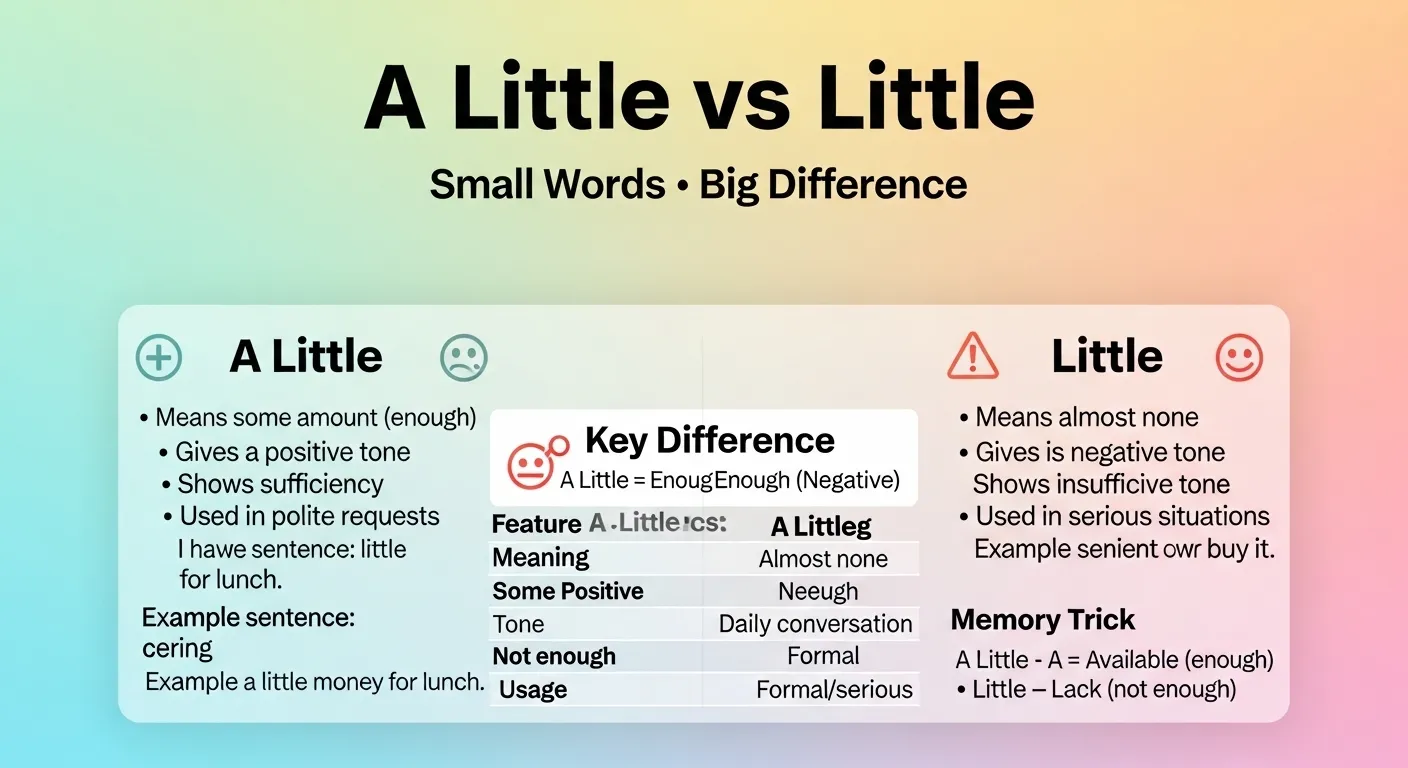
The difference between a little and little is about meaning and tone. A little means a small but enough amount, while little means almost none or not enough.
Imagine a person making tea at home. There is only a small amount of sugar left. If the person says, “There is a little sugar,” it means the sugar is enough for use.
But if the person says, “There is little sugar,” it means the sugar is not enough. This simple situation explains the difference between a little vs little in daily life.
Many learners search questions like “a little vs little meaning,” “difference between little and a little examples,” and “when to use little in sentences.”
These questions show that the difference between a little or little is important in English grammar. Both phrases describe quantity, but their meanings change the message completely.
Understanding the difference between a little and little helps learners express ideas clearly and avoid confusion in speaking and writing.
Key Difference Between the Both
The main difference is meaning and sufficiency. A little means some amount that is enough, while little means almost no amount or not enough.
Why Their Difference Is Necessary for Learners and Experts
Understanding this difference improves clarity in communication. Students use these expressions to describe quantity in writing and speaking.
Teachers rely on them to explain ideas precisely. In daily life, people use these phrases when talking about food, time, money, or resources.
Using the wrong phrase can change the meaning of a sentence completely. Knowing the correct use helps learners avoid mistakes and communicate more effectively.
Pronunciation (US & UK)
| Term | US Pronunciation | UK Pronunciation |
| A little | /ə ˈlɪt̬əl/ | /ə ˈlɪtəl/ |
| Little | /ˈlɪt̬əl/ | /ˈlɪtəl/ |
Now that the basic idea is clear, the next section explains the detailed difference between a little and little.
Difference Between the Keywords
1. Basic Meaning
A little means some amount. Little means almost none.
Example 1:
There is a little milk in the fridge.
Example 2:
There is little milk left.
2. Sense of Sufficiency
A little suggests enough for use. Little suggests not enough.
Example 1:
I have a little money for lunch.
Example 2:
I have little money, so I cannot buy it.
3. Tone
A little gives a positive tone. Little gives a negative tone.
Example 1:
She showed a little interest in the topic.
Example 2:
She showed little interest in the topic.
4. Usage with Uncountable Nouns
Both are used with uncountable nouns.
Example 1:
We need a little water.
Example 2:
We have little water left.
5. Effect on Meaning
Changing the article changes the meaning completely.
Example 1:
He has a little hope.
Example 2:
He has little hope.
6. Emotional Expression
A little can express comfort or satisfaction. Little can express worry or disappointment.
Example 1:
There is a little time left to finish.
Example 2:
There is little time left.
7. Use in Requests
A little is common in polite requests.
Example 1:
Can you give me a little help?
Example 2:
We have little help available.
8. Use in Formal Writing
Little often appears in formal or serious tone.
Example 1:
A little effort can solve the problem.
Example 2:
Little progress was made.
9. Context of Quantity
A little shows small but useful quantity. Little shows small and insufficient quantity.
Example 1:
He added a little salt to the food.
Example 2:
There is little salt in the dish.
10. Communication Impact
A little encourages a positive message. Little shows limitation.
Example 1:
A little practice improves skills.
Example 2:
Little practice leads to poor results.
Nature and Behaviour
Nature of A Little
A little is positive and helpful. It suggests enough quantity to continue or complete an action.
Nature of Little
Little is negative and limiting. It suggests shortage or lack of something.
Why People Are Confused About Their Use
Both phrases look almost the same. The only difference is the article “a.” Many learners ignore this small change, but it creates a big difference in meaning. This similarity causes confusion.
Table Showing Difference and Similarity
| Feature | A little | Little | Similarity |
| Meaning | Some amount | Almost none | Both show quantity |
| Tone | Positive | Negative | Both used with uncountable nouns |
| Sufficiency | Enough | Not enough | Both describe small amounts |
| Usage | Everyday speech | Formal or serious tone | Both used in English grammar |
| Impact | Encouraging | Limiting | Both affect meaning strongly |
Which Is Better in What Situation
When A Little Is Better
A little is better when the speaker wants to show that a small amount is enough. It is useful in polite requests and positive communication. For example, saying “I need a little help” sounds polite and hopeful. It also works well in situations where even a small amount is useful.
When Little Is Better
Little is better when the speaker wants to show shortage or lack. It is useful in serious or negative situations. For example, saying “There is little time left” shows urgency. It helps express concern or limitation clearly.
How the Keywords Are Used in Metaphors and Similes
A little metaphor:
Example: “A little hope is like a small light in darkness.”
Little metaphor:
Example: “Little courage is like a weak shield.”
Connotative Meaning
A little positive meaning
Example: “She made a little progress today.”
Little negative meaning
Example: “He showed little effort in his work.”
Idioms or Proverbs Related to the Words
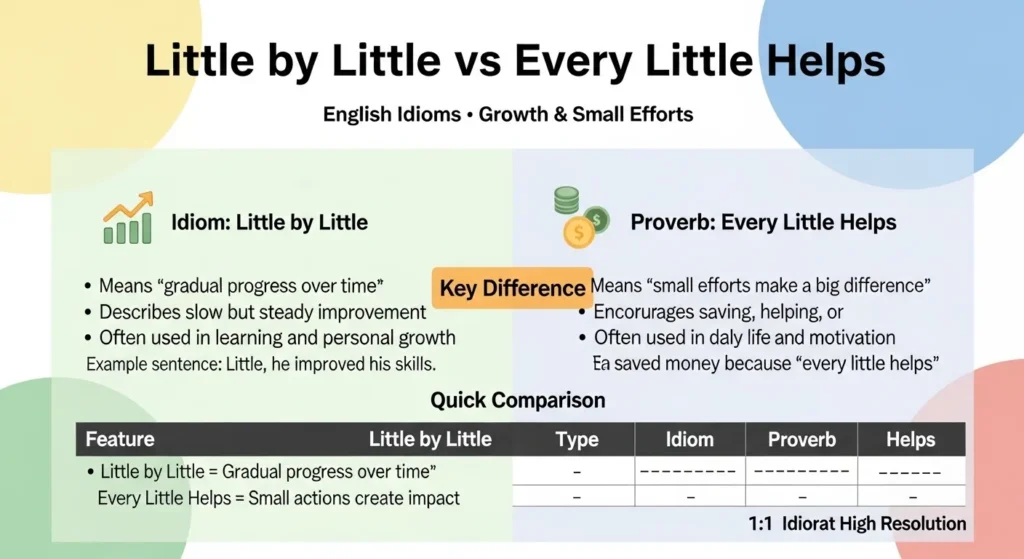
Little by little
Example: Little by little, he improved his skills.
Every little helps
Example: She saved money because every little helps.
Works in Literature
- Little Women Novel, Louisa May Alcott, 1868
- A Little Life Novel, Hanya Yanagihara, 2015
- The Little Prince Novella, Antoine de Saint-Exupéry, 1943
Movies Related to the Keywords
- Little Women 2019, United States
- The Little Prince 2015, France
- A Little Princess 1995, United States
Frequently Asked Questions
1. What is the difference between a little and little?
A little means some amount, while little means almost none.
2. Can both be used with countable nouns?
No. They are used with uncountable nouns.
3. Is a little positive or negative?
It has a positive meaning.
4. Is little always negative?
Yes. It usually shows lack or insufficiency.
5. Why is this difference important?
Because it changes the meaning of a sentence completely.
How Both Are Useful for Surroundings
Both phrases help people describe quantity in daily life. They are useful when talking about food, time, money, and resources. They help express If something is enough or not.
Final Words for the Both
A little and little are small phrases with a big difference in meaning. One shows sufficiency, while the other shows lack.
Conclusion
The difference between a little and little lies in meaning and tone. A little expresses a small but sufficient amount, while little expresses a small and insufficient amount.
This small grammatical change creates a big difference in communication. Both forms are important in English and are used in daily conversations and writing.
By understanding the difference between a little and little, learners can express ideas more clearly and avoid confusion.
Discover More Articals!
Difference Between Babylights and Highlights
Difference Between Labyrinth and Maze

labdiff.com is my English grammar comparison website where I simplify confusing words, spelling differences, and usage rules through clear explanations and examples. My goal is to help learners, writers, and students understand English easily and use correct grammar with confidence.