The difference between say and tell is simple. Say is used to express words, while tell is used to give information to someone.
Imagine a teacher in a classroom. The teacher says something like, “Open your books.” This focuses on the words spoken.
Then the teacher tells the students to open their books. This focuses on giving instruction to someone. This real life situation explains the difference between say and tell clearly.
Many learners search questions like “say vs tell examples,” “when to use say and tell,” and “difference between say tell speak talk.” These questions show that the difference between say and tell is important in English learning.
Both words relate to speaking, but their usage is different. Understanding the difference between say and tell helps learners avoid common grammar mistakes and communicate clearly in daily life.
Key Difference Between the Both
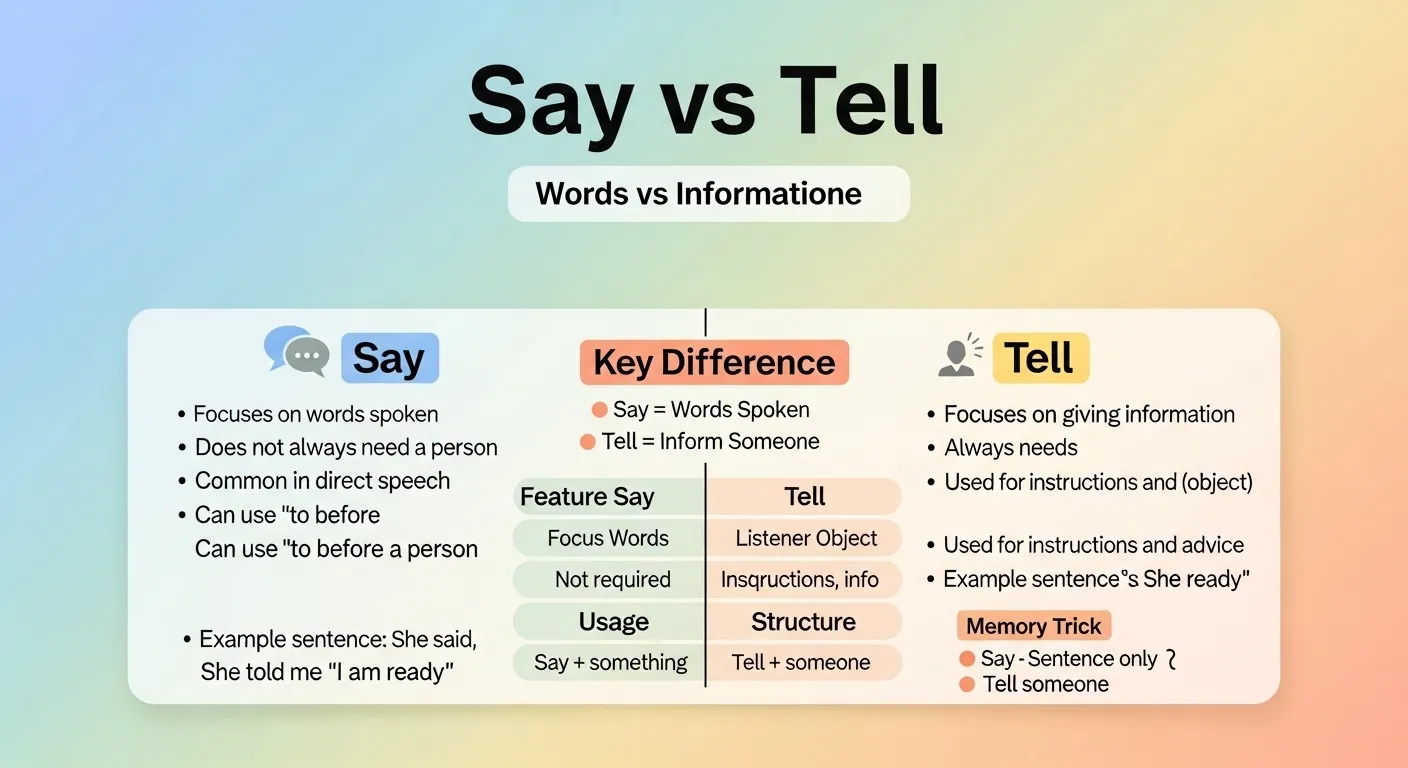
The main difference is structure and usage. Say focuses on words spoken, while tell focuses on the person receiving the message.
Why Their Difference Is Necessary for Learners and Experts
Understanding this difference improves communication skills. Students use these verbs in writing and speaking. Teachers explain instructions using tell, while say is used to report speech.
In professional settings, clear communication depends on correct word choice. Using say and tell correctly helps avoid confusion and makes messages clear and effective.
Pronunciation (US & UK)
| Term | US Pronunciation | UK Pronunciation |
| Say | /seɪ/ | /seɪ/ |
| Tell | /tɛl/ | /tel/ |
Now that the basics are clear, let’s explore the detailed difference between say and tell.
Difference Between the Keywords
1. Basic Meaning
Say focuses on the words spoken. Tell focuses on giving information to someone.
Example 1:
She said, “I am ready.”
Example 2:
She told me she was ready.
2. Object Usage
Say does not always need an object. Tell usually needs a person as an object.
Example 1:
He said something important.
Example 2:
He told me something important.
3. Sentence Structure
Say is often followed by “that.” Tell is followed by a person.
Example 1:
She said that she was tired.
Example 2:
She told him that she was tired.
4. Use in Instructions
Tell is commonly used for giving orders or instructions.
Example 1:
He said, “Close the door.”
Example 2:
He told me to close the door.
5. Reporting Speech
Both are used in reported speech, but differently.
Example 1:
She said she would come.
Example 2:
She told me she would come.
6. Use with Direct Speech
Say is more common in direct speech.
Example 1:
He said, “Hello.”
Example 2:
He told me hello.
7. Use with Prepositions
Say can use “to” before a person. Tell does not use “to.”
Example 1:
She said to me that she was busy.
Example 2:
She told me that she was busy.
8. Focus of Meaning
Say focuses on words. Tell focuses on the listener.
Example 1:
He said a few words.
Example 2:
He told the story to the children.
9. Use in Stories
Tell is used when narrating stories or facts.
Example 1:
She said something interesting.
Example 2:
She told a story.
10. Communication Impact
Say reports speech. Tell gives clear information or instruction.
Example 1:
He said he was leaving.
Example 2:
He told me to wait.
Nature and Behaviour
Nature of Say
Say is flexible. It focuses on speech content and is common in both direct and indirect speech.
Nature of Tell
Tell is more structured. It focuses on communication with a listener and often includes an object.
Why People Are Confused About Their Use
Both words relate to speaking. Many learners think they are interchangeable. The confusion increases because both appear in reported speech. However, their grammar patterns are different.
Table Showing Difference and Similarity
| Feature | Say | Tell | Similarity |
| Meaning | Express words | Give information | Both relate to speaking |
| Object | Not always needed | Needed (person) | Both used in communication |
| Structure | Say + something | Tell + someone | Both used in sentences |
| Focus | Words spoken | Listener | Both used in speech |
| Usage | Direct speech | Instructions, stories | Both used daily |
Which Is Better in What Situation
When Say Is Better
Say is better when focusing on the exact words spoken. It is useful in direct speech and quotations. For example, in conversations or writing dialogue, say helps report what someone said clearly.
When Tell Is Better
Tell is better when giving information or instructions to someone. It is used when a listener is important. For example, teachers tell students instructions, and parents tell children what to do.
How the Keywords Are Used in Metaphors and Similes
Say metaphor:
Example: “His eyes said everything without words.”
Tell metaphor:
Example: “Her smile told a hidden story.”
Connotative Meaning
Say neutral meaning
Example: “He said something interesting.”
Tell slightly positive meaning
Example: “She told the truth honestly.”
Idioms or Proverbs Related to the Words

Actions speak louder than words
Example: He did not say much, but his work proved everything.
Tell the truth
Example: She always tells the truth.
Works in Literature
- Tell Me Your Dreams Novel, Sidney Sheldon, 1998
- The Tell Tale Heart Short Story, Edgar Allan Poe, 1843
- As You Like It Play, William Shakespeare, 1623
Movies Related to the Keywords
- You Can’t Say No 2017, United States
- Tell Me Who I Am 2019, United Kingdom
- Say Anything 1989, United States
Frequently Asked Questions
1. What is the main difference between say and tell?
Say focuses on words, while tell focuses on the listener.
2. Do we say “tell to someone”?
No. We say “tell someone,” not “tell to someone.”
3. Can say be used without an object?
Yes. Say does not always need an object.
4. Why does tell need a person?
Because it focuses on giving information to someone.
5. Which is used in direct speech?
Say is commonly used in direct speech.
How Both Are Useful for Surroundings
Both words help people communicate ideas, instructions, and emotions. They are essential in conversations, teaching, storytelling, and daily interactions.
Final Words for the Both
Say and tell are closely related but different in structure and usage. Understanding their difference improves grammar and communication skills.
Conclusion
The difference between tell and say lies in structure and meaning. Say focuses on the words spoken, while tell focuses on giving information to someone. Both verbs are important in English and are used daily in speaking and writing.
By understanding the difference between say vs tell, learners can avoid common mistakes and communicate more clearly and effectively.
Discover More Articals!
Difference Between Labyrinth and Maze
When to Use A Little vs Little: Understanding the Main Difference(2026)
Difference Between Synecdoche and Metonymy

labdiff.com is my English grammar comparison website where I simplify confusing words, spelling differences, and usage rules through clear explanations and examples. My goal is to help learners, writers, and students understand English easily and use correct grammar with confidence.