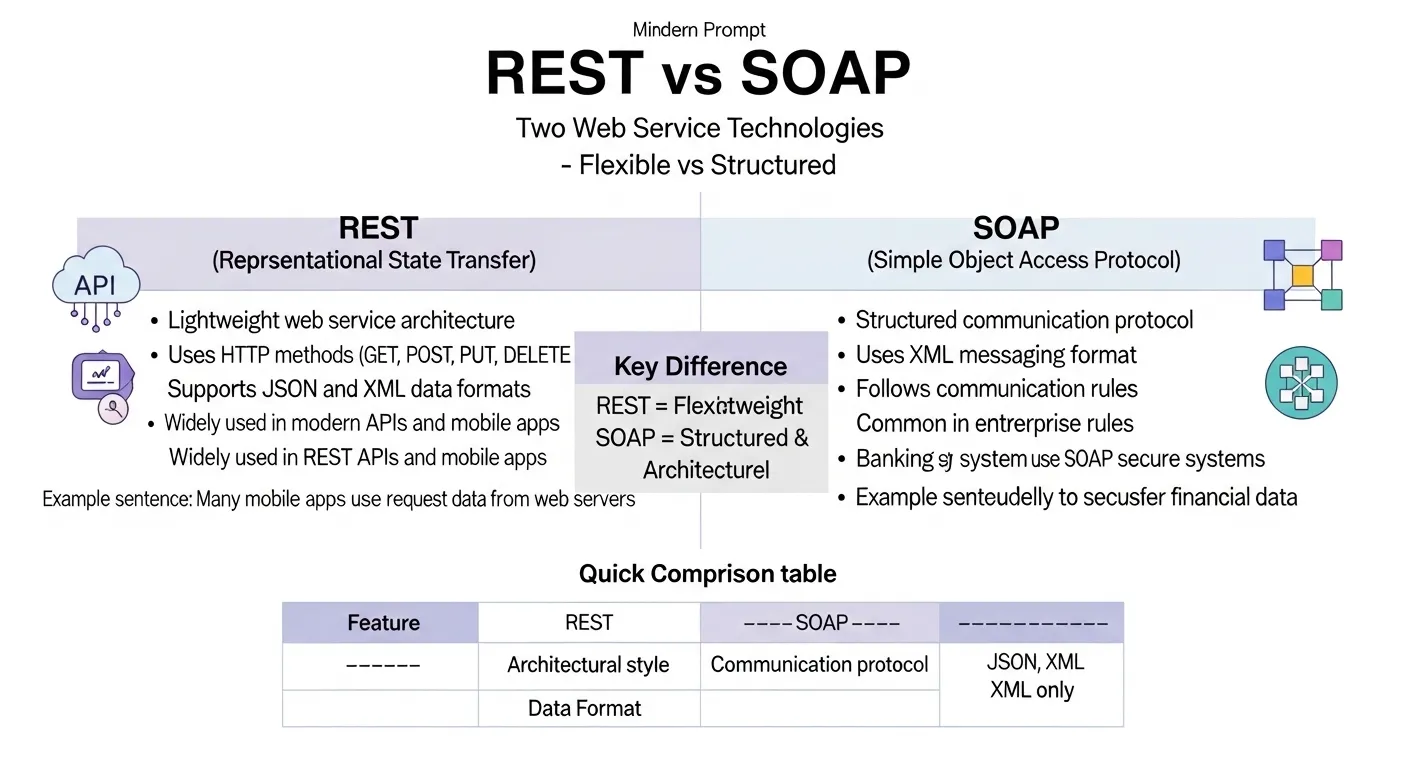
REST is a lightweight, flexible API style that uses standard HTTP methods, while SOAP is a strict protocol with built-in rules and security features for structured data exchange.
Modern apps talk to each other through the internet. They share data between systems. This process is called web service communication.
Web services help different systems connect and exchange information. A mobile app can request data from a server.
A website can send information to another service. Cloud platforms also rely on this communication. Without web services, many modern digital tools would not work.
Two common technologies used for web services are REST or SOAP. Both allow applications to send requests and receive responses.Both support communication across networks. However, they are built in different ways.
REST is an architectural style. It focuses on simplicity and flexibility. SOAP is a strict communication protocol. It follows defined rules and structured messaging.
Many modern web APIs use REST because it is lightweight and fast. Developers find it easier to build and maintain. On the other hand, SOAP is still used in enterprise systems.
These systems require strong reliability and security. Industries like banking, healthcare, and government often rely on SOAP services.
Understanding the difference between REST vs SOAP helps developers choose the right technology for building software systems.
📖 Definitions
🌐 Definition of REST
REST stands for Representational State Transfer. It is an architectural style used to design web services that communicate over the internet. REST works with the HTTP protocol, which is the standard protocol used by websites.
REST communication uses common HTTP methods such as GET, POST, PUT, and DELETE. Each method performs a specific action.
GET retrieves data from a server. POST sends new data to the server. PUT updates existing information. DELETE removes data.
REST also uses the concept of resources. A resource is any piece of data available on the server. Examples include user profiles, products, or weather information. Each resource has a unique URL. Clients send requests to that URL to retrieve or modify data.
REST services usually exchange data in JSON format. JSON is lightweight and easy to read. Because of this, REST communication is fast and efficient. This is why REST APIs are widely used in modern web and mobile applications.
Example:
A weather mobile application may request temperature data from a server using a REST API.
📡 Definition of SOAP
SOAP stands for Simple Object Access Protocol. It is a protocol used for exchanging structured messages between systems. SOAP defines strict rules for how messages should be formatted and transmitted.
SOAP messages use XML format. XML organizes data using tags and structured elements. Each SOAP message contains specific parts such as an Envelope, Header, and Body.
The Envelope defines the structure of the message. The Header contains optional information such as security data.
The Body contains the main message or request. If an error occurs, a Fault element may appear in the message.
SOAP services also use WSDL, which stands for Web Services Description Language. WSDL describes how the service works and how other systems should communicate with it.
SOAP can run over several network protocols including HTTP, SMTP, and TCP. Because of its strict rules and reliability, SOAP is often used in enterprise environments.
Example:
A banking system may use a SOAP web service to securely send transaction information between servers.
🔍 Key Differences Between SOAP and REST
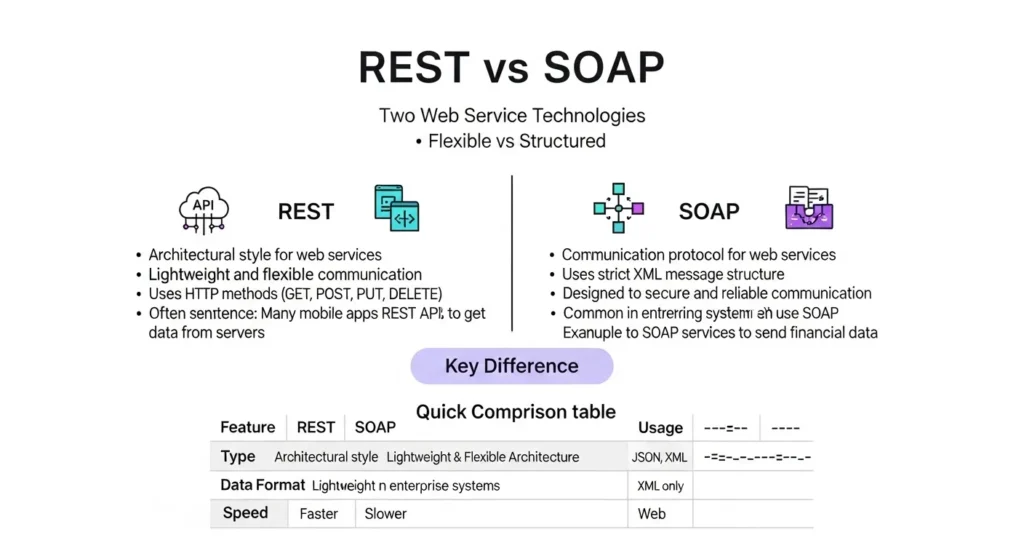
1️⃣ Scope
REST:
REST is an architectural style. It defines how web services are designed. It focuses on flexibility and scalability.
SOAP:
SOAP is a communication protocol. It defines strict rules for message formatting and exchange.
2️⃣ Purpose
REST:
REST is designed for simple and fast communication. It is commonly used for web APIs and mobile services.
SOAP:
SOAP focuses on secure and reliable communication. It ensures that messages follow strict standards.
3️⃣ Process / Structure
REST:
REST uses HTTP methods such as GET, POST, PUT, and DELETE. The server returns responses often in JSON format.
SOAP:
SOAP uses XML-based messages. Every message follows a predefined structure that includes envelope and body elements.
4️⃣ Usage
REST:
REST is widely used in modern applications. Websites, mobile apps, and cloud services rely on REST APIs.
SOAP:
SOAP is commonly used in enterprise systems such as banking platforms and corporate software.
5️⃣ Origin
REST:
REST was introduced in the year 2000 by Roy Fielding. It was described in his doctoral research on web architecture.
SOAP:
SOAP was developed in the late 1990s by Microsoft and other companies to standardize communication between systems.
6️⃣ Method / Preparation
REST:
REST APIs are simple to build. Developers can create them using standard web technologies.
SOAP:
SOAP services require more setup. Developers must define message structures and service descriptions using WSDL.
7️⃣ Size or Form
REST:
REST messages are usually smaller. JSON format keeps communication lightweight and efficient.
SOAP:
SOAP messages are larger because XML structure adds additional formatting information.
8️⃣ Cultural Role
REST:
REST is the most popular approach for building modern APIs. Many technology companies rely on it.
SOAP:
SOAP remains important in enterprise systems that require strict communication standards.
9️⃣ Examples
REST Examples:
Weather APIs
Social media APIs
Online shopping APIs
Mobile application APIs
SOAP Examples:
Banking transaction systems
Payment gateway services
Enterprise resource planning software
Government data exchange systems
🔟 Key Difference Summary
REST:
REST is a flexible architecture used for modern web services. It relies on HTTP methods and lightweight formats such as JSON.
SOAP:
SOAP is a structured communication protocol. It uses XML and predefined messaging rules for reliable communication.
🏁 Conclusion
REST and SOAP are both technologies used to enable communication between applications over networks.
They allow systems to exchange data through web services. Both methods are important in modern computing environments.
REST focuses on simplicity and flexibility. It uses standard HTTP methods and lightweight data formats such as JSON. Because REST messages are usually smaller, communication becomes faster and more efficient.
REST APIs are easier to build and maintain, which makes them ideal for web applications, mobile apps, and cloud platforms.
SOAP focuses on structured communication and reliability. It uses XML message formats and strict communication rules.
SOAP also supports advanced features such as security protocols and transaction management. These features make SOAP suitable for enterprise environments where reliability is essential.
Another key difference is complexity. REST is easier to implement and requires fewer resources. SOAP requires more configuration and larger message structures. However, SOAP provides stronger security and reliability.
Today, many developers prefer REST because it is simple and efficient. However, SOAP still plays an important role in industries such as banking, healthcare, and government systems.
In simple terms, REST provides flexible and lightweight communication for modern applications, while SOAP provides structured and secure messaging for enterprise systems.
Discover More Articals!
📘 Difference Between Moral and Morale : Clear and Simple Guide
📚 Difference Between Endnotes and Footnotes
Difference Between Cupboard and Cabinet: With In 30 Seconds

labdiff.com is my English grammar comparison website where I simplify confusing words, spelling differences, and usage rules through clear explanations and examples. My goal is to help learners, writers, and students understand English easily and use correct grammar with confidence.