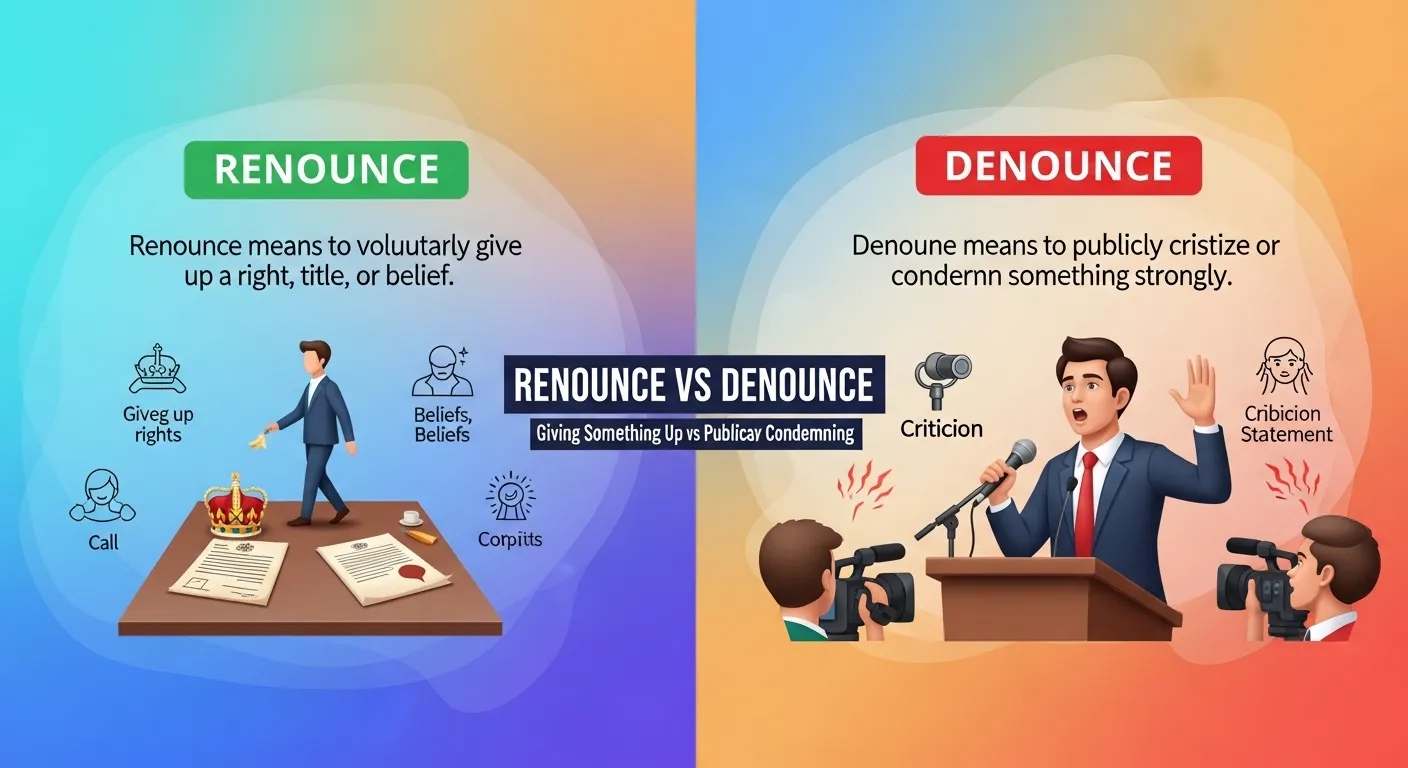
Renounce means to formally give up something (like a claim, belief, or title), while Denounce means to publicly criticize or condemn someone or something.
Language often contains words that look similar but carry very different meanings. Two such words are renounce and denounce.
Many students, writers, and English learners confuse these words because they sound alike and sometimes appear in similar contexts.
However, there is a clear difference between renounce or denounce in meaning and usage.
Imagine a public figure who decides to give up their citizenship. In that situation, they renounce it. But if the same person publicly criticizes a corrupt leader, they denounce that leader.
These examples show that the difference between renounce vs denounce lies mainly in the action being taken.
Understanding the difference between renounce and denounce is important for correct communication. Writers, journalists, and students often use these words in formal writing.
Learning the difference between renounce and denounce helps avoid misunderstandings and improves vocabulary skills.
📖 Definitions
📌 Definition of Renounce
Renounce means to formally give up something. It may be a belief, right, title, or possession. The action is usually voluntary. A person decides to abandon something they once accepted or owned.
Renouncing often involves a personal decision. It may happen for moral, political, or religious reasons.
Example:
A prince may renounce his royal title to live a private life.
📌 Definition of Denounce
Denounce means to publicly criticize or condemn something or someone. The criticism is usually strong and clear. It often happens in political, legal, or social situations.
Denouncing is not about giving something up. Instead, it is about openly declaring disapproval.
Example:
A leader may denounce corruption in government.
🔍 Difference Between Denounce and Renounce
1️⃣ Scope
Renounce:
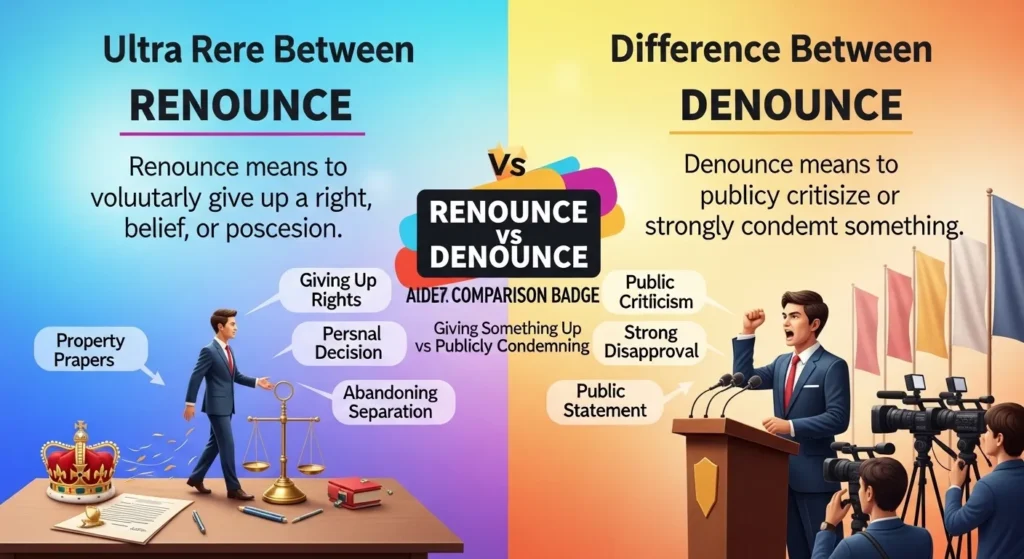
Renounce refers to giving something up.
It focuses on abandoning rights or beliefs.
The action is usually personal.
Denounce:
Denounce refers to criticizing something publicly.
It focuses on expressing strong disapproval.
The action is usually public.
Examples
Renounce examples:
• A monk renounces worldly possessions.
• A citizen renounces their nationality.
Denounce examples:
• A politician denounces unfair policies.
• A judge denounces criminal behavior.
2️⃣ Purpose
Renounce:
The purpose is to abandon something voluntarily.
It may involve moral or personal decisions.
Denounce:
The purpose is to criticize wrongdoing.
It aims to expose or condemn actions.
Examples
Renounce example:
A person renounces violence after joining a peace movement.
Denounce example:
An activist denounces human rights violations.
3️⃣ Structure of Meaning
Renounce:
The word focuses on separation.
It describes leaving something behind.
Denounce:
The word focuses on accusation.
It involves speaking against something.
Examples
Renounce example:
A leader renounces power after retirement.
Denounce example:
A journalist denounces corruption in an article.
4️⃣ Usage Context
Renounce:
Used in legal, political, or religious contexts.
Often related to rights or responsibilities.
Denounce:
Used in political debates and public speeches.
Often related to crime or injustice.
Examples
Renounce example:
A king renounces the throne.
Denounce example:
A protester denounces government policies.
5️⃣ Emotional Tone
Renounce:
Usually neutral or calm.
It expresses a personal decision.
Denounce:
Often strong and emotional.
It expresses anger or disapproval.
Examples
Renounce example:
A person renounces luxury to live simply.
Denounce example:
A leader denounces violence strongly.
6️⃣ Social Impact
Renounce:
The action mostly affects the individual.
It may change personal identity or status.
Denounce:
The action affects society.
It can influence public opinion.
Examples
Renounce example:
A businessman renounces wealth to become a monk.
Denounce example:
A public figure denounces discrimination.
7️⃣ Communication Style
Renounce:
Usually expressed formally.
Often appears in legal documents.
Denounce:
Often spoken in speeches or media.
Used in strong public statements.
Examples
Renounce example:
A legal document states that someone renounces property rights.
Denounce example:
A news report states that leaders denounced corruption.
8️⃣ Cultural Role
Renounce:
Common in religious traditions.
Many religions encourage renouncing material wealth.
Denounce:
Common in political activism.
Activists denounce injustice.
Examples
Renounce example:
A monk renounces worldly pleasures.
Denounce example:
A community leader denounces discrimination.
9️⃣ Examples
Renounce Examples
Renouncing citizenship
Renouncing inheritance
Renouncing a title
Denounce Examples
Denouncing corruption
Denouncing crime
Denouncing injustice
🔟 Key Difference Summary
The main difference between renounce and denounce is their action and intention.
Renounce means to give up something voluntarily.
It focuses on abandoning rights, beliefs, or possessions.
Denounce means to publicly criticize something strongly.
It focuses on expressing disapproval or condemnation.
Understanding the difference between denounce and renounce helps writers and speakers use these words correctly.
🏁 Conclusion
The difference between renounce and denounce is mainly about the type of action being taken. Renounce refers to giving something up willingly. It often involves abandoning rights, titles, beliefs, or possessions.
This action usually comes from a personal decision. People may renounce something for moral, legal, or religious reasons.
Denounce, on the other hand, means to openly criticize or condemn something. It involves public statements that express strong disapproval.
Leaders, activists, and organizations often denounce actions they believe are wrong or harmful. The goal is usually to expose wrongdoing and influence public opinion.
Another important difference between renounce or denounce is their tone. Renounce usually carries a neutral or calm tone because it focuses on personal decisions. Denounce often carries a stronger tone because it involves criticism and condemnation.
Understanding the difference between renounce vs denounce helps improve writing and speaking skills. These words appear frequently in news reports, legal discussions, and academic writing.
When used correctly, they communicate clear and precise meanings. Learning the difference between renounce and denounce therefore helps people express ideas accurately and confidently.
Discover More Articals!
🥞 Difference Between Crepes and Pancakes: Simple Guide
🌸 Difference Between Parfum and Elixir : Complete Guide

James Whitmore. Labdiff.com is my english grammar comparision website. I explore the history and evolution of English words. I write detailed comparisons explaining why spellings change over time and how British and American English diverged. My articles add depth and credibility to grammar comparison topics.