A corporation is a legally separate entity owned by shareholders with limited liability, while a company is a broader term for any business organization, including corporations, partnerships, and sole proprietorships.
When I first studied business terms, I heard the words corporation and company. I thought both were the same.
Many people use them in daily conversation. But there is a clear difference between corporation vs company.
The difference between corporation or company is mainly about legal structure and formation. A company is a broad term.
A corporation is a specific legal entity. All corporations are companies. But not all companies are corporations.
Understanding the difference between corporation and company helps students and entrepreneurs.
Once you know the difference between corporation and company, business concepts become easier.
🔑 Key Difference Between the Both
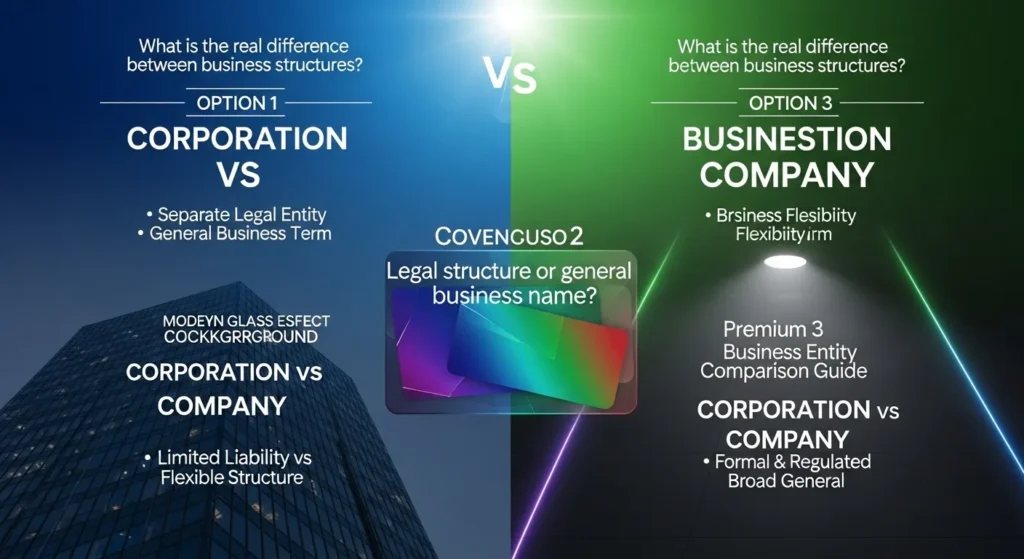
The main difference between company and corporation is that a corporation is a legally separate entity from its owners, while a company is a general term for any business organization.
🎓 Why Is Their Difference Important?
Knowing the difference between corporation and company helps business students. It helps investors. It also helps in legal understanding.
🔊 Pronunciation
🗣️ Corporation
- US: /ˌkɔːrpəˈreɪʃən/
- UK: /ˌkɔːpəˈreɪʃən/
🗣️ Company
- US: /ˈkʌmpəni/
- UK: /ˈkʌmpəni/
Now let’s see the detailed differences.
📊 Difference Between Corporation and Company
📖 Definition of Corporation
A corporation is a legal business entity. It is separate from its owners. It can sue and be sued.
📖 Definition of Company
A company is any type of business organization. It can be a sole proprietorship, partnership, LLC, or corporation.
1️⃣ Meaning Scope
Corporation: Specific legal structure.
- Registered under corporate law.
- Has shareholders.
Company: General business term.
- Includes many structures.
- Used in common language.
2️⃣ Legal Identity
Corporation: Separate legal entity.
- Owners not personally liable.
- Exists independently.
Company: May or may not be separate.
- Sole proprietorship is not separate.
- Depends on structure.
3️⃣ Ownership
Corporation: Owned by shareholders.
- Shares can be sold.
- Ownership divided into stock.
Company: Ownership varies.
- Owned by one person or many.
- Depends on type.
4️⃣ Liability
Corporation: Limited liability.
- Personal assets protected.
- Owners risk only investment.
Company: Liability depends on type.
- Unlimited in sole proprietorship.
- Limited in LLC or corporation.
5️⃣ Management Structure
Corporation: Board of directors.
- Appoints executives.
- Formal structure.
Company: Flexible management.
- Owner-managed or partner-managed.
- Structure varies.
6️⃣ Formation Process
Corporation: Complex formation.
- Filed with government.
- Articles of incorporation required.
Company: Simple or complex.
- Sole proprietorship easy to form.
- Partnership agreement possible.
7️⃣ Taxation
Corporation: Corporate tax rules apply.
- May face double taxation.
- Separate tax filing.
Company: Tax varies.
- Pass-through taxation possible.
- Depends on type.
8️⃣ Continuity
Corporation: Perpetual existence.
- Continues after owner leaves.
- Shares transferable.
Company: May end easily.
- Ends if owner dies (sole prop).
- Depends on structure.
9️⃣ Regulation
Corporation: Highly regulated.
- Must follow corporate laws.
- Regular reporting required.
Company: Regulation varies.
- Small businesses fewer rules.
- Based on size and type.
🔟 Examples
Corporation: Large public businesses.
- Apple Inc.
- Microsoft Corporation
Company: Any business entity.
- Small local shop.
- Partnership firm.
🌿 Nature and Behavior
🏢 Corporation
Formal structure.
Legal separation.
Strong protection.
🏬 Company
General business term.
Flexible meaning.
Wide usage.
🤔 Why Are People Confused?
Both run businesses.
Both use business names.
Terms used interchangeably.
📊 Difference and Similarity Table
| Feature | Corporation | Company | Similarity |
| Meaning | Specific type | General term | Business entity |
| Legal Status | Separate entity | Depends on type | Can earn profit |
| Ownership | Shareholders | Owner(s) vary | Organized structure |
| Liability | Limited | Depends | Business activity |
| Regulation | Strict | Varies | Registered business |
🏆 Which Is Better in What Situation?
🏢 Corporation (Best for Large Business)
Good for raising capital.
Strong legal protection.
Suitable for big operations.
🏬 Company (Best for Small Business)
Flexible structure.
Easy to start.
Good for local business.
❓ FAQs
1. Is every corporation a company?
Yes.
2. Is every company a corporation?
No.
3. Which has limited liability?
Corporation has limited liability.
4. Can a small business be a corporation?
Yes.
5. Which is easier to form?
Simple company types are easier.
🌍 Usefulness
Both help in business operations.
Both support economy.
📝 Final Words
Corporation and company are related terms.
But they are not exactly the same.
📌 Conclusion
The difference between corporation and company is mainly about legal structure and scope of meaning. A company is a broad term.
It refers to any business organization formed to earn profit. It can include sole proprietorships, partnerships, limited liability companies, and corporations.
The word company is often used in daily language. It does not always describe a specific legal structure.
On the other hand, a corporation is a specific type of company. It is legally separate from its owners.
It offers limited liability protection. This means owners are not personally responsible for business debts.
Corporations follow strict legal rules. They must register with the government and follow corporate laws.
Many large businesses such as Apple Inc. operate as corporations because they need strong legal structure and the ability to raise capital through shares.
In simple words, all corporations are companies, but not all companies are corporations. The best choice depends on business size, goals, and legal needs.
Understanding the difference between corporation and company helps entrepreneurs choose the right structure and operate legally and successfully.
Discover More Articals!
Difference Between Fog and Clouds: Clear Guide for Everyone
Difference Between CFO and Controller: Clear and Simple Guide

James Whitmore. Labdiff.com is my english grammar comparision website. I explore the history and evolution of English words. I write detailed comparisons explaining why spellings change over time and how British and American English diverged. My articles add depth and credibility to grammar comparison topics.