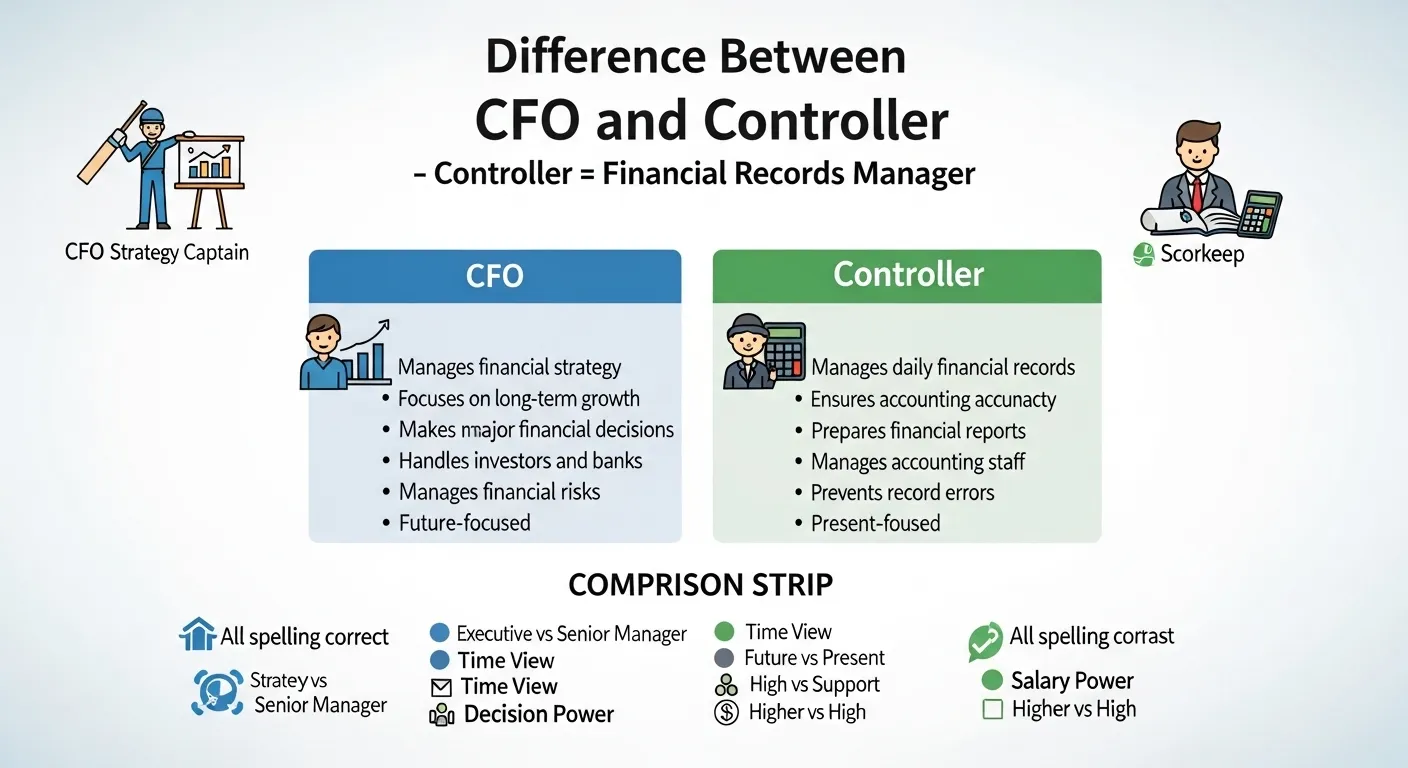
The difference between a CFO and a Controller is that a CFO manages the company’s financial strategy and financial records. Both roles are important in a company. But their responsibilities are different.
Imagine a company like a cricket team. The CFO is like the team captain. The captain plans strategies and makes big decisions.
The Controller is like the scorekeeper. The scorekeeper records every run and keeps the numbers correct. Both are needed for success.
Understanding the difference between CFO and Controller helps students, business learners, and future professionals. It also helps business owners know whom to hire and for what purpose.
Pronunciation
- CFO: /ˌsiː ef ˈoʊ/
- Controller: /kənˈtroʊlər/
Who is a CFO?
CFO stands for Chief Financial Officer.
A CFO is a top executive in a company.
The CFO manages financial planning and strategy.
The CFO focuses on:
- Long term financial growth
- Investment decisions
- Risk management
- Financial forecasting
- Budget planning
Who is a Controller?
.A Controller is a senior accounting manager.
.The Controller manages daily financial records.
.Controller ensures all accounts are correct.
The Controller focuses on:
- Recording transactions
- Preparing financial reports
- Managing accounting staff
- Checking financial accuracy
- Following tax rules
The Controller looks at present financial records.
10 Key Differences Between CFO and Controller
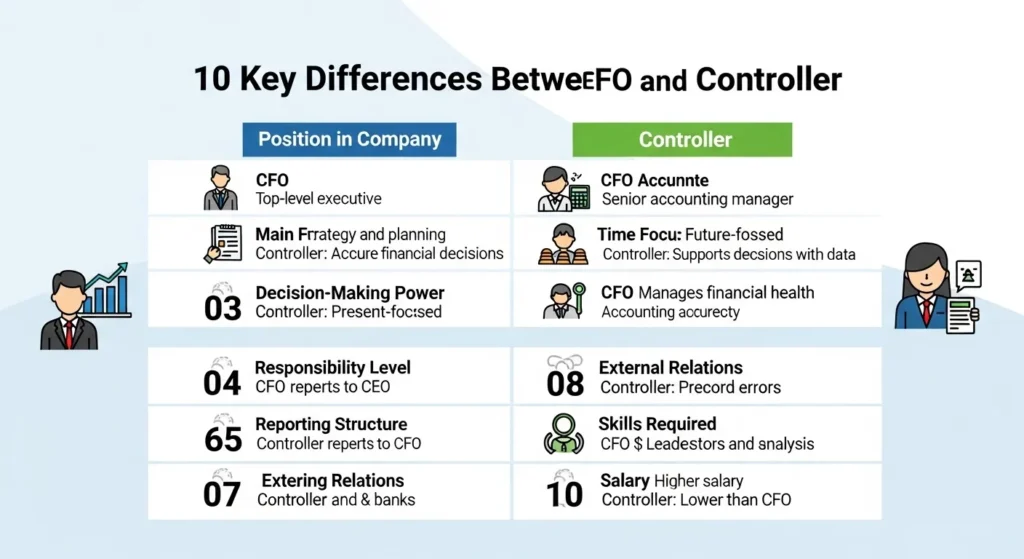
1. Position in Company
- CFO: Top level executive.
- Controller: Senior accounting manager.
Example 1: The CFO sits in board meetings.
Example 2: The Controller works closely with accounting teams.
2. Main Focus
- CFO: Strategy and planning.
- Controller: Accuracy and reporting.
Example:
CFO plans next year’s budget.
Controller prepares monthly financial reports.
3. Decision Making Power
- CFO: Makes major financial decisions.
- Controller: Supports decisions with data.
Example:
CFO decides to invest in new project.
Controller provides financial reports for that decision.
4. Time Focus
- CFO: Future focused.
- Controller: Present focused.
Example:
CFO predicts company growth.
Controller checks current expenses.
5. Responsibility Level
- CFO: Responsible for overall financial health.
- Controller: Responsible for accounting accuracy.
6. Reporting Structure
- CFO reports to CEO.
- Controller reports to CFO.
Example:
Controller submits reports to CFO.
CFO presents reports to CEO.
7. Risk Management
- CFO manages financial risks.
- Controller ensures records reduce errors.
Example:
CFO checks investment risks.
Controller prevents accounting mistakes.
8. External Relations
- CFO deals with investors and banks.
- Controller usually works internally.
Example:
CFO meets investors.
Controller works in accounting department.
9. Skills Required
- CFO: Leadership, strategy, communication.
- Controller: Accounting, detail focus, analysis.
10. Salary Level
- CFO: Higher salary.
- Controller: Lower than CFO but still high.
Reason: CFO has more responsibility and authority.
Table: CFO vs Controller
| Feature | CFO | Controller |
| Full Form | Chief Financial Officer | Financial Controller |
| Level | Executive | Senior Manager |
| Focus | Strategy | Accounting |
| Time View | Future | Present |
| Reports To | CEO | CFO |
| Main Role | Planning & Growth | Record Keeping |
| Deals With | Investors, Banks | Accounting Staff |
| Risk Handling | Financial Risk | Record Errors |
| Decision Power | High | Medium |
| Salary | Very High | High |
Nature and Behavior
CFO
- Visionary
- Strategic thinker
- Leadership role
- Focuses on growth
The CFO thinks big. The CFO plans for years ahead.
Controller
- Detail oriented
- Careful and organized
- Focused on accuracy
- Manages numbers daily
The Controller checks details carefully.
Why People Get Confused
Many people think both roles are the same.
Both work with money.
Both work in finance.
But their level and responsibilities are different.
The CFO makes big financial plans.
The Controller ensures the financial records are correct.
Which Is Better in What Situation?
When CFO is More Important
A growing company needs a CFO.
If a company wants investment, expansion, or strategy planning, a CFO is essential.
The CFO helps in big decisions.
The CFO ensures long term success.
When Controller is More Important
A company must maintain accurate records.
If accounting is weak, problems may happen.
The Controller ensures compliance with laws.
The Controller keeps daily finances organized.
Both roles are necessary in large companies.
Metaphors and Similes
- CFO is like a ship captain guiding the company.
- Controller is like a navigator checking maps and numbers.
- CFO is the brain of financial strategy.
- Controller is the backbone of accounting accuracy.
Connotative Meaning
CFO
Positive meaning: Leadership, power, authority.
Example: “He became the CFO at a young age.”
Controller
Positive meaning: Organized, careful, responsible.
Example: “The controller found errors in reports.”
Both words have positive business meanings.
Idioms Related to Finance
- “Keep an eye on the ball.”
CFO must keep an eye on company growth. - “Numbers don’t lie.”
Controller checks numbers carefully. - “Think big.”
CFO must think big for company expansion.
Literature References
- Financial Intelligence Business Guide, Karen Berman, 2006
- The Outsiders (Business Strategy), William Thorndike, 2012
- Corporate Finance Jonathan Berk, 2014
Movies Related to Finance
- The Accountant (2016, USA)
- The Big Short (2015, USA)
- Wall Street (1987, USA)
Frequently Asked Questions
1. Is a CFO higher than a Controller?
Yes. CFO is higher in rank.
2. Can a Controller become a CFO?
Yes. With experience and leadership skills.
3. Do small companies need both?
Small companies may only have a Controller. Large companies need both.
4. Who earns more?
CFO usually earns more.
5. Who handles investors?
CFO handles investors and banks.
How Both Help the Business Environment
CFO ensures company growth and stability.
Controller ensures financial accuracy and compliance.
Together, they protect company finances.
They reduce financial mistakes and risks.
Final Words
CFO and Controller are both important roles.
CFO leads financial strategy.
Controller manages financial records.
CFO focuses on the future.
Controller focuses on the present.
Both together make a company strong.
Conclusion
The difference between CFO and Controller is clear. A CFO manages financial strategy and long term planning. A Controller manages daily accounting and financial records. The CFO works at executive level.
The Controller works at senior management level. Both roles are important for business success.
Understanding their difference helps students, business learners, and future professionals. Large companies need both roles to grow and stay financially strong.
Discover More Posts!
Difference Between Fog and Clouds: Clear Guide for Everyone
Difference Between Fog and Clouds: Clear Guide for Everyone

James Whitmore. Labdiff.com is my english grammar comparision website. I explore the history and evolution of English words. I write detailed comparisons explaining why spellings change over time and how British and American English diverged. My articles add depth and credibility to grammar comparison topics.